Asymptote of x^3 - x^5 / ( x^2 + 1) and similar curves

  • Thread starter Thread starter Swamp Thing
  • Start date Start date
  • Tags Tags
    Asymptote Curves
Click For Summary
SUMMARY

The discussion focuses on the asymptotic behavior of the function \(x^3 - \frac{x^5}{x^2 + 2}\), revealing that it approaches the slant asymptote \(y = 2x\) rather than zero as \(x\) approaches infinity. Participants utilized Wolfram Cloud / Mathematica for numerical simulations and graphical representation. The analysis involved polynomial division and basic fraction algebra to derive the asymptote, confirming that when the degree of the numerator exceeds that of the denominator by one, a slant asymptote exists.

PREREQUISITES
  • Understanding of polynomial functions and their degrees
  • Familiarity with rational functions and asymptotic behavior
  • Basic algebraic manipulation, including fraction operations
  • Experience with Wolfram Cloud / Mathematica for plotting functions
NEXT STEPS
  • Learn polynomial long division techniques for rational functions
  • Study the concept of slant asymptotes in calculus
  • Explore advanced plotting features in Wolfram Cloud / Mathematica
  • Investigate the properties of asymptotic behavior in higher-degree polynomials
USEFUL FOR

Mathematicians, calculus students, educators, and anyone interested in understanding the asymptotic behavior of polynomial functions and rational expressions.

Swamp Thing
Insights Author
Messages
1,047
Reaction score
783
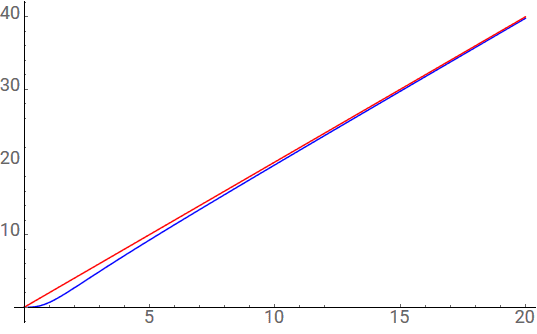
Playing with some numerical simulations, I plotted this in Wolfram Cloud / Mathematica:
##x^3-\frac{x^5}{x^2+2}##
1575855561058.png

I had naively expected it to approach ##x^3−x^3=0##, but that isn't the case. It approaches 2x.
I can now vaguely understand that the two terms need not cancel at infinity, but I'd like to get a better handle on this.

[1] How to break this down intuitively and estimate the qualitative nature of the asymptote "by inspection"?

[2] How can we obtain the asymptote ##2x## theoretically?

[3] Can we find the equation of the asymptote using Mathematica etc?

[Moderator's note: Moved from a technical forum and thus no template.]
 
Last edited by a moderator:
Physics news on Phys.org
##x^3 -\dfrac{x^5}{x^3+2} \sim x^3 -x^{5-3} = x^3 -x^2 \sim x^3## although it looks as if you used another scaling.
 
Sorry, the laTex formula was wrong. I've corrected it. It has ##x^2## in the denominator.
Code:
Plot[{x^3-x^5/(x^2+2),2*x},{x,0,20},ImageSize->600,AxesStyle->20,PlotStyle->{Blue,Red},PlotRange->All]

Corrected the title as well.
 
Then use good old basic fraction algebra! Search a common denominator, expand the first fraction, add them, calculate the new numerator, divide again and see what the leading term is. Where is the problem?
 
Last edited:
Silly me. :oops:
 
##x^3-\frac{x^5}{x^2+2} = \frac{x^3(x^2 + 2) - x^5}{x^2 + 2} = \frac{x^5 + 2x^3 - x^5}{x^2 + 2} = \frac {2x^3}{x^2 + 2}##
If you carry out the polynomial division, you get 2x plus a proper rational expression.

Whenever you have a rational function, as in the third expression above, where the degree of the numerator is one more than the degree of the denominator, there will be a slant asymptote. In this case, the slant asymptote is the line y = 2x, which is what you're seeing in the Wolfram graph.
 
  • Like
Likes   Reactions: Charles Link and SammyS

Similar threads

Replies
3
Views
2K
Replies
21
Views
4K
Replies
5
Views
2K
  • · Replies 10 ·
Replies
10
Views
2K
Replies
1
Views
2K
Replies
4
Views
3K
  • · Replies 3 ·
Replies
3
Views
1K
Replies
2
Views
2K
  • · Replies 1 ·
Replies
1
Views
2K
  • · Replies 3 ·
Replies
3
Views
1K