At what angle do we have to kick a ball up the hill for n-rebounds?

Click For Summary

Homework Help Overview

The discussion revolves around determining the angle at which a ball should be kicked up a hill to achieve a specified number of rebounds. The problem involves concepts from kinematics and projectile motion, particularly in a tilted coordinate system.

Discussion Character

  • Exploratory, Conceptual clarification, Mathematical reasoning, Problem interpretation, Assumption checking

Approaches and Questions Raised

  • Participants explore the relationship between the angle of launch and the number of rebounds, with some attempting to derive equations based on the conditions of motion. Questions arise regarding the assumptions made about the angle of incidence and the nature of the rebounds.

Discussion Status

The discussion is active, with participants providing insights and corrections to each other's reasoning. Some have proposed potential equations for the angle based on their interpretations of the problem, while others have raised questions about the clarity of the problem statement and the assumptions involved.

Contextual Notes

There is ambiguity regarding whether the specified number of rebounds refers to total bounces or bounces to the highest point. Additionally, the role of time and the changing velocities at each bounce are points of contention among participants.

bolzano95
Messages
89
Reaction score
7
Homework Statement
Under what angle do we have to kick a ball up the hill so it comes back after n-rebounds?
Relevant Equations
α=?
I decided to try and find a solution in a green (tilted) coordinate system.
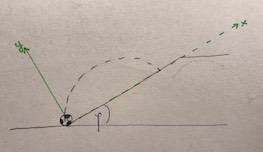
IMG_4407 copy.jpg

I started solving this problem with thinking about 1-rebound:
##⟹y=0, α=\text{angle under which we kick a ball}##;
##y=sin\alpha v_0t-\frac{1}{2}gt^2##; because I'm trying to solve this in a tilted system, I have to switch to ##g \implies a_y= gcos\varphi##. I get
## 0=sin\alpha v_0t-\frac{1}{2}gcos\varphi t^2##
##\frac{1}{2}gcos\varphi t^2=sin\alpha v_0t##
##\frac{1}{2}gcos\varphi t^2=sin\alpha v_0t \implies sin\alpha = \frac{cos\varphi}{2v_0}tg##

Here I got an angle under which I have to kick a ball for 1-rebound.

But which condition (or more of them) will give me an angle for n-rebounds?
I have been banging my head up the wall for the last few hours, even a relaxing break doesn't help anymore.

Thank you for your help.
 
Last edited:
Physics news on Phys.org
Your answer for the 1 rebound case may be "right" (except for a missing factor g at the end), but I don't follow your logic. Anyway, it does not constitute an answer because you have unknowns t and v in there.
Somewhere you should be using the known angle at which the ball must strike the slope, no?
For the n rebound case, consider how the launch angle changes at each bounce.

Edit: I see the missing factor g has been restored.
 
Last edited:
I'm likely mistaken, but couldn't we say that if the ball strikes the hill at normal incidence, by symmetry it will bounce back down the hill in exactly the same manner to the starting point?

So if we want ##k## bounces until it reaches its highest point of contact with the hill, where ##v_{\parallel} = 0##, we can write ##v\cos{\alpha} - gt_{k}\sin{\varphi} = 0##. Since each individual bounce lasts ##t_{b} = \frac{2v\sin{\alpha}}{g\cos{\varphi}}##, ##t_{k}## must be an integer multiple, ##k##, of ##t_{b}##? The resulting system when solved should yield a relation only involving angles (the ##v##'s cancel) and then we can substitute in ##n## instead of the integer multiple placeholder (##n=2k-1##)?
 
Last edited by a moderator:
etotheipi said:
if the ball strikes the hill at normal incidence, by symmetry it will back down the hill in exactly the same manner to the starting point?
Quite so, but you should have given @bolzano95 more time to think of that.

For the n bounce case the question is ambiguous. Is it n bounces in total, in which case the out and back paths could be different, or n to the highest point and n-1 returning?

etotheipi said:
Since each individual bounce lasts ##t_{b} = \frac{2v\sin{\alpha}}{g\cos{\varphi}}##,
Yes, but v and α change at each bounce.
 
  • Like
Likes   Reactions: etotheipi
By the way, this can be thought of as purely a problem in algebraic geometry, avoiding any reference to time.
 
  • Like
Likes   Reactions: etotheipi
I don't believe that the single bounce scenario is viable. The angle of incidence of the ball with the slope is necessarily less that 90° for a parabolic trajectory.

1579387191108.png
 
  • Like
Likes   Reactions: etotheipi
Hang on, I was entirely too hasty (read: sloppy) in my thinking:

1579388668924.png


Clearly it is possible. D'oh!
 
  • Like
Likes   Reactions: etotheipi
gneill said:
Hang on, I was entirely too hasty (read: sloppy) in my thinking:

View attachment 255794

Clearly it is possible. D'oh!

If it makes it any better, I believed you too!
 
  • Like
Likes   Reactions: gneill
I'm on to something!

I forgot there is also an acceleration in x-direction as written above. Here is the complete part:
## 0=v_0cos\alpha -gsinφ t ##
## gsinφt=v_0cos\alpha##
##cos\alpha=\frac{gsinφt}{v_0}##
Now, let's express t from condition y=0 (##t=\frac{2sin\alpha v_0}{gcosφ})## and substitute this expression in ##cos\alpha=\frac{gsinφt}{v_0}##. I get the solution as previously indicated: ##tan\alpha=\frac{1}{2tanφ}##.

This is an angle, under which we have to kick a ball for 1-rebound. OK. Now let's go onto n-rebounds.

The ball bounces 2times and it contacts the floors 3x, 3times and with the floors 5x,... you get the idea. Therefore the bounces k are connected with how many times the ball touches the floor and it is truly the way as etotheipi wrote above: ##k=2n-1##.

Now let's say that an individual bounce lasts ##t_b##. So how are k and the bounces connected? ##k=2n-1##.

When I plug this into ##t=kt_b## I get ##t=\frac{n+1}{2}t_b##.

And the final solution would therefore be ##tan\alpha=\frac{1}{tanφ(n+1)}##.

Thank you @etotheipi for clearing the things for me. As you wrote in your post, I totally forgot about x-direction. And then I was stuck. Even in my dreams I wouldn't come with an idea of ##t=kt_b##. But it makes sense. After this I was also stuck on bounces k and n-s. And of course I'm trying to find a solution for n, not k! I didn't even think about bounces and their contact with the floor. After this the transition to final solution was much easier. So thank you again. It really means a lot to me that I solved this with your help.
 
  • Like
Likes   Reactions: etotheipi
  • #10
bolzano95 said:
And the final solution would therefore be ##tan\alpha=\frac{1}{tanφ(n+1)}##.

That's what I ended up with, though probably best just for completeness to put it in the form ##\alpha = \arctan{\frac{\cot{\varphi}}{(n+1)}}##.

I'd still be interested in trying to work it out geometrically as @haruspex suggested earlier!
 
  • #11
etotheipi said:
That's what I ended up with, though probably best just for completeness to put it in the form ##\alpha = \arctan{\frac{\cot{\varphi}}{(n+1)}}##.

I'd still be interested in trying to work it out geometrically as @haruspex suggested earlier!
We know it describes a parabola. Consider a line at some slope tan(phi) intersecting a parabola y=-ax2 at x=+c and x=-d. Write down expressions for the tangents at the points of intersection and for the slope of the line in terms of a, c, d.
What relationship do you get between the three slopes?

And well done to both of you,
 

Similar threads

Replies
2
Views
2K
  • · Replies 6 ·
Replies
6
Views
3K
Replies
34
Views
3K
Replies
12
Views
1K
  • · Replies 24 ·
Replies
24
Views
2K
Replies
62
Views
7K
Replies
2
Views
2K
  • · Replies 8 ·
Replies
8
Views
2K
  • · Replies 21 ·
Replies
21
Views
2K
  • · Replies 8 ·
Replies
8
Views
2K