Autocorrelation function of a Wiener process and Poisson process

3 replies · 4K views · last reply
JohanL
Messages
154
Reaction score
0

Homework Statement


3. The Attempt at a Solution [/B]
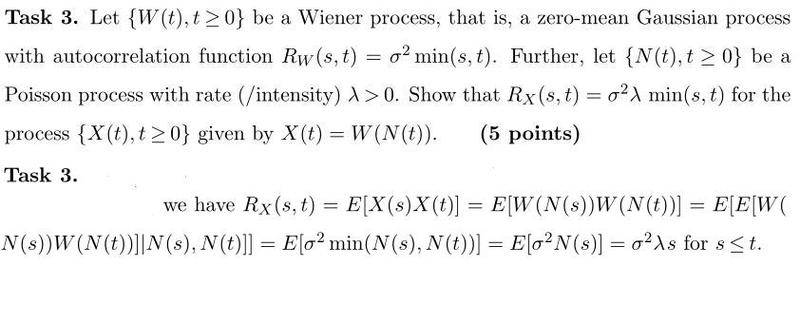
Typed homework problem 'Task 3' stating the Wiener process autocorrelation R_W(s,t) = σ² min(s,t) and a Poisson process with rate λ, asking to show R_X(s,t) = σ²λ min(s,t) for X(t) = W(N(t)), followed by a worked derivation using conditioning on N(s) and N(t).


*****************************************

Can anyone possibly explain step 3 and 4 in this solution?
 
Step 3 looks like an application of the Tower Law or 'Law of Total Expectation' (see link). It's a very useful law and well worth spending the time to familiarise yourself with it!
The fourth step is just an application of the given autocorrelation function to the expression inside the outer expectation.
 
  • Like
Likes   Reactions: JohanL
JohanL said:

Homework Statement


3. The Attempt at a Solution [/B]

Typeset math task: Task 3 defines a Wiener process W(t) with autocorrelation sigma^2 min(s,t) and a Poisson process N(t) with rate lambda, asks to show R_X(s,t) = sigma^2 lambda min(s,t) for X(t) = W(N(t)), and gives a partial derivation via conditional expectation.


*****************************************

Can anyone possibly explain step 3 and 4 in this solution?

Sometimes (at least when one is starting out) it is better to be less abstract and more explicit. So, let's be explicit.

Assume ##s < t##, so ##N(t) \geq N(s)## (because of the possible arrivals between ##s## and ##t##). Thus
[tex]\begin{array}{rcl}R_X(s,t) &= & \sum_{j=0}^{\infty} \sum_{k=0}^{\infty} P(N(s)=j, N(t) = j+k) E[W(j) W(j+k)] \\<br /> &= &\sigma^2 \sum_j \sum_k P(N(s)=j) P(N(t) = j+k|N(s)=j) \min(j,j+k)<br /> \end{array}[/tex]
Of course, ##\min(j,j+k) = j## and we also have ##P(N(t) = j+k | N(s) = j) = P(N(t-s) = k)##, by stationarity and independent increments of the Poisson process. Now the rest is easy.

Of course, if ##t < s## we can just interchange the roles of ##s## and ##t## in the argument.
 
  • Like
Likes   Reactions: JohanL
Ray Vickson said:
Sometimes (at least when one is starting out) it is better to be less abstract and more explicit. So, let's be explicit.

Assume ##s < t##, so ##N(t) \geq N(s)## (because of the possible arrivals between ##s## and ##t##). Thus
[tex]\begin{array}{rcl}R_X(s,t) &= & \sum_{j=0}^{\infty} \sum_{k=0}^{\infty} P(N(s)=j, N(t) = j+k) E[W(j) W(j+k)] \\<br /> &= &\sigma^2 \sum_j \sum_k P(N(s)=j) P(N(t) = j+k|N(s)=j) \min(j,j+k)<br /> \end{array}[/tex]
Of course, ##\min(j,j+k) = j## and we also have ##P(N(t) = j+k | N(s) = j) = P(N(t-s) = k)##, by stationarity and independent increments of the Poisson process. Now the rest is easy.

Of course, if ##t < s## we can just interchange the roles of ##s## and ##t## in the argument.

andrewkirk said:
Step 3 looks like an application of the Tower Law or 'Law of Total Expectation' (see link). It's a very useful law and well worth spending the time to familiarise yourself with it!
The fourth step is just an application of the given autocorrelation function to the expression inside the outer expectation.

I had only seen the tower law used in connection with martingales, and defined in connection with martingales, and the law of total expectation have i ofc used but only in what they call the special case on the wiki-page. Did not know it was a more general case. Ty!