B-field for a half-infinitely long wire

  • Thread starter member 731016
  • Start date
  • Tags Tags
    B-field Wire
9 replies · 3K views · last reply
member 731016
Homework Statement
Please see below
Relevant Equations
Please see below
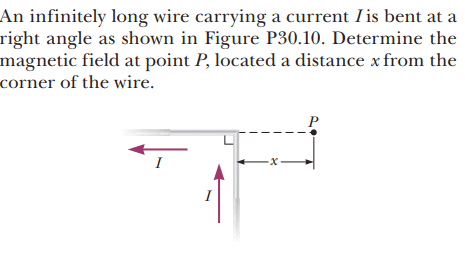
For this problem,
Diagram of a long wire bent at a right angle, with current I flowing left along the horizontal segment and up along the vertical segment; point P lies a distance x to the right of the vertical wire, at the height of the horizontal segment.

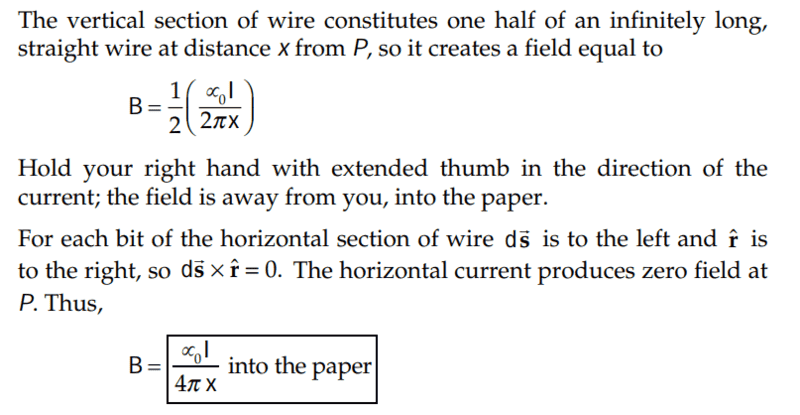
The solution is
Printed worked solution showing the magnetic field from half of an infinite straight wire, B = mu0 I / (4 pi x), directed into the paper, with the horizontal wire section contributing zero field.


However, I would like to understand how to solve this using Biot–Savart Law.

So far my working is:

## \vec {dB} = \frac {\mu_0Ids\sin\theta} {4\pi r^2}##

However, I'm not sure what to do about the ## r^2 ## since the wire is infinitely long. I am thinking about having the limits of integration to be ## \theta_1 = 0 ## and ## \theta_2 = \frac {\pi} {2} ##

Many thanks!
 
Callumnc1 said:
.So far my working is:

## \vec {dB} = \frac {\mu_0Ids\sin\theta} {4\pi r^2}##
Knowing a formula is of no value unless you know what all the variables mean and in what context the formula applies.
Please state what those variables mean here. From that you should be able to answer your question.
 
  • Like
Likes   Reactions: anuttarasammyak, member 731016 and PeroK
haruspex said:
Knowing a formula is of no value unless you know what all the variables mean and in what context the formula applies.
Please state what those variables mean here. From that you should be able to answer your question.
Thank you for your reply @haruspex!

##\mu_0## is the magnetic permeability of free space
##I## is the current in the vertical wire
## ds ## is the length element of the wire
## r^2 ## is the distance from each ##ds## to point ##P##

I think the thing that was tripping me up was that I thinking that we could call the infinite length to be ##a## which would mean that ##\tan\theta = \frac {x} {a} ## however this would be zero since ## a \rightarrow \infty ## then ##\tan \theta \rightarrow 0 ##. I was then going to solve for ##\theta## and have limits of integration to be angles ## \theta_1 = 0 ## and ## \theta_2 = \frac {\pi} {2} ##. However now I think I should get ## r ## in terms of ## \sin\theta ##. I will try to solve that now. Is my reasoning correct so far?
 
Last edited by a moderator: