Math Amateur
Gold Member
MHB
- 3,920
- 48
- TL;DR
- The post concerns an aspect of Stromberg's proof of the Baire Category Theorem ... ...
I am reading Karl R. Stromberg's book: "An Introduction to Classical Real Analysis". ... ...
I am focused on Chapter 3: Limits and Continuity ... ...
I need help in order to fully understand the proof of Theorem 3.55 on page 110 ... ...Theorem 3.55 and its proof read as follows:
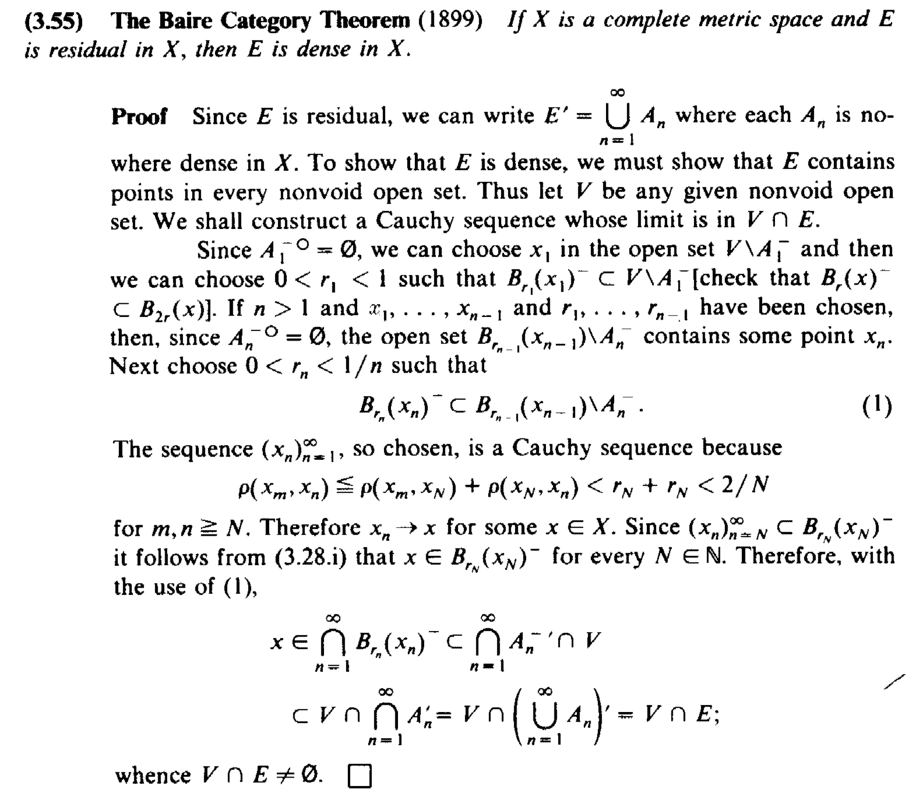 At the start of the second paragraph of the above proof by Stromberg we read the following:
" ... ...Since ##A_1^{ - \ \circ } = \emptyset##, we can choose ##x_1## in the open set ##V## \ ##A_1^{ - }## and then we can choose ##0 \lt r_1 \lt 1## such that ##B_{ r_1 } ( x_1 )^{ - } \subset V## \ ##A_1^{ - }## [ check that ##B_r (x)^{ - } \subset B_{ 2r } (x) ## ] ... ...My questions are as follows:Question 1
Can someone explain and demonstrate exactly/rigorously why/how it is that ##A_1^{ - \ \circ } = \emptyset## means that we can choose ##x_1## in the open set ##V## \ ##A_1^{ - }## ... it seems very plausibly the case ... but ... how are we (rigorously) sure this is true ... ?
Question 2
How/why can we choose ##0 \lt r_1 \lt 1## such that ##B_{ r_1 } ( x_1 )^{ - } \subset V## \ ##A_1^{ - }## ... ?
... and why are we checking that ##B_r (x)^{ - } \subset B_{ 2r } (x)## ... ... ?
*** EDIT ***
My thoughts on Question 2 ...
Since ##V## \ ##A_1^{ - }## is open ... ##\exists \ r_1## such that ##B_{ r_1 } ( x_1 ) \subset V## \ ##A_1^{ - }## ...
... BUT ... how do we formally and rigorously show that ...
... we can choose an ##r_1## such that the closure of ##B_{ r_1 } ( x_1 )## is a subset of ##V## \ ##A_1^{ - }## ... ( ... intuitively we just choose ##r_1## somewhat smaller yet ... )
... and further why is Stromberg talking about ##r_1## between ##0## and ##1## ...?
Help will be much appreciated ...
Peter
==========================================================================================================================
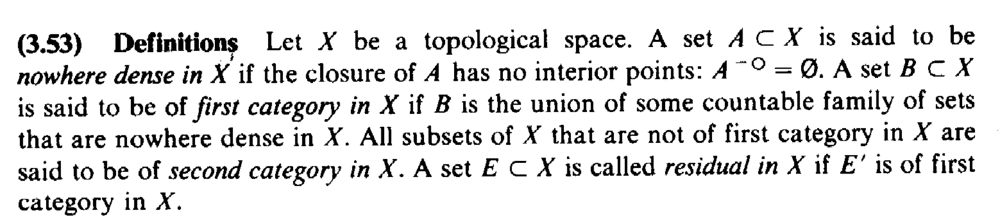
The definitions of nowhere dense, first and second category and residual are relevant ... so I am providing Stromberg's definitions ... as follows:
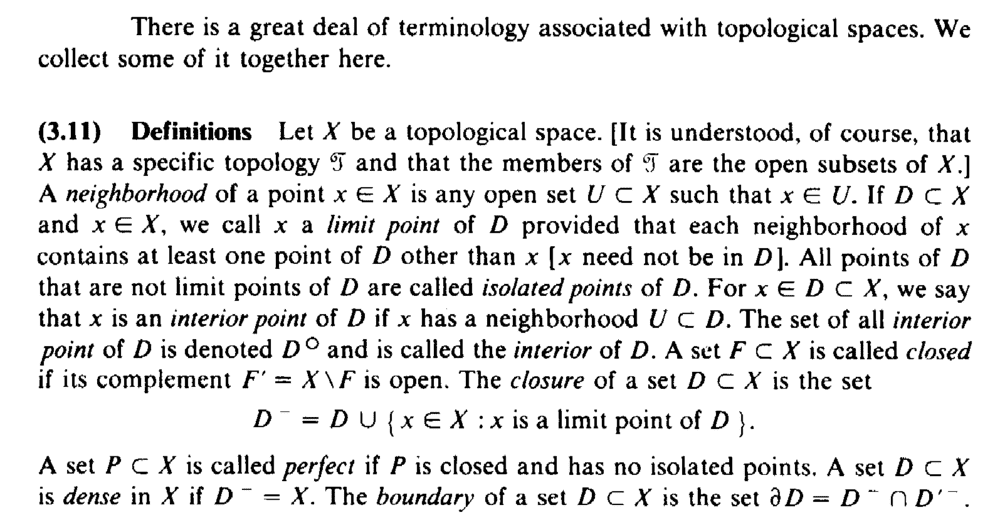
Stromberg's terminology and notation associated with the basic notions of topological spaces are relevant to the above post ... so I am providing the text of the same ... as follows:
Hope that helps ...
Peter
I am focused on Chapter 3: Limits and Continuity ... ...
I need help in order to fully understand the proof of Theorem 3.55 on page 110 ... ...Theorem 3.55 and its proof read as follows:
" ... ...Since ##A_1^{ - \ \circ } = \emptyset##, we can choose ##x_1## in the open set ##V## \ ##A_1^{ - }## and then we can choose ##0 \lt r_1 \lt 1## such that ##B_{ r_1 } ( x_1 )^{ - } \subset V## \ ##A_1^{ - }## [ check that ##B_r (x)^{ - } \subset B_{ 2r } (x) ## ] ... ...My questions are as follows:Question 1
Can someone explain and demonstrate exactly/rigorously why/how it is that ##A_1^{ - \ \circ } = \emptyset## means that we can choose ##x_1## in the open set ##V## \ ##A_1^{ - }## ... it seems very plausibly the case ... but ... how are we (rigorously) sure this is true ... ?
Question 2
How/why can we choose ##0 \lt r_1 \lt 1## such that ##B_{ r_1 } ( x_1 )^{ - } \subset V## \ ##A_1^{ - }## ... ?
... and why are we checking that ##B_r (x)^{ - } \subset B_{ 2r } (x)## ... ... ?
*** EDIT ***
My thoughts on Question 2 ...
Since ##V## \ ##A_1^{ - }## is open ... ##\exists \ r_1## such that ##B_{ r_1 } ( x_1 ) \subset V## \ ##A_1^{ - }## ...
... BUT ... how do we formally and rigorously show that ...
... we can choose an ##r_1## such that the closure of ##B_{ r_1 } ( x_1 )## is a subset of ##V## \ ##A_1^{ - }## ... ( ... intuitively we just choose ##r_1## somewhat smaller yet ... )
... and further why is Stromberg talking about ##r_1## between ##0## and ##1## ...?
Help will be much appreciated ...
Peter
==========================================================================================================================
The definitions of nowhere dense, first and second category and residual are relevant ... so I am providing Stromberg's definitions ... as follows:
Stromberg's terminology and notation associated with the basic notions of topological spaces are relevant to the above post ... so I am providing the text of the same ... as follows:
Hope that helps ...
Peter
Last edited: