Basic Math - Learn the Basics of Mathematics

Join the discussion
Ask a follow-up here, or get your own question answered by working scientists, mathematicians and engineers — people, not an autocomplete.
Real named experts · corrections over time · the nuance an AI answer skips
1 replies · 2K views
Ande Yashwanth
Messages
2
Reaction score
0

Attachments

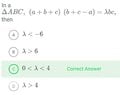
  • Screenshot_20170509-154200-1.jpg
    Screenshot_20170509-154200-1.jpg
    20.1 KB · Views: 129
Mathematics news on Phys.org
Hi Ande Yashwanth! Welcome to MHB! (Smile)

First step would be to multiply out the left hand side.
Did you already do that?
Anyway, being smart about it, we can write the left hand side as:
$$(a+b+c)(b+c-a)=((b+c)+a)((b+c)-a)=(b+c)^2-a^2$$
So we get:
$$(b+c)^2-a^2=\lambda bc$$

Now we want to get rid of the $a^2$.
We can do so by applying the law of cosines:
$$a^2=b^2+c^2 - 2bc\cos\alpha$$
What would we get if we fill that in and simplify further? (Wondering)