Battery vs Hydrogen Power: Volkswagen's Efficiency Comparison

  • Thread starter Thread starter BWV
  • Start date Start date
  • Tags Tags
    Batteries
Click For Summary

Discussion Overview

The discussion centers on the efficiency comparison between battery-powered electric vehicles (EVs) and hydrogen fuel cell vehicles, particularly in light of Volkswagen's recent graphic supporting their shift towards battery technology. Participants explore various aspects including manufacturing processes, life cycle analysis, refueling times, and the overall practicality of hydrogen as a fuel source.

Discussion Character

  • Debate/contested
  • Technical explanation
  • Exploratory

Main Points Raised

  • Some participants question the omission of energy and material costs in the comparison of battery and hydrogen fuel cell manufacturing.
  • Others argue that the life cycle costs and maintenance of both technologies are not fully considered, highlighting hidden costs associated with energy production and waste management.
  • A participant expresses skepticism about the graphic's presentation, suggesting it may be misleading and indicative of marketing tactics.
  • One contributor shares personal experience with plug-in hybrid electric vehicles (PHEVs), noting that while EVs may excel in most areas, hydrogen vehicles could be advantageous for long-distance travel due to faster refueling times.
  • Another participant references historical critiques of hydrogen fuel cells, suggesting they may not be competitive with hybrid vehicles like the Toyota Prius in terms of cost and emissions until significant technological advancements occur.
  • Some participants discuss the efficiency of hydrogen combustion versus electric drivetrains, raising questions about the overall energy efficiency of hydrogen fuel cells compared to batteries.

Areas of Agreement / Disagreement

Participants express a range of views, with no clear consensus on the superiority of either technology. While some acknowledge the potential benefits of hydrogen, others highlight significant drawbacks and uncertainties regarding its practicality and efficiency.

Contextual Notes

Participants note limitations in the analysis presented by Volkswagen, including the lack of comprehensive life cycle assessments and the complexities of energy production methods. There is also discussion about the efficiency of different energy storage and conversion methods, which remains unresolved.

BWV
Messages
1,667
Reaction score
2,012
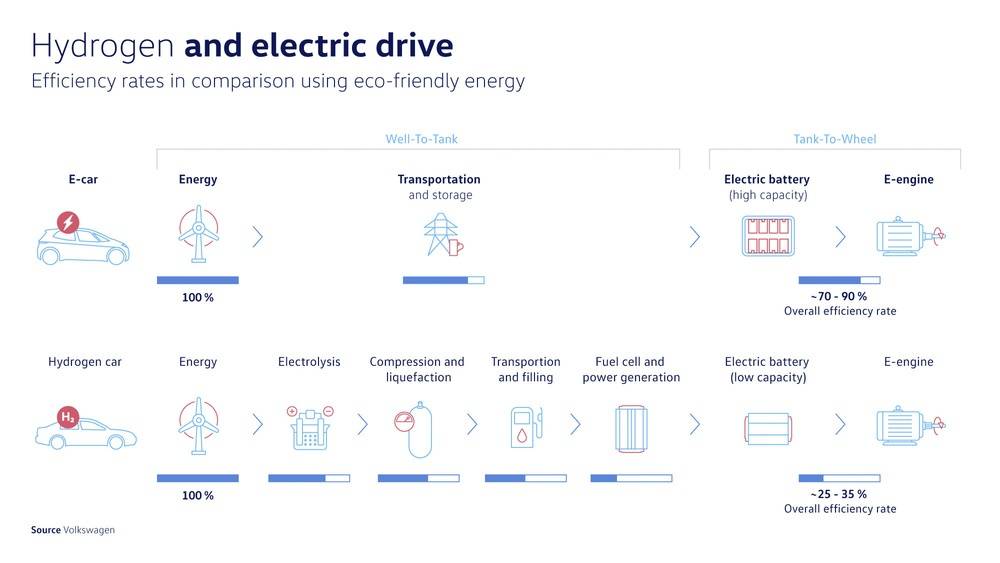
Volkswagen recently published this graphic supporting their decision to focus on battery-powered EVs and abandon hydrogen fuel cells
https://insideevs.com/news/406676/battery-electric-hydrogen-fuel-cell-efficiency-comparison/
ic-bev-or-hydrogen-fuel-cell-fcv-source-volkswagen.jpg

however it does not include the energy and materials required to manufacture batteries vs fuel cells. Any reason to believe that would make a difference, or is hydrogen as worthless for transportation as this implies? Note this is for green hydrogen, the electrolysis step for brown would be more efficient
 
  • Like
Likes   Reactions: mcastillo356
Computer science news on Phys.org
It looks like it doesn't consider the complete life cycles of batteries and fuel cells either, or maintenance, or availability, or risk of failure, or waste management. The problem with such studies is almost always, that they concentrate on costs and efficiency of their segment of the process. There are a lot of hidden costs, too, e.g. how green energy is produced, or how replacements are realized. It would be interesting to know the cost objects involved in the entire process. I assume that their general conclusion is correct - more or less - but what makes fuel cells attractive, is the refilling process, i.e. the time needed to do so.
 
  • Informative
Likes   Reactions: mcastillo356
Looks like PR to me. Note how the upper image contains just one convenient step "transportation and storage" while the lower has it split into many separate steps to make it look complicated. That's Marketing Snake Oil 101.

No idea what their analysis is worth, could be they are right, but the way they present it raises several warning flags for me.
 
  • Informative
Likes   Reactions: mcastillo356
fresh_42 said:
It looks like it doesn't consider the complete life cycles of batteries and fuel cells either

Very little does. Including gasoline.

Borek said:
Looks like PR to me.

But it's from VW! They would never lie!

In the interest of full disclosure, I have a PHEV. PR or not, I think the case can be made that EVs are as good or better than hydrogen in all but one area: long-distance driving. EV charges at about 15 miles per minute, Hydrogen around 30, and gasoline around 350 or 400. Gasoline is easy to find, EV somewhat less so, and hydrogen is availabnle only in California and one station in Connecticut.

Most trips are short, and charging at home at ~12 miles/hour is not difficult, although it can be for renters.

My experience - ignoring cross-country trips, I spend between 80-90% of my time on electricity. My all-electric range is 30 miles, and if it were 50 it would be 90-95% electricity. Most of my gas use is in winter.
 
Last edited:
Not surprising to me. People have been pointing out these flaws with hydrogen fuel cells vehicles for decades. For example, see this article from 2004 (plus the book of the same name by the author):

Yet for all this hype, hydrogen cars are likely to remain inferior to the best gasoline-electric hybrid vehicles such as the Toyota Prius in virtually every respect-cost, range, annual fueling bill, convenience, safety-through at least 2030. The Prius will even have lower overall emissions of many pollutants than cars running on the hydrogen that is likely to be available at fueling stations for the foreseeable future. And a premature push toward hydrogen cars would undermine efforts to reduce the heat-trapping carbon dioxide emissions that cause global climate change.

For hydrogen cars to become both practical from a consumer’s perspective and desirable from an environmental perspective will require at least three major technology breakthroughs. In addition, the nation will have to shift its energy policy dramatically toward renewable energy sources such as wind and solar.
https://www.technologyreview.com/2004/03/17/233141/hype-about-hydrogen/

There may be uses for hydrogen fuel cells in the long term, but in the short term, I don't see fuel cell vehicles having much of an impact.
 
Why does the hydrogen car diagram need a fuel pump and a fuel cell conversion to electricity?

Their diagram could have eliminated the fuel pump, with the station fuel cell producing electricity for the e-car, which would then have the similar high capacity battery. Overall efficiency would be nearer 50%.

Or, the car fills up with hydrogen, eliminate the fuel cell in the car, and use an internal combustion engine.
Overall efficiency < 50 %.
 
256bits said:
Why does the hydrogen car diagram need a fuel pump and a fuel cell conversion to electricity?

Their diagram could have eliminated the fuel pump, with the station fuel cell producing electricity for the e-car, which would then have the similar high capacity battery. Overall efficiency would be nearer 50%.

Or, the car fills up with hydrogen, eliminate the fuel cell in the car, and use an internal combustion engine.
Overall efficiency < 50 %.

Is combusting H2 more efficient given most of the energy in an IC engine is lost to heat, electric drivetrains are far more efficient, which is the primary reason batteries have any chance of that working as well as gasoline, given that a gallon of gas stores far more energy than a battery of similar mass
 
  • Like
Likes   Reactions: 256bits
BWV said:
Is combusting H2 more efficient given most of the energy in an IC engine is lost to heat, electric drivetrains are far more efficient, which is the primary reason batteries have any chance of that working as well as gasoline, given that a gallon of gas stores far more energy than a battery of similar mass
thanks - I think I get it now.
 

Similar threads

  • · Replies 1 ·
Replies
1
Views
1K
  • · Replies 96 ·
4
Replies
96
Views
14K
  • · Replies 17 ·
Replies
17
Views
3K
  • · Replies 6 ·
Replies
6
Views
6K
Replies
10
Views
13K
Replies
13
Views
3K
Replies
1
Views
3K
Replies
4
Views
10K
  • · Replies 3 ·
Replies
3
Views
9K
  • · Replies 0 ·
Replies
0
Views
3K