How does the thickness of a beam splitter affect the phase shift produced?

Click For Summary
SUMMARY

The discussion centers on the phase shift produced by a 50/50 beam splitter with a dielectric mirror. It is established that the thickness of the beam splitter does not introduce an additional phase shift that affects the operation of the beam splitter as a Hadamard gate in quantum information. The phase shift due to reflection is compensated by a phase-shifter in the transmitted beam, ensuring that the output maintains the necessary phase relationships. The consensus is that the finite width of the beam splitter is often ignored in theoretical discussions because it does not significantly impact the overall phase difference at the output ports.

PREREQUISITES
  • Understanding of beam splitter operation and phase shifts
  • Familiarity with quantum gates, specifically the Hadamard gate
  • Knowledge of dielectric materials and their refractive indices
  • Basic principles of quantum optics and interference
NEXT STEPS
  • Research the mathematical derivation of phase shifts in beam splitters
  • Explore the implementation of Hadamard gates using optical components
  • Study the effects of dielectric materials on light propagation
  • Investigate recent advancements in quantum optics and beam splitter technology
USEFUL FOR

Quantum physicists, optical engineers, and anyone involved in quantum computing or optical system design will benefit from this discussion.

confused_man
Messages
15
Reaction score
1
I'm having trouble understanding the phase shift produced by a beam splitter. I seem to be finding conflicting information.

I'm specifically looking to understand a 50/50 beam splitter where one side has a dielectric mirror, as shown in this figure from wikipedia:
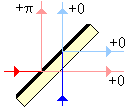
Wavesplitter1.gif


I understand the pi phase shift (due to air/dielectric reflection, where n_air < n_dielectric). Why doesn't the thickness of the beam splitter have any effect? Shouldn't there be an additional phase?

On a related note, I'm trying to see how such a beam splitter would be able to act like a Hadamard gate in quantum information, if the additional phase shift due to the thickness of the plate is included. I've seen many articles/documents say that a beam splitter can implement a Hadamard gate, but this only seems to work if the thickness of the splitter is ignored. What am I missing?

Thank you for any insight.
 

Attachments

  • Wavesplitter1.gif
    Wavesplitter1.gif
    924 bytes · Views: 1,829
Physics news on Phys.org
confused_man said:
I'm having trouble understanding the phase shift produced by a beam splitter. I seem to be finding conflicting information.

I'm specifically looking to understand a 50/50 beam splitter where one side has a dielectric mirror, as shown in this figure from wikipedia:
View attachment 223275

I understand the pi phase shift (due to air/dielectric reflection, where n_air < n_dielectric). Why doesn't the thickness of the beam splitter have any effect? Shouldn't there be an additional phase?

On a related note, I'm trying to see how such a beam splitter would be able to act like a Hadamard gate in quantum information, if the additional phase shift due to the thickness of the plate is included. I've seen many articles/documents say that a beam splitter can implement a Hadamard gate, but this only seems to work if the thickness of the splitter is ignored. What am I missing?

Thank you for any insight.

The phase shift of the reflected beam can be compensated by putting a phase-shifter in the transmtted beam.

To make a Hadamard gate the outputs from the input state |0>|1> must be recombined in a second BS to give (|0>|1>+i|1>|0>)√2
 
Last edited:
Thank you for the reply. What about the phase shift due in the transmitted beam due to the plate thickness? This is the one that I am confused about, as it seems that many sources just ignore the fact that the beam splitter has some finite width, which would introduce some additional phase shift in the transmitted and reflected blue beams. I don't see how you could compensate for this.
 
confused_man said:
Thank you for the reply. What about the phase shift due in the transmitted beam due to the plate thickness? This is the one that I am confused about, as it seems that many sources just ignore the fact that the beam splitter has some finite width, which would introduce some additional phase shift in the transmitted and reflected blue beams. I don't see how you could compensate for this.
There is another recent post dealing with this but I cannot find it. Try searching posts in the last 3 months.
 
Most texts do not discuss the phase shift introduced by the dimensions of the crystal because it does not matter. Let us consider all possible phase deviations. Let \phi_0 be th einitial phase difference between the red and the blue beam, \phi the phase shift introduced by the beam splitter width from the reflecting surface to the right and \phi&#039; the phase shift due to light going from the lower surface to the reflecting surface.
For the for beams you will find the following phases:
red one from the left to the top: \phi_0+\pi
blue one from bottom to top: \phi&#039;
red one from the left to the right: \phi_0+\phi
blue one from the bottom to the right: \phi+\phi&#039;

Now the first thing that matters is the phase difference at the output ports:
top: \phi_0+\pi-\phi&#039;
right:\phi_0+\phi-\phi-\phi&#039;=\phi_0-\phi&#039;

Now the final quantity of interest is the phase difference of these differences and as you can see, this will always be \pi regardless of how the other parameters are chosen.
 
  • Like
Likes   Reactions: Derek P, DrChinese and Mentz114

Similar threads

  • · Replies 4 ·
Replies
4
Views
5K
  • · Replies 7 ·
Replies
7
Views
4K
Replies
8
Views
2K
  • · Replies 1 ·
Replies
1
Views
3K
  • · Replies 2 ·
Replies
2
Views
3K
  • · Replies 2 ·
Replies
2
Views
2K
  • · Replies 1 ·
Replies
1
Views
7K
  • · Replies 2 ·
Replies
2
Views
3K
  • · Replies 2 ·
Replies
2
Views
2K
  • · Replies 12 ·
Replies
12
Views
11K