Bending moment on multi beam sign post

Click For Summary

Discussion Overview

The discussion revolves around determining the bending moments on a multi-beam sign post subjected to wind loading, specifically focusing on the moments about the x and z planes. Participants explore the implications of having two beams supporting the sign instead of one, addressing concepts such as equilibrium, normal and shear forces, and the distribution of moments.

Discussion Character

  • Technical explanation
  • Conceptual clarification
  • Debate/contested
  • Mathematical reasoning

Main Points Raised

  • One participant questions whether the moment about the z-axis (Mz) becomes negligible or if it is halved and distributed across the two beams.
  • Another participant suggests creating a free-body diagram to analyze the reactions at the supports, similar to the approach taken with a single support.
  • A participant notes that the moment about z was previously calculated as the weight of the sign multiplied by the moment arm and wonders if this still applies with two beams.
  • There is a discussion about the need for reaction forces and moments at the supports to maintain static equilibrium, with specific reactions identified (Ry1, Ry2, Rz1, Rz2).
  • Participants express that Mz1 and Mz2 should act equally and oppositely to maintain equilibrium, suggesting a formula for Mzi based on the weight of the sign and distances to centroids.
  • One participant expresses uncertainty about the magnitudes of Mz1 and Mz2, suggesting they may be small unless the sign is particularly heavy.

Areas of Agreement / Disagreement

Participants generally agree on the need for equilibrium in the system and the roles of various forces and moments. However, there is no consensus on the exact treatment of the moment about the z-axis, with differing views on its significance and calculation.

Contextual Notes

Some assumptions regarding the distribution of forces and moments may depend on the specific configuration of the sign and beams, which is not fully detailed in the discussion.

Who May Find This Useful

Readers interested in structural engineering, mechanics of materials, or those working on similar problems involving load distribution on multi-beam systems may find this discussion relevant.

CompactDisc
Messages
4
Reaction score
0
Hey guys,

So just completed a question on a sign post subject to wind loading of 2 kPa where you had to determine bending moments across x and z planes (picture below), to determine normal, shear, max stresses and then determine the factor of safety depending on the beam type you chose. That's all good.

The next question is to do with the same problem but now rather than a single beam holding the sign up, there is a beam either side! Moment about x was relatively similar, just slightly larger area and displaced across the two beams but I am stumped with the moment about z. The weight of the sign is now in equilibrium and in the previous problem Mz = weight of the sign * moment arm.

Is Mz now just negligible (equal to 0), or does Mz halve and get spread across the two beams? Any help would be fantastic! And was also unsure where to post this.
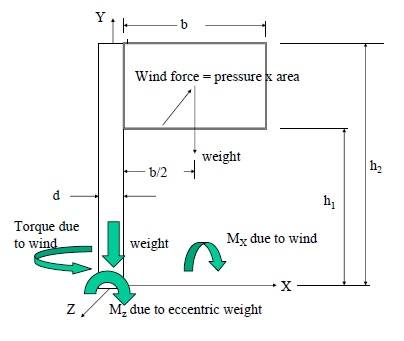
nuvsw.jpg
 
Engineering news on Phys.org
CompactDisc said:
Hey guys,

So just completed a question on a sign post subject to wind loading of 2 kPa where you had to determine bending moments across x and z planes (picture below), to determine normal, shear, max stresses and then determine the factor of safety depending on the beam type you chose. That's all good.

The next question is to do with the same problem but now rather than a single beam holding the sign up, there is a beam either side! Moment about x was relatively similar, just slightly larger area and displaced across the two beams but I am stumped with the moment about z. The weight of the sign is now in equilibrium and in the previous problem Mz = weight of the sign * moment arm.

Is Mz now just negligible (equal to 0), or does Mz halve and get spread across the two beams? Any help would be fantastic! And was also unsure where to post this.

nuvsw.jpg

Why don't you make a free-body diagram of the sign with two supports? You know, figure out the reactions in the two supports, like what was done with a single support.
 
SteamKing said:
Why don't you make a free-body diagram of the sign with two supports? You know, figure out the reactions in the two supports, like what was done with a single support.

156bhps.jpg


Okay, did the free body diagram for the system (I believe that's right?). In the previous diagram, moment about Z was the weight of the sign multiplied by the length of the centroid of the sign to the centroid of the cross section of the pole.

I'm assuming this still applies but pole 2 is equal and opposite to pole 1 (which would mean Mz2 is reversed?)?
 
CompactDisc said:
156bhps.jpg


Okay, did the free body diagram for the system (I believe that's right?). In the previous diagram, moment about Z was the weight of the sign multiplied by the length of the centroid of the sign to the centroid of the cross section of the pole.

I'm assuming this still applies but pole 2 is equal and opposite to pole 1 (which would mean Mz2 is reversed?)?
Why do you think there would be a moment about the z-axis?

In any event, for the sign to remain in equilibrium, the forces and moments shown at the footings of the support beams should be the reactions which keep the sign in static equilibrium.

You should have reactions Ry1 and Ry2 at the footings pointing up.
You should have reactions Rz1 and Rz2 at the footings pointing in the positive z-direction.

The reaction torques Mx1 and Mx2 should be acting in the opposite sense, to keep the sign upright against the wind loading.

Ditto the two "torques", or My1 and My2. These should be shown acting in the opposite sense, to oppose the wind loading.

Mz1 should act in the opposite direction from what is shown.
 
SteamKing said:
Why do you think there would be a moment about the z-axis?

In any event, for the sign to remain in equilibrium, the forces and moments shown at the footings of the support beams should be the reactions which keep the sign in static equilibrium.

You should have reactions Ry1 and Ry2 at the footings pointing up.
You should have reactions Rz1 and Rz2 at the footings pointing in the positive z-direction.

The reaction torques Mx1 and Mx2 should be acting in the opposite sense, to keep the sign upright against the wind loading.

Ditto the two "torques", or My1 and My2. These should be shown acting in the opposite sense, to oppose the wind loading.

Mz1 should act in the opposite direction from what is shown.

Yeah all of that definitely makes sense, seeing as sum of forces should equal zero and sum of moments should equal zero.

So Ry1 and Ry2 will be the normal forces opposing the dead load of the system.
Rz1 and Rz2 oppose the 2kPa force of the wind trying to push the sign.

There is a moment about Z because the weight of the sign is exerting a force (its weight), onto the beam from a radius (moment arm). Mz1 and Mz2 act equally and oppositely to maintain static equilibrium and therefore should be bearing half of the force each.

So it would still be Mzi = (Weight of sign * Distance to centroid + distance to centroid of post)/2
 
CompactDisc said:
Yeah all of that definitely makes sense, seeing as sum of forces should equal zero and sum of moments should equal zero.

So Ry1 and Ry2 will be the normal forces opposing the dead load of the system.
Rz1 and Rz2 oppose the 2kPa force of the wind trying to push the sign.

There is a moment about Z because the weight of the sign is exerting a force (its weight), onto the beam from a radius (moment arm). Mz1 and Mz2 act equally and oppositely to maintain static equilibrium and therefore should be bearing half of the force each.

So it would still be Mzi = (Weight of sign * Distance to centroid + distance to centroid of post)/2
Unless this is a rather heavy sign, I would expect the magnitudes of Mz1 and Mz2 to be very small.
 
SteamKing said:
Unless this is a rather heavy sign, I would expect the magnitudes of Mz1 and Mz2 to be very small.

Yeah the initial question states 1kN so not too heavy at all! Thank you very much for the help
 

Similar threads

Replies
4
Views
3K
Replies
5
Views
3K
  • · Replies 7 ·
Replies
7
Views
3K
Replies
3
Views
4K
  • · Replies 11 ·
Replies
11
Views
3K
  • · Replies 2 ·
Replies
2
Views
4K
Replies
2
Views
7K
  • · Replies 2 ·
Replies
2
Views
3K
  • · Replies 3 ·
Replies
3
Views
3K
  • · Replies 8 ·
Replies
8
Views
4K