Bending of a telescopic crane boom

  • Thread starter Thread starter FEAnalyst
  • Start date Start date
  • Tags Tags
    Bending Crane
Click For Summary
SUMMARY

The analysis of a telescopic crane boom involves treating it as two cantilever beams connected at the point of cross-section change. The first beam, from point C to B, requires calculating vertical and angular deflections at point B, which serve as boundary conditions for the second beam, from B to A. Stress calculations are based on the bending moment at specific points and the section properties, with a notable step change in stress at point B. The presence of concentrated loads and the effects of sliding surfaces must also be considered in the analysis.

PREREQUISITES
  • Understanding of beam theory and deflection analysis
  • Familiarity with bending moment diagrams
  • Knowledge of stress calculations in structural engineering
  • Experience with cantilever beam analysis techniques
NEXT STEPS
  • Research the derivation of deflection formulas for beams with sudden changes in cross-section
  • Study the principles of moment distribution in cantilever beams
  • Learn about the effects of concentrated loads on beam stress and deflection
  • Explore analytical methods for analyzing simply-supported beams with overhangs
USEFUL FOR

Structural engineers, mechanical engineers, and anyone involved in the design and analysis of crane systems and telescopic structures.

FEAnalyst
Messages
348
Reaction score
149
TL;DR
How to analyze the telescopic boom of a workshop crane in terms of bending?
Hi,

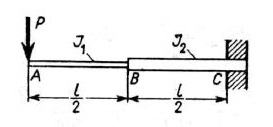
how can one analyze the telescopic boom of a workshop crane in terms of bending ? Of course the worst case is when the boom is fully extended. Should we treat it as a beam with sudden change of cross-section (or otherwise - with sudden change of flexural stiffness) ? I know that there are different formulas for the deflection of such beam. Where can I find them (or how can I derive them) ? What about the stresses (are they calculated differently too) ?
belka.JPG


Thanks in advance for your help
 
  • Like
Likes   Reactions: Nina1
Engineering news on Phys.org
Analyze it as two cantilever beams connected at the point where they change dimensions (##l/2##). The first beam, from C to B, has a moment curve from which you calculate vertical deflection and angular deflection at Point B. The second beam, from B to A, has those vertical and angular deflections as its boundary conditions at Point B.

Another way to look at it is the deflection, both vertical and angular, of beam B - A is added to the deflection of beam C - B.

Stress is calculated from the bending moment at a point and the section properties at that point. The plot of stress vs location will have a step change at point B.
 
  • Like
Likes   Reactions: FEAnalyst and Lnewqban
Thanks for reply. Actually, I forgot to add that the image attached to my post is an example of a beam with sudden change of cross-section. In my case the beam will look differently. It represents a crane boom so it will be more like a simply-supported beam with overhang:
854F2223-9CA8-47ED-AA72-EAA170B9D5B0.jpeg

The right support is where hydraulic actuator connects with the boom.

Is it even possible to analyze such beam analytically ?
 
  • Like
Likes   Reactions: Nina1
It may also be important to consider the concentrated loads on the area of overlap of both sections.
In many cases the sliding is facilitated by rollers or sliding pads.
If sliding without those, the top and bottom overlapping surfaces still do not have a uniformly distribuited load or contact, due to normal clearance between both cross sections.
 
The two beams in the telescoping boom are analyzed separately.

Generally, the small telescoping beam is supported at two points, and loaded at one point. The forces at those two support points are calculated using sum of moments for the first support point, and either sum of moments or sum of forces for the second support point.

The the larger beam is loaded at two points with known forces (from above), and supported at two points. The forces at those two support points are calculated using sum of moments as above.

Now you know all forces, so you can construct moment diagrams for each of the two beams. The stresses are calculated from the moment diagrams and section properties.
 
  • Like
Likes   Reactions: FEAnalyst

Similar threads

  • · Replies 2 ·
Replies
2
Views
2K
  • · Replies 30 ·
2
Replies
30
Views
8K
  • · Replies 1 ·
Replies
1
Views
2K
  • · Replies 11 ·
Replies
11
Views
3K
  • · Replies 7 ·
Replies
7
Views
3K
  • · Replies 9 ·
Replies
9
Views
2K
  • · Replies 2 ·
Replies
2
Views
3K
  • · Replies 4 ·
Replies
4
Views
2K
  • · Replies 10 ·
Replies
10
Views
2K
  • · Replies 9 ·
Replies
9
Views
3K