Bessel Equation and Bessel fuctions

  • Context: Graduate 
  • Thread starter Thread starter unscientific
  • Start date Start date
  • Tags Tags
    Bessel Bessel equation
Click For Summary
SUMMARY

The discussion focuses on the derivation of Bessel functions from Bessel's Equation expressed in Sturm-Liouville form. The participants detail the process of obtaining a recurrence relation by substituting integer values for m, leading to the conclusion that coefficients a0, a1, ..., am-1 must equal zero for m ≠ 0 and m ≠ 1. The series solution is established, demonstrating that only even coefficients yield non-zero values, ultimately resulting in the formulation of Bessel functions J_m(x) through a specific recurrence relation.

PREREQUISITES
  • Understanding of Bessel's Equation and its properties
  • Familiarity with Sturm-Liouville theory
  • Knowledge of series solutions and recurrence relations
  • Basic concepts of differential equations
NEXT STEPS
  • Study the derivation of Bessel functions from Bessel's Equation in detail
  • Learn about Sturm-Liouville theory and its applications in solving differential equations
  • Explore advanced techniques for solving recurrence relations
  • Investigate the applications of Bessel functions in physics and engineering
USEFUL FOR

Mathematicians, physicists, and engineers who are working with differential equations, particularly those interested in the applications of Bessel functions in various scientific fields.

unscientific
Messages
1,728
Reaction score
13
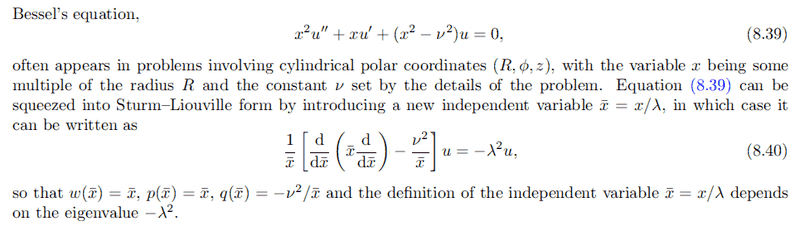
We first express Bessel's Equation in Sturm-Liouville form through a substitution:
Bessel1.png
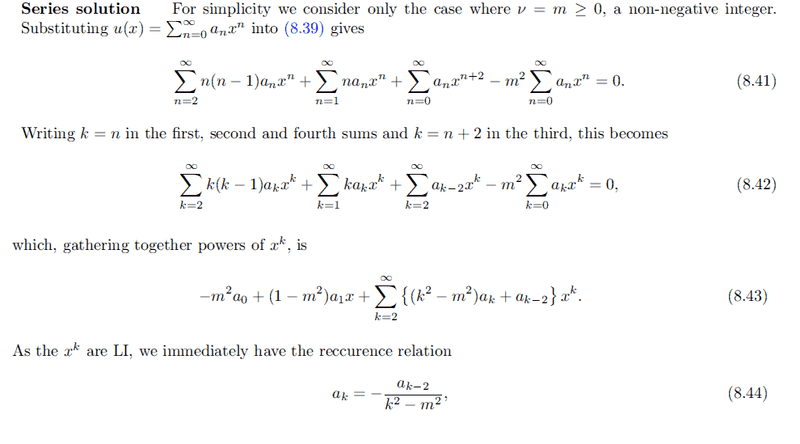
Next, we consider a series solution and replace v by m where m is an integer. We obtain a recurrence relation:
bessel2.png


Then, since all these terms must be = 0,

Consider m = 0

First term vanishes and second term =

a1x = 0

therefore, a1 = 0. Then by recurrence relation above, a1 = a3 = a5 = ... = a2n-1 = 0

Then only the even series give non-zero coefficients, so we start with a0 ≠ 0.

Consider m = 1

Second term vanishes, and first term =

a0 = 0

By recurrence relation, this implies a2n = 0

So we start the series with a1 ≠ 0

Book's Explanation
bessel3.png


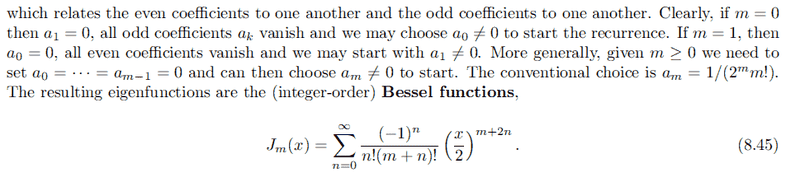
I don't understand why a0 = a1 = ... = am-1 = 0

Surely, for any value of m that is ≠ 1 we have:

a_{1}x = \frac{m^2}{1 - m^2} a_0

This doesn't imply anything above? Also, how did they get the resulting Bessel functions? It looks wildly different from mine.

a0 = a1 = ... = am-1 = 0,

u = \sum_{n=m}^\infty a_{n} x^n = \frac {1}{2^n n!} x^n
 
Last edited:
Physics news on Phys.org
From 8.44 you have ##(k^2 - m^2)a_k = -a_{k-2}##

When ##k = m##, that is ##0a_k = a_{k-2}##.

Using ##a_{k-2} = 0## and the recurrence relation, ##a_{k-4} = a_{k-6} = \dots = 0##.
 
Start from
<br /> -m^2 a_0 + (1 - m^2)a_1 x + \sum_{k= 2}^{\infty} ((k^2 - m^2)a_k + a_{k-2})x^k = 0<br />

We need this equation to hold for all x. Thus looking at the constant term we must have
<br /> m^2 a_0 = 0<br />
Thus if m \neq 0 we must have a_0 = 0. On the other hand if m = 0 then m^2 a_0 = 0 whatever the value of a_0.

Looking at the coefficient of x^1 we have
<br /> (1 - m^2)a_1 = 0<br />
so that if m \neq 1 we are forced to take a_1 = 0. If m = 1 then (1 - m^2)a_1 = 0 whatever the value of a_1.

At order x^2 and higher we find that
(k^2 - m^2)a_k + a_{k-2} = 0
from which it follows that if a_{k-2} = 0 then we must have a_k = 0 unless k = m, in which case we can choose a_m as we see fit. But this only happens if m \geq 2, so that m \neq 0 and m \neq 1, and by the above we must take a_0 = a_1 = 0. The recurrence relation then tells us that a_0 = a_1 = \dots = a_{m - 1} = 0.

We also have
((m + 1)^2 - m^2)a_{m + 1} + a_{m - 1}<br /> = (2m + 1)a_{m+1} + 0 = 0
so that a_k = 0 for k = m + 2n + 1, n \geq 0.

If k = m + 2n, n \geq 0, then
<br /> ((m + 2n)^2 - m^2)a_{m + 2n} + a_{m + 2(n-1)} = 0<br />
so that
<br /> a_{m + 2n} = - \frac{a_{m + 2(n-1)}}{(m^2 + 4mn + 4n^2) - m^2} <br /> = - \frac{a_{m + 2(n-1)}}{4n(m + n)}<br />
which can be solved to obtain
<br /> a_{m + 2n} = \frac{(-1)^n}{4^n n!(m + 1) \times \dots \times (m + n) }a_m = \frac{(-1)^n m!}{2^{2n} n!(m + n)!}a_m<br />
(looking at a_{m + 2}, a_{m + 4}, and a_{m + 6} establishes the pattern which can then be proven by induction on n) from which the given series for J_m(x) follows.
 
  • Like
Likes   Reactions: 1 person

Similar threads

  • · Replies 2 ·
Replies
2
Views
2K
  • · Replies 1 ·
Replies
1
Views
551
Replies
1
Views
11K
  • · Replies 6 ·
Replies
6
Views
3K
  • · Replies 2 ·
Replies
2
Views
983
  • · Replies 10 ·
Replies
10
Views
2K
  • · Replies 1 ·
Replies
1
Views
3K
  • · Replies 1 ·
Replies
1
Views
2K
  • · Replies 1 ·
Replies
1
Views
3K
  • · Replies 7 ·
Replies
7
Views
2K