unscientific
- 1,728
- 13
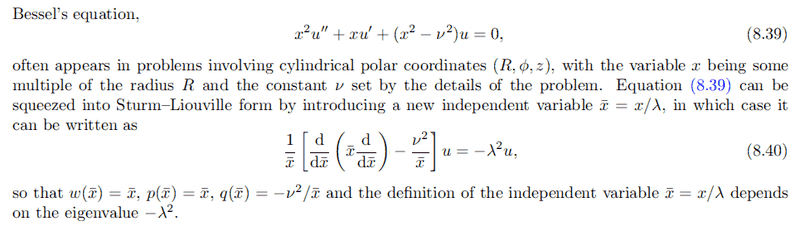
We first express Bessel's Equation in Sturm-Liouville form through a substitution:
 Next, we consider a series solution and replace v by m where m is an integer. We obtain a recurrence relation:
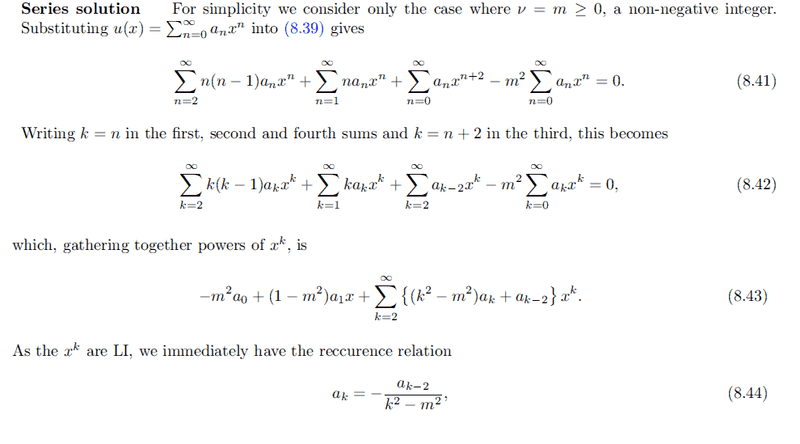
Then, since all these terms must be = 0,
Consider m = 0
First term vanishes and second term =
a1x = 0
therefore, a1 = 0. Then by recurrence relation above, a1 = a3 = a5 = ... = a2n-1 = 0
Then only the even series give non-zero coefficients, so we start with a0 ≠ 0.
Consider m = 1
Second term vanishes, and first term =
a0 = 0
By recurrence relation, this implies a2n = 0
So we start the series with a1 ≠ 0
Book's Explanation
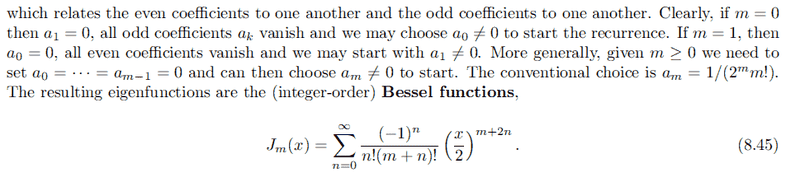
I don't understand why a0 = a1 = ... = am-1 = 0
Surely, for any value of m that is ≠ 1 we have:
[tex]a_{1}x = \frac{m^2}{1 - m^2} a_0[/tex]
This doesn't imply anything above? Also, how did they get the resulting Bessel functions? It looks wildly different from mine.
a0 = a1 = ... = am-1 = 0,
[tex]u = \sum_{n=m}^\infty a_{n} x^n = \frac {1}{2^n n!} x^n[/tex]
Then, since all these terms must be = 0,
Consider m = 0
First term vanishes and second term =
a1x = 0
therefore, a1 = 0. Then by recurrence relation above, a1 = a3 = a5 = ... = a2n-1 = 0
Then only the even series give non-zero coefficients, so we start with a0 ≠ 0.
Consider m = 1
Second term vanishes, and first term =
a0 = 0
By recurrence relation, this implies a2n = 0
So we start the series with a1 ≠ 0
Book's Explanation
I don't understand why a0 = a1 = ... = am-1 = 0
Surely, for any value of m that is ≠ 1 we have:
[tex]a_{1}x = \frac{m^2}{1 - m^2} a_0[/tex]
This doesn't imply anything above? Also, how did they get the resulting Bessel functions? It looks wildly different from mine.
a0 = a1 = ... = am-1 = 0,
[tex]u = \sum_{n=m}^\infty a_{n} x^n = \frac {1}{2^n n!} x^n[/tex]
Last edited: