cwatki14
- 56
- 0
Two infinitely long straight wires lie in the same plane and carry the currents depicted in Figure P.48.
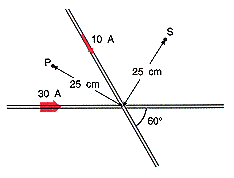
(a) Find the magnetic field at the point P located 24 cm from the intersection of the wires along the bisector of the acute angle between them.
(b) Find the magnetic field at the point S, located 20 cm from the intersection of the wires along the bisector of the obtuse angle between the wires.
Here's my solution which is wrong...:
At point P a magnetic field is created by the wire with the 30 A current and the wire with the 10 A current. You should be able to arithmetically add these fields since they both lie in the same plane, the z plane.
The Bio-Savart Law states:
B(vector)=([tex]\mu[/tex]/4[tex]\pi[/tex])(I)([tex]\int[/tex]dlxr/r^2)
At point P: The magnetic field is equal to the sum of the field caused by the 30 A wire and the 10 A wire.
http://photos-g.ak.fbcdn.net/hphotos-ak-snc1/hs259.snc1/10621_1139688773814_1275240494_30745014_2380313_n.jpg
This image represents the triangle created by the point and the wires. I used this to calculate the l and r vectors.
The field of the 30 A on P is is:
([tex]\mu[/tex]/4[tex]\pi[/tex])(30A)((.2078)/(.12)^2)
=4.3301e-5 T in the positive z direction
the cross product of l x r indicates that B has a positive value.
The field of 10 A on P is similarly calculated, but from the image of the wires, l x r should give a B field in the negative z direction. I am not going to plug all the numbers in because they are pretty much the same, just the values for I change and the direction of the B vector is now negative.
Thus the total B field on point A is the magnetic field due to 30A - magnetic field due to 10A.
I calculated for the point S in the same manner, except here I think the two B vectors are in the positive z direction so they add. So the total magnetic field at S=field caused by 10A + field caused by 30A.
I don't know if I am using the wrong equation, or my right hand rule is wrong. Please help, it's killing me!
(a) Find the magnetic field at the point P located 24 cm from the intersection of the wires along the bisector of the acute angle between them.
(b) Find the magnetic field at the point S, located 20 cm from the intersection of the wires along the bisector of the obtuse angle between the wires.
Here's my solution which is wrong...:
At point P a magnetic field is created by the wire with the 30 A current and the wire with the 10 A current. You should be able to arithmetically add these fields since they both lie in the same plane, the z plane.
The Bio-Savart Law states:
B(vector)=([tex]\mu[/tex]/4[tex]\pi[/tex])(I)([tex]\int[/tex]dlxr/r^2)
At point P: The magnetic field is equal to the sum of the field caused by the 30 A wire and the 10 A wire.
http://photos-g.ak.fbcdn.net/hphotos-ak-snc1/hs259.snc1/10621_1139688773814_1275240494_30745014_2380313_n.jpg
This image represents the triangle created by the point and the wires. I used this to calculate the l and r vectors.
The field of the 30 A on P is is:
([tex]\mu[/tex]/4[tex]\pi[/tex])(30A)((.2078)/(.12)^2)
=4.3301e-5 T in the positive z direction
the cross product of l x r indicates that B has a positive value.
The field of 10 A on P is similarly calculated, but from the image of the wires, l x r should give a B field in the negative z direction. I am not going to plug all the numbers in because they are pretty much the same, just the values for I change and the direction of the B vector is now negative.
Thus the total B field on point A is the magnetic field due to 30A - magnetic field due to 10A.
I calculated for the point S in the same manner, except here I think the two B vectors are in the positive z direction so they add. So the total magnetic field at S=field caused by 10A + field caused by 30A.
I don't know if I am using the wrong equation, or my right hand rule is wrong. Please help, it's killing me!
Last edited by a moderator: