BJT amplifier - calculate resistances

  • Thread starter Thread starter etf
  • Start date Start date
  • Tags Tags
    Amplifier Bjt
Click For Summary
SUMMARY

The forum discussion focuses on calculating the resistances RC1, RC2, and RE2 for a BJT amplifier to achieve maximum undistorted symmetrical output signals with specified parameters. The values determined are RE2=700Ω, RC1=5.724kΩ, and RC2=3.141kΩ, with a voltage gain Av calculated using the transconductance and resistance values. The discussion emphasizes the importance of accurate DC analysis and the application of Kirchhoff's laws to derive the correct resistance values.

PREREQUISITES
  • BJT amplifier design principles
  • Kirchhoff's voltage law
  • Understanding of DC analysis in electronic circuits
  • Basic knowledge of transconductance and voltage gain calculations
NEXT STEPS
  • Study BJT amplifier design for maximum symmetrical output
  • Learn about Kirchhoff's laws in circuit analysis
  • Explore transconductance calculations in BJT circuits
  • Research voltage gain formulas for BJT amplifiers
USEFUL FOR

Electronics engineers, students studying circuit design, and anyone involved in designing or analyzing BJT amplifiers for optimal performance.

etf
Messages
179
Reaction score
2
Hi!
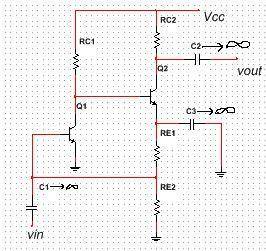
Here is my task:
Calculate RC1, RC2, RE2 for maximum undistorted symmetrical signal at output if DC collector currents are IC1=IC2=1mA. Calculate voltage gain Av.
Vcc=9V, RE1=1.8kΩ , VBE=0.7V, VCES=0.2V, VT=26mV, beta=100, VA→∞.
Solution: RE2=700Ω, RC1=5.724kΩ, RC2=3.141kΩ, Av=gm1*gm2*rpi2*RC1*RC2/(rpi2+RC1).

nik.JPG


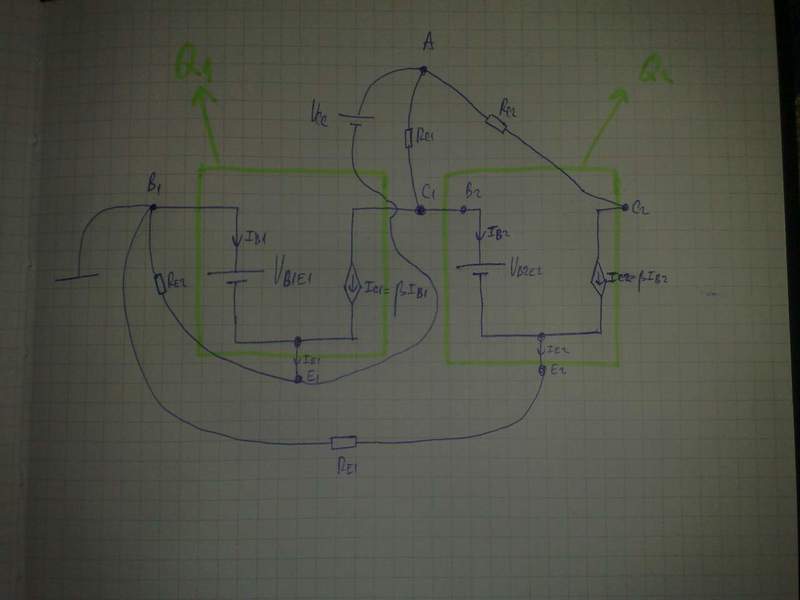
After assuming that BJT's operate in forward active mode and solving circuit bellow I got RE2=700Ω, RC1=5.782kΩ. Is it ok? How to find RC2? I have no problems calculating Av.
31052014894.jpg
 
Physics news on Phys.org
Re1 looks good
But you are slightly off the true Rc1 value.
What is the current that is flow Rc1 ? What is the voltage across Rc1?

As for the Rc2 maybe this will give you some hint
https://www.physicsforums.com/showthread.php?t=633117&highlight=swing
But for your circuit Vc is not equal to 4.5V. You must include DC emitter voltage and Vce(sat).
9V - (2.518 + 0.2) = 6.282V.
So to get maximum undistorted signal Vc2 must be equal to ??

P.S

What it is ??
https://www.physicsforums.com/attachment.php?attachmentid=70181&d=1401493487
 
Last edited:
Thanks, I will take a look on post... My second scheme is scheme for DC analysis, I just used models for BJT's in forward active mode (http://people.senecac.on.ca/john.kawenka/EDV255/images/bjt05.png ) instead of usual BJT symbol.
 
Last edited by a moderator:
Your DC model is incorrect. Try to draw it again.
 
Whats wrong with model?
 
etf said:
Whats wrong with model?
The model is ok. The overall diagram is wrong. Why T1 base is short to ground?
Why Vcc is connect is not connected to ground ?
 
E1 should be connected to ground, instead of B1. I don't know why I connected B1 to ground :)
 
Do you managed to find Vc2 voltage ?
 
I can't figure it out :(
 
  • #10
What is the voltage at Q2 emitter ??
And notice that voltage at collector can swing from Ve2 + Vce(sat) up to Vcc.
So to get maximum undistorted symmetrical signal at collector we must chose Vc at the middle of this swing.
 
  • #11
VE2=VC1E1-VB2E2=2.518V so voltage at collector (VC2) can swing from 2.518V+0.2V=2.718V up to Vcc=9V (6.282V swing). Now I should find Vc and after that RC2?
 
  • #12
etf said:
VE2=VC1E1-VB2E2=2.518V so voltage at collector (VC2) can swing from 2.518V+0.2V=2.718V up to Vcc=9V (6.282V swing). Now I should find Vc and after that RC2?
Exactly, and you should pus Vc at the middle of the swing.
 
  • #13
2*(vc2e2-0.2)=6.282 → vc2e2=3.341v.
Vc2e2+rc*ic2-rc1*ic1-vb2e2=0 → rc2=(rc1*ic1+vb2e2-vc2e2)/ic2
rc2=3141Ω
Thanks a lot!
 
  • #14
The answer is good, but you over complicate this.
All you need to find Rc2 is to use a II Kirchhoff law for the output loop.

attachment.php?attachmentid=70196&stc=1&d=1401570058.png


Vcc = VRc2 + Vce2 + Ve2

Ve2 = Ie2*Re1 + Ic2*Re2 = 1.01mA*1.8kΩ + 1mA*700Ω = 2.518V

The swing

Vcc - (Ve2 + Vce(sat)) = 9V - (2.518V + 0.2V) = (9V - 2.718V) = 6.282V

From this VRc2 = Vce2 = 6.282V/2 = 3.141V

And

Rc2 = VRc2/Ic2 = 3.141/1mA = 3.141kΩ

And Rc1 = (Vcc - (Ve2 + Vbe2))/( Ic1 + Ib2 ) = 5.782V/(1mA + 10μA) = 5.724kΩ
 

Attachments

  • 31.PNG
    31.PNG
    2.2 KB · Views: 1,039
  • Like
Likes   Reactions: 1 person
  • #15
I have another example.
Calculate resistances R1, R2, RC, RE for maximal symmetrical undistorted voltage on output, if total maximal collector current is Icmax=4mA. Vcc=10V, load resistance RL=10kΩ, β=100, VBE=0.7V, VCES=0.2V, VT=26mV, VA=100.

prvi.JPG


In DC analysis, I calculated VCE=VCC-(beta*RC/(RE*(beta+1))+1)*((VCC/R1-VBE/R1-VBE/R2)/(1/R1+1/R2+(1-beta/(beta+1))/RE)). For maximal swing Vce shoud be on middle of load line. I'm not sure I understand what total maximal collector current means :confused:
Here is solution:
RE=2*beta*(Vcc-VCES)/(Icmax*(1+beta))-(beta/(1+beta))*(RC*RL/(RC+RL)+RC)
R2=R1*(2*beta*VBE+(1+beta)*RE*Icmax)/(2*beta*(Vcc-VBE)-[R1+(1+beta)*RE]*Icmax)
 
Last edited:
  • #16
OMG, how do you manage to derive the formula for RE and Vce ??
 
  • #17
I'm also not sure what total maximal collector current is.
I see two options.
First:
Ic_max = Icq - quiescent DC current or maybe Ic_tot = Icq + Ic_ac ?

And to find components values we can use ohms law.
For example assume Veq = 1V and Icq = 1mA and from there we have
Re = 1V/1.01mA = 990Ω = 1K.
Rc = 4.5V/1mA = 4.4KΩ ≈ 4.3KΩ and voltage at base Vb = Veq + Vbe.
So you design voltage divider to get Vb at output. And the current that is flow through divider should be much larger than the Ib

http://eelinux.ee.usm.maine.edu/cou....BJT Amps. for Undistorted VoltageSwing-X.pdf
 

Similar threads

  • · Replies 2 ·
Replies
2
Views
4K