Boundary conditions of linear materials

Click For Summary
SUMMARY

The discussion focuses on the boundary conditions of linear materials, specifically in the context of magnetostatics involving a uniformly magnetized sphere. Key equations include the magnetic field of the sphere, represented as $$ \vec B = \mu_o \vec H $$ and $$ H^{\perp}_{s} = \frac{2}{3} \vec M \cdot \hat r $$. Participants analyze the relationships between the magnetic fields and magnetization, emphasizing the importance of the outer layer's contribution to the magnetic field inside the sphere. The discussion concludes that the boundary condition for the perpendicular component of $$ H $$ can be derived from the divergence equations $$ \nabla \cdot H = -\nabla \cdot M $$.

PREREQUISITES
  • Understanding of magnetostatics principles
  • Familiarity with vector calculus, particularly divergence and dot products
  • Knowledge of magnetic fields and materials, specifically the relationship between $$ B $$, $$ H $$, and $$ M $$
  • Experience with boundary conditions in electromagnetic theory
NEXT STEPS
  • Study the derivation of boundary conditions in magnetostatics
  • Learn about the implications of the outer layer on magnetic fields in materials
  • Explore the differences between isotropic and nonisotropic media in magnetism
  • Investigate the application of Biot-Savart law in calculating magnetic fields
USEFUL FOR

Students and professionals in physics, particularly those specializing in electromagnetism, materials science, and engineering, will benefit from this discussion. It is especially relevant for those working with magnetic materials and boundary conditions in magnetostatics.

Tony Hau
Messages
107
Reaction score
30
Homework Statement
Please see the picture below
Relevant Equations
1) ##\vec M = \chi_m \vec H##
2)##\vec B = \mu \vec H##
Boundary conditions:
1) ##H^{\perp}_{above} - H^{\perp}_{below}= -(M^{\perp}_{above} - M^{\perp}_{below})##
2) ##H^{\parallel}_{above} - H^{\parallel}_{below} = K_{free} \times \hat n##
The question is as follows:
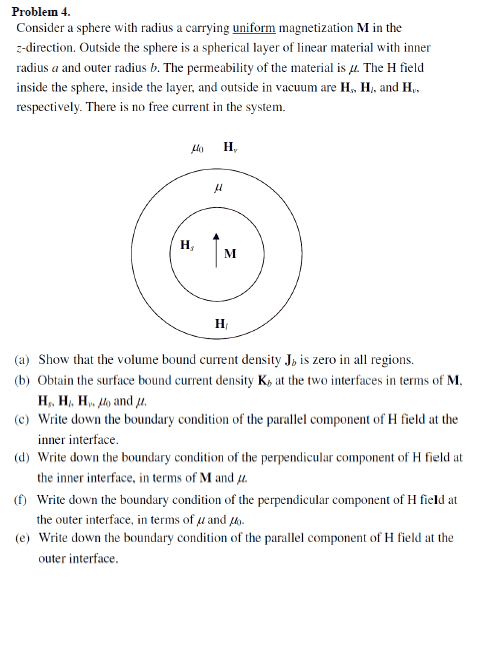
1607839563985.png

Solutions given only contain part a) to c), which is as follows:
1607839613473.png

So I now try to attemp d), e) and f).
d)
The magnetic field of a uniformly magnetized sphere is:
$$ \vec B =\frac{2}{3}\mu_{o} \vec M = \mu_{o}\vec H$$
$$\frac{2}{3}\vec M = \vec H$$
The perpendicular component of ##\vec H## is: $$ H^{\perp}_{s} = \vec H \cdot \hat r = \frac{2}{3} \vec M \cdot \hat r$$

e) ##H^{\parallel}_{above} - H^{\parallel}_{below} = \vec K_{free} \times \hat n =0##,
Therefore, $$H^{\parallel}_{l}(a) = H^{\parallel}_{s}(a)$$

f)
By $$\oint \vec H \cdot d\vec a= - \oint \vec M \cdot d\vec a$$
$$ H^{\perp}_{above} - H^{\perp}_{below}= -(M^{\perp}_{above} - M^{\perp}_{below})$$
Given that:
##H^{\perp}_{below} = \vec H_{s}(a) \cdot \hat r##
##M^{\perp}_{above} = \vec M_{above} \cdot \hat r = \chi_{m} \vec H_{l}(a) \cdot \hat r##
##M^{\perp}_{below} = \vec M \cdot \hat r##
Therefore, $$ H^{\perp}_{above} - \vec H_{s}(a) \cdot \hat r = - (\chi_{m} \vec H_{l}(a) \cdot \hat r - \vec M \cdot \hat r)$$
$$ H^{\perp}_{l} = - (\chi_{m} \vec H_{l}(a) \cdot \hat r - \vec M \cdot \hat r)+ \vec H_{s}(a) \cdot \hat r = - [(\frac{\mu}{\mu_{o}}-1) \vec H_{l}(a) \cdot \hat r - \vec M \cdot \hat r] +\frac{2}{3}\vec M \cdot \hat r$$

I cannot proceed further, or I do not even know if I am correct. Can anyone give me any advice?
 
  • Like
Likes   Reactions: Delta2
Physics news on Phys.org
You don't know what ## B ## is doing inside the uniformly magnetized sphere, because it will be affected by the ## H ## from contributions from the outer layer. To compute the boundary condition of the perpendicular component of ## H##, you just need ## \nabla \cdot H =-\nabla \cdot M ##, (comes from ## \nabla \cdot B=0 ##, and ## B=\mu_o (H+M) ##), which will give you ## H_{1} \cdot \hat{n}_1+H_{2} \cdot \hat{n}_2=-(M_{1} \cdot \hat{n}_1+M_2 \cdot \hat{n}_2) ##. The dot products will give you the perpendicular components. There will also be minus signs, because ## \hat{n}_1=-\hat{n}_2 ##, etc.

@vanhees71 You might find this one of interest as well, and I welcome your inputs=I think I got it right, but please confirm. :)
 
Last edited:
  • Like
Likes   Reactions: Delta2 and Tony Hau
Charles Link said:
You don't know what ## B ## is doing inside the uniformly magnetized sphere, because it will be affected by the ## H ## from contributions from the outer layer. To compute the boundary condition of the perpendicular component of ## H##, you just need ## \nabla \cdot H =-\nabla \cdot M ##, (comes from ## \nabla \cdot B=0 ##, and ## B=\mu_o (H+M) ##), which will give you ## H_{1} \cdot \hat{n}_1+H_{2} \cdot \hat{n}_2=-(M_{1} \cdot \hat{n}_1+M_2 \cdot \hat{n}_2) ##. The dot products will give you the perpendicular components. There will also be minus signs, because ## \hat{n}_1=-\hat{n}_2 ##, etc.

@vanhees71 You might find this one of interest as well, and I welcome your inputs=I think I got it right, but please confirm. :)
But isn't it what I am doing for part f? $$ \nabla \cdot \vec H = -\nabla \cdot \vec M$$ $$ \oint \vec H \cdot d\vec a = -\oint \vec M \cdot d\vec a$$
 
  • Like
Likes   Reactions: Charles Link
Upon reading further down, you did some things very well. When I posted, I only read through part (d), and I don't agree with it. The ## M ## in that region is simply fixed. Meanwhile, where does ## B=\mu_o H ## come from? (If you meant ## B=\mu H ##, that would also be incorrect for this region). Once again, I don't think you can say ## B=(2/3) \mu_o M ##. That would be the case only if there were no outer layer.
 
  • Like
Likes   Reactions: Delta2 and Tony Hau
Charles Link said:
Upon reading further down, you did some things very well. When I posted, I only read through part (d), and I don't agree with it. The ## M ## in that region is simply fixed. Meanwhile, where does ## B=\mu_o H ## come from? (If you meant ## B=\mu H ##, that would also be incorrect for this region). Once again, I don't think you can say ## B=(2/3) \mu_o M ##. That would be the case only if there were no outer layer.
Yes, ##\vec B = \mu \vec H## is what I meant. I use this equation because there is no linear material in this inner magnetized sphere. Hence, we can assume that ##\mu## in ##\vec B = \mu \vec H## can be assumed to be ##\mu_o##. Why is it incorrect for this region?

By the way, I have come up with one solution to calculate the magnetic ##B## ## ##field inside the sphere. We can do this by calculating the magnetic field produced by the surface currents at ##r = a## and ##r=b## respectively, which is calculated in part b. After all, all the fields produced by the linear layer equals to that produced by the surface currents.
 
Last edited:
When you have a specified ##M ## inside the material, the ## H ## is computed as always from any and all magnetic poles, using the inverse square law, with magnetic pole density ## \rho_m=-\nabla \cdot M ##, (along with the contribution to ## H ## from any currents in conductors using Biot-Savart). The ## H ## will not affect the ##M ## in this case. You still have ## B=\mu_o(H+M) ##.
(Note: You do not have ## M=\chi H ## for this case. You cannot say ## H=M/\chi ##. )

See https://www.physicsforums.com/threads/a-magnetostatics-problem-of-interest-2.971045/
You might find this worthwhile reading.
 
Last edited:
  • Like
Likes   Reactions: Tony Hau
Charles Link said:
When you have a specified ##M ## inside the material, the ## H ## is computed as always from any and all magnetic poles, using the inverse square law, with magnetic pole density ## \rho_m=-\nabla \cdot M ##, (along with the contribution to ## H ## from any currents in conductors using Biot-Savart). The ## H ## will not affect the ##M ## in this case. You still have ## B=\mu_o(H+M) ##.
(Note: You do not have ## M=\chi H ## for this case. You cannot say ## H=M/\chi ##. )

See https://www.physicsforums.com/threads/a-magnetostatics-problem-of-interest-2.971045/
You might find this worthwhile reading.
Alright. But your article is a bit complicated and may take some time...
 
  • Like
Likes   Reactions: Charles Link
The solution is finally released:
Screenshot (141).png
 
  • Like
Likes   Reactions: Charles Link
  • #10
Do you see how they did part (d)? They had to use ## H_s ##, which can have contributions from the outer layer.

If the outer layer is absent, then ## H_s ## is uniform throughout the entire interior of the sphere including ## H_s(a) ## and is then ## \vec{H}_s(a)=-\vec{M}/3 ##.

With the outer layer in place, they don't ask you to compute ## H_s ##. That would be rather difficult, and they simply want the boundary condition for now.
 
  • Like
Likes   Reactions: Tony Hau
  • #11
However I have come up with another way for d) and f):
For d), $$ \nabla \cdot \vec H = - \nabla \cdot \vec M$$, $$ H^{\perp}_{l} - H^{\perp}_{s} = -(M^{\perp}_{l} - M^{\perp}_{s})$$
Given that:
##M^{\perp}_{l} = \vec M_{l} \cdot \hat r##

For ##\vec M_{l}##, because ## \vec B_{l} = \mu_o (\vec H_{l} + \vec M_{l})##,
##\mu \vec H_{l} = \mu_o (\vec H_{l} +\vec M_{l})##,
##(\frac{\mu}{\mu_o}-1)\vec H_{l} = \vec M_{l}##,
##M^{\perp}_{l} = (\frac{\mu}{\mu_o}-1)\vec H_{l} \cdot \hat r = \vec M_{l} \cdot \hat r##,

Therefore, $$ H^{\perp}_{l} - H^{\perp}_{s} = -((\frac{\mu}{\mu_o}-1)H^{\perp}_{l} - \vec M_{l} \cdot \hat r)$$
$$\mu H^{\perp}_{l} = \mu_o \vec M_{l} \cdot \hat r + \mu_o H^{\perp}_{s}$$

For f),
By $$ H^{\perp}_{v} - H^{\perp}_{l} = -(M^{\perp}_{v} - M^{\perp}_{l} )$$,
Because $$M^{\perp}_{v} =0$$,
therefore, $$H^{\perp}_{v}= \frac{\mu}{\mu_o} H^{\perp}_{l}$$

After reading a passage from Electromagnetics by John Kraus, I finally understand when to apply ##\vec B = \mu_o(\vec H + \vec M)## and ##\vec B = \mu \vec H##. The paragraph reads as follows:

##\dots## In isotropic media ##\vec M## and ##\vec H## are in the same direction, so that their quotient is a scalar and hence ##\mu## is a scalar. In nonisotropic media, such as crystals, ##\vec M## and ##\vec H## are, in general, not in the same direction, and ##\mu## is not a scalar. Hence, ##\vec B = \mu_o(\vec H + \vec M)## is a general relation, while ##\vec B = \mu \vec H## is a more consise expression, which, however, has a simple significance only for isotropic media or certain special cases in nonisotropic media.
 
  • #12
Charles Link said:
Do you see how they did part (d)? They had to use ## H_s ##, which can have contributions from the outer layer.

If the outer layer is absent, then ## H_s ## is uniform throughout the entire interior of the sphere including ## H_s(a) ## and is then ## \vec{H}_s(a)=-\vec{M}/3 ##.

With the outer layer in place, they don't ask you to compute ## H_s ##. That would be rather difficult, and they simply want the boundary condition for now.
The outer layer is magnetized and radiates H field, which alters the H field inside the sphere, am I right?
 
  • Like
Likes   Reactions: Charles Link
  • #13
Tony Hau said:
Therefore,
Right after "Therefore", you should have ## M_s ## in that expression, not ## M_l ##. Otherwise, part (d) that you have there looks correct to me. :)
 
  • Like
Likes   Reactions: Tony Hau
  • #14
Tony Hau said:
The outer layer is magnetized and radiates H field, which alters the H field inside the sphere, am I right?
Yes, and it is not uniform and not simply in the z-direction, like the ## H ## field is inside the sphere for the case of no outer layer. With no outer layer, the ## H=-M/3 ## field inside the sphere is much simpler.
 
  • Like
Likes   Reactions: Tony Hau

Similar threads

Replies
10
Views
2K
  • · Replies 17 ·
Replies
17
Views
3K
  • · Replies 5 ·
Replies
5
Views
3K
Replies
1
Views
2K
Replies
7
Views
3K
  • · Replies 1 ·
Replies
1
Views
2K
  • · Replies 3 ·
Replies
3
Views
2K
Replies
2
Views
2K
  • · Replies 4 ·
Replies
4
Views
3K
Replies
3
Views
2K