What is the role of Thales' Theorem in the proof of Brahmagupta's Theorem?

  • Context: High School 
  • Thread starter Thread starter aheight
  • Start date Start date
  • Tags Tags
    Proof Theorem
Click For Summary
SUMMARY

Brahmagupta's Theorem states that a cyclic quadrilateral is orthodiagonal if and only if the perpendicular from the intersection of the diagonals bisects the opposite side. The discussion clarifies the initial step of the proof, which relies on Thales' Theorem to establish that segments AF, FM, and FD are equal. The proof involves recognizing that triangle AMD has a right angle at M, leading to the conclusion that triangle AFM is equilateral, thus confirming AF equals FM. The connection to Thales' Theorem is essential for understanding the geometric relationships in the proof.

PREREQUISITES
  • Understanding of Brahmagupta's Theorem
  • Familiarity with Thales' Theorem
  • Knowledge of cyclic quadrilaterals
  • Basic principles of triangle geometry
NEXT STEPS
  • Study the proof of Brahmagupta's Theorem in detail
  • Explore applications of Thales' Theorem in geometry
  • Investigate properties of cyclic quadrilaterals
  • Learn about the relationship between angles and sides in triangles
USEFUL FOR

Mathematicians, geometry students, educators, and anyone interested in advanced geometric proofs and theorems.

aheight
Messages
318
Reaction score
108
TL;DR
Problems following proof of Bragmagupta's Theorem
Brahmagupta's theorem:

A cyclic quadrilateral is orthodiagonal (diagonals are perpendicular) if and only if the perpendicular to a side from the point of intersection of the diagonals bisects the opposite side.

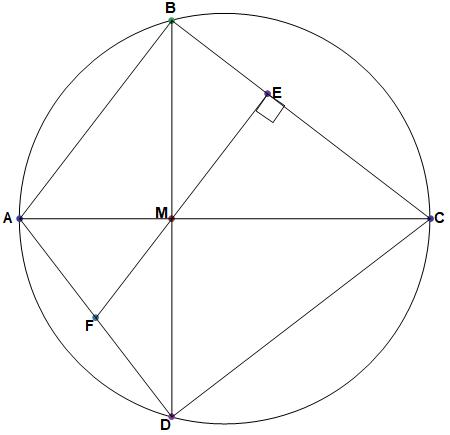
But I don't understand the first step of the proof for the necessary condition from Proof Wiki: Proof of Brahmagupta's Theorem, that is, if the perpendicular bisects the opposite side then the quad is orthodiagonal. It states:

From Thales' Theorem (indirectly) we have that ##AF=FM=FD##

I've looked at Thale's theorem but do not understand how we can initially state that ##AF=FM=FD## and I was wondering if someone could help me with this?

Thanks guys.
bragamaguptadiagram.jpg
 
Mathematics news on Phys.org
aheight said:
A cyclic quadrilateral is orthodiagonal (diagonals are perpendicular) if and only if the perpendicular to a side from the point of intersection of the diagonals bisects the opposite side.
That is not the same as the theorem you linked to. Proofwiki only deals with orthodiagonal quadriliterals. In that case the triangle AMD has a right angle at M, which means the angles FAM and FMA are the same, the triangle AFM is an equilateral triangle and AF=FM. AF=FD was given already.
 
  • Like
Likes   Reactions: aheight
Ok thanks MFB. I understand it now and now see why the reference to Thales was made: if ##\angle AMD## is a right angle, then we can inscribe ##\triangle AMD## in a circle with diameter AD and therefore, AM=FM since F is the midpoint.
bragmaguptaplot.jpg
 

Similar threads

  • · Replies 2 ·
Replies
2
Views
1K
  • · Replies 13 ·
Replies
13
Views
2K
  • · Replies 12 ·
Replies
12
Views
2K
  • · Replies 2 ·
Replies
2
Views
3K
  • · Replies 1 ·
Replies
1
Views
2K
  • · Replies 2 ·
Replies
2
Views
1K
  • · Replies 1 ·
Replies
1
Views
2K
  • · Replies 8 ·
Replies
8
Views
2K
  • · Replies 1 ·
Replies
1
Views
4K
Replies
4
Views
2K