Brake Caliper Spacer and Leverage question

  • Thread starter Thread starter cp914
  • Start date Start date
  • Tags Tags
    Brake
Click For Summary
SUMMARY

The discussion centers on the use of a 1" thick brake caliper spacer in a custom spindle/hub/rotor assembly. Concerns include the potential for bolt shearing and spindle failure due to added leverage. It is established that using 6061 T6 aluminum may not be advisable due to thermal expansion issues, and grade 8 or higher bolts are recommended. The necessity of a shoulder on the spacer to handle rotary loads is emphasized to prevent failure during braking.

PREREQUISITES
  • Understanding of brake caliper mechanics
  • Knowledge of material properties, specifically 6061 T6 aluminum and steel
  • Familiarity with bolt grades, particularly grade 8 specifications
  • Basic principles of stress and strain calculations
NEXT STEPS
  • Research the mechanical properties of 6061 T6 aluminum versus steel for automotive applications
  • Learn about the implications of thermal expansion in brake components
  • Study the design and machining of custom spacers for brake systems
  • Investigate the effects of bolt shear loads and proper fastening techniques in automotive engineering
USEFUL FOR

Automotive engineers, mechanics, and DIY enthusiasts involved in custom brake system modifications and those seeking to enhance their understanding of brake component dynamics.

cp914
Messages
1
Reaction score
0
This has got my brain tied in a knot. Read https://www.physicsforums.com/showthread.php?t=304215" and felt you folks would have good insights.

I have pieced together a spindle/hub/rotor combo that would require a 1" thick spacer to work. Using a 1 piece spacer and 10.9 mounting bolts, will this hold? My concerns are bolts shearing or the cast iron spindle snapping from the added leverage, neither of which I want to discover by test drive. Also wondering if it would induce vibrations during braking.

If OK, then do I need to make the spacer from steel or will 6061 t6 suffice (being lighter and easier to machine).
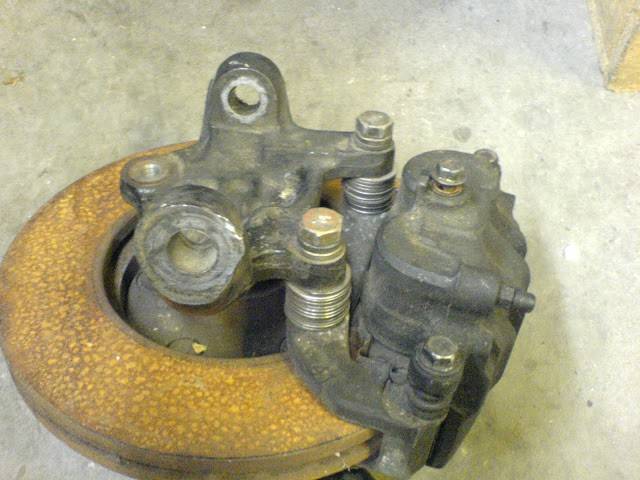
DSC01199.JPG
 
Last edited by a moderator:
Physics news on Phys.org
Somebody mentioned in yor other thread about the bolts not having a shear load when tightened. So watch out for that. Usually bolts aren't intended to carry shear loads.

Bending could be a problem, as you say. But where are any bending moments coming from? Once you can identify the source of the load, then you can estimate what it would be. It seems to me that the braking force puts nearly zero bending load on those bolts. Is there any outward (along the wheel's radius) force on the calliper?

Also nearly no axial load, since the calliper will be floating in that direction. So I'd guess it hardly matters what metal you use as a spacer, from a static load point of view anyway.

I suspect more serious issues could come up over time, like unusual loads, fatigue, unsafe failure modes, corrosion, etc. What happens if one bolt comes loose? Will the brakes still work? Will the wheel lock up? Etc.

Oh, if you use aluminium make sure it won't deflect much (or fail!) under the tension of the bolts. Just a basic stress/strain calc.
 
Last edited:
i think you will be ok with the bolts..if...there is a recessed non threaded bore in the spindle and the bolt thread area is shorter than the clear bore..in other words the bolt thread does not end at the top of the spindle thread area. Also you need a grade 8 or higher bolt.
if you have machine shop capability i would machine the spacer to have a shoulder that butts up to the spindle and butts up to the caliper so the spacer would take the rotary load. Do not use aluminum as there is a lot of heat generated during braking and the thermal expansion characteristics of the two materials are different. the bolt would eventually loosen up and you are in trouble..
 

Similar threads

  • · Replies 3 ·
Replies
3
Views
2K
  • · Replies 17 ·
Replies
17
Views
16K