Brake Power, Engine Speed and bmep Relationship

Join the discussion
Ask a follow-up here, or get your own question answered by working scientists, mathematicians and engineers — people, not an autocomplete.
Real named experts · corrections over time · the nuance an AI answer skips
2 replies · 9K views
smr101
Messages
72
Reaction score
0
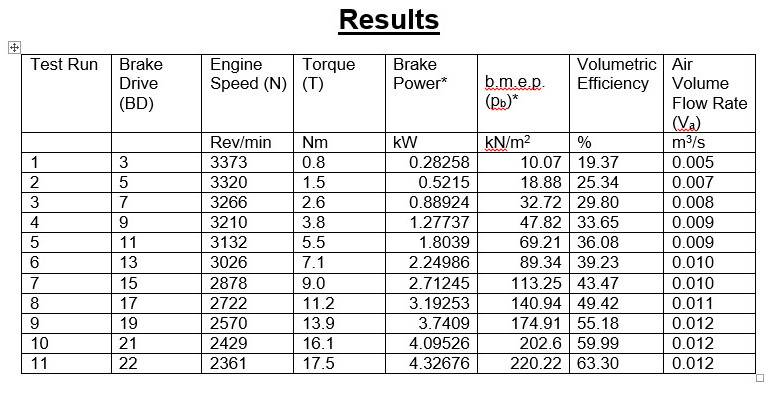
I'm currently doing a report on Petrol Engines and I'm having a problem with my results not making sense.

Am I correct in saying Break mean effective pressure (bmep) should increase as Engine Speed (rev/min) increases? My results do not reflect this and I don't understand why.

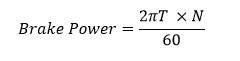
I have attached my results table below, I calculated brake power and bmep myself using these equations:

e6jDp.jpg

APWGV.jpg


I believe the problem is in the Brake Power & bmep results, help is much appreciated.
m2qhU.jpg
 
Physics news on Phys.org
I think the following quote from the above reference site addresses your concern:

The definition of BMEP is: the average (mean) pressure which, if imposed on the pistons uniformly from the top to the bottom of each power stroke, would produce the measured (brake) power output.

While the equations shown are based upon torque, in fact BMEP is really a measure primary of the filling efficiency of a cylinder during the intake stroke combined with fuel combustion energy; and, neither of these factors are related to engine speed. In reality, there is a potential for a reduction in BMEP at increased engine speeds due to a flowing pressure drop in the engines inlet system as the engine demands higher and higher air cfm flow rates. Increasing BMEP by raising the cylinder(s) air charge pressure is the primary reason for and function of superchargers and turbochargers. i.e. higher cylinder charging pressure = higher compression pressures and more air to be expanded during the combustion power cycle.

Added note: BMEP can also be potentially reduced at increased engine speeds due to the fact that the piston's downward travel rate is increased during the power stroke which in turn increases the cylinder volume increase rate relative to the cylinder's reduced combustion pressure rise burn time; this is where ignition timing and variable valve timing functions can come into play to offset this effect.
 
Last edited: