SUMMARY
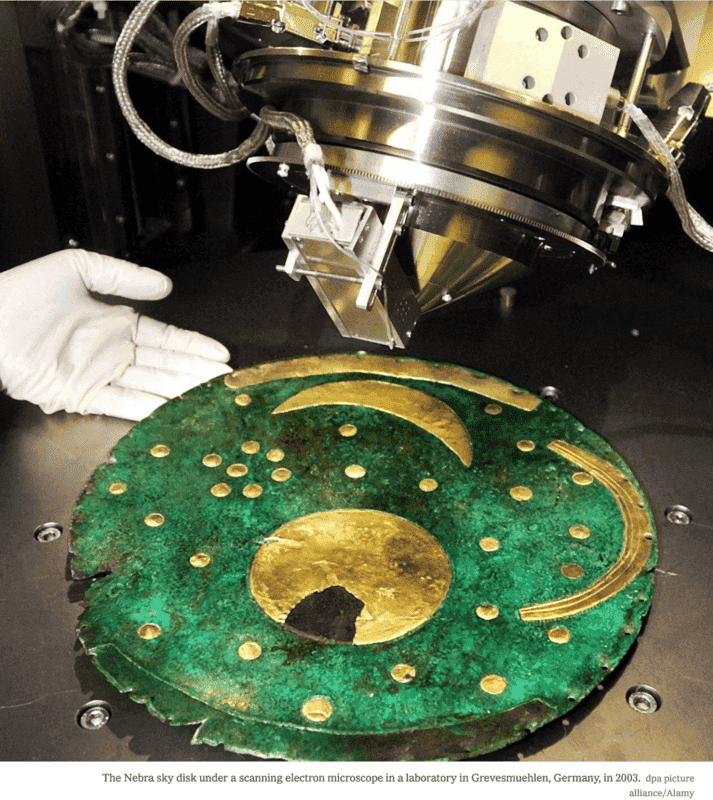
The Nebra Sky Disk's age is contested, with recent studies suggesting it may originate from the Iron Age (800 to 50 BC) rather than the early Bronze Age. Researchers Rupert Gebhard and Rüdiger Krause argue that the disk lacks convincing evidence linking it to Bronze Age artifacts, instead showing similarities to Iron Age motifs. Radiocarbon dating of associated birch bark indicates a date of around 1600 to 1560 BC, while analysis at the BESSY particle accelerator revealed non-uniform gold plating, suggesting multiple phases of creation. The provenance of the disk remains unclear due to its discovery in the black market.
PREREQUISITES
- Understanding of archaeological dating techniques, including radiocarbon dating
- Familiarity with the historical context of the Bronze and Iron Ages
- Knowledge of astronomical representations in ancient cultures
- Experience with materials analysis techniques, such as X-ray fluorescence
NEXT STEPS
- Research the methodologies of radiocarbon dating and its applications in archaeology
- Explore the significance of the Pleiades in various ancient cultures
- Investigate the implications of provenance in archaeological findings
- Learn about the techniques used in materials analysis, particularly at particle accelerators
USEFUL FOR
Archaeologists, historians, and anyone interested in the intersection of ancient cultures and astronomical representations will benefit from this discussion.