Buffer solution + equilibrium + Organic compound

Click For Summary
SUMMARY

The discussion centers on the equilibrium expression for the dissociation constant (Ka) of acetic acid (CH3COOH) and its conjugate base acetate (CH3COO-). The correct formula for Ka is given as Ka = (CH3COO-)(H+)/(CH3COOH), which utilizes equilibrium concentrations. This contrasts with an incorrect approach that modifies initial concentrations with an extent of dissociation variable (x). The confusion arises from the representation of sodium acetate (CH3COONa) in solution and its interaction with hydrochloric acid (HCl).

PREREQUISITES
  • Understanding of acid-base equilibrium concepts
  • Familiarity with the dissociation constant (Ka) and its significance
  • Knowledge of chemical species in aqueous solutions
  • Basic grasp of equilibrium concentration calculations
NEXT STEPS
  • Study the derivation and application of the dissociation constant (Ka) for weak acids
  • Learn about the role of sodium acetate (CH3COONa) in buffer solutions
  • Explore the concept of pH and its calculation in buffer systems
  • Investigate the effects of adding strong acids like HCl to buffer solutions
USEFUL FOR

Chemistry students, educators, and professionals involved in acid-base chemistry, particularly those focusing on buffer solutions and equilibrium calculations.

myvow
Messages
10
Reaction score
0
For this question,why Ka =(ch3coo-)(h+)/(ch3cooh) instead of Ka =(ch3coo +x)(x)/(ch3cooh-x) ?
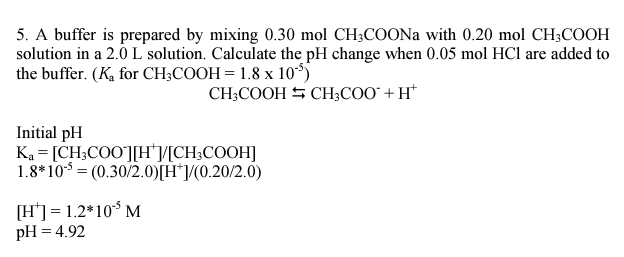
20141228_7bca95847216b430816fm7mRBFmSHq75.png
 
Last edited by a moderator:
Physics news on Phys.org
myvow said:
why Ka =(ch3coo-)(h+)/(ch3cooh) instead of Ka =(ch3coo +x)(x)/(ch3cooh-x)

First equation uses equilibrium concentrations, second uses initial concentrations modified by the extent of the dissociation, to calculate equilibrium concentrations. Do you understand what these means?
 
myvow said:
For this question,why Ka =(ch3coo-)(h+)/(ch3cooh) instead of Ka =(ch3coo +x)(x)/(ch3cooh-x) ?
20141228_7bca95847216b430816fm7mRBFmSHq75.png

You have now modified your initial post. I do not understand what you have in mind by your x.
You might have been confused by the CH3COONa. That is a conventional formula, it really just represents the composition of sodium acetate but in aqueous solution and for that matter in crystal sodium acetate is all Na+ and CH3COO-. When you add to this "HCl" - I.e. H+ + Cl- - a fraction of the acetate ions CH3COO- become protonated to form CH3COOH and then the calculations you are asked about involve that fraction, which actually determines the pH as you can see from the given formulae.
 
Last edited:

Similar threads

  • · Replies 1 ·
Replies
1
Views
2K
Replies
1
Views
2K
  • · Replies 5 ·
Replies
5
Views
6K
Replies
4
Views
2K
  • · Replies 13 ·
Replies
13
Views
17K
  • · Replies 1 ·
Replies
1
Views
2K
Replies
4
Views
4K
Replies
3
Views
4K
Replies
15
Views
3K
  • · Replies 3 ·
Replies
3
Views
5K