xcom2112
- 2
- 0
I was thinking about the law of conservation of energy, states that energy can neither be created nor destroyed.
Then I thought about it more broadly, it actually states that the universe was created with a fixed amount of energy (and this energy only transforms from one form to another)
And then I thought a little more, in the big bang the universe was formed from energy, part of that energy became matter, according to the famous equation E = mc2
or Electromagnetic waves
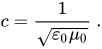
so C is not the speed of electromagnetic waves (in a vacuum) or anything like that, it is simply the ratio in which energy becomes something else.
And if the energy in the universe is constant (as I assumed at the beginning), which for me is the only axiom, then if the waves will move faster than C , the energy conservation law will simply be violated.
Maybe someone already put it this way? (I've never seen, at least not at university, a way of looking at things like that)
Then I thought about it more broadly, it actually states that the universe was created with a fixed amount of energy (and this energy only transforms from one form to another)
And then I thought a little more, in the big bang the universe was formed from energy, part of that energy became matter, according to the famous equation E = mc2
or Electromagnetic waves
so C is not the speed of electromagnetic waves (in a vacuum) or anything like that, it is simply the ratio in which energy becomes something else.
And if the energy in the universe is constant (as I assumed at the beginning), which for me is the only axiom, then if the waves will move faster than C , the energy conservation law will simply be violated.
Maybe someone already put it this way? (I've never seen, at least not at university, a way of looking at things like that)