How Do You Calculate Angles AEC and ADC in Geometry?

  • Thread starter Thread starter chwala
  • Start date Start date
  • Tags Tags
    Adc Angle
chwala
Gold Member
Messages
2,827
Reaction score
415
Homework Statement
See attached
Relevant Equations
Deductive Geometry- Alternate segment theorem
Question;
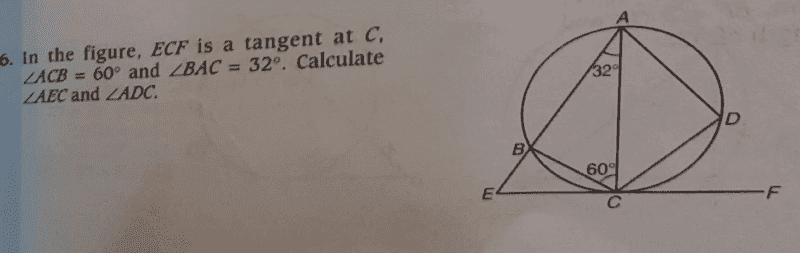
1665293177519.png


Text Solution;

1665293221966.png


My reasoning;
##∠ABC= 180^0 -(32^0+60^0)##
=##88^0##

##∠ABC=∠ACF=88^0## (Alternate segment theorem).

##∠EBC=92^0## i.e angles lying on a straight line and ##∠BCE=180^0 -(88^0+60^0)=32^0## therefore;
##∠BEC=180^0 -(32^0+92^0)=56^0##
##∠ECA=∠ADC=32^0+60^0=92^0## (by Alternate segment theorem).

Cheers...there may be another way of looking at this...
 
  • Like
Likes Lnewqban
Physics news on Phys.org
Regarding ##∠EBC=92^0##:
Doesn't the problem figure contradicts the fact that an angle inscribed across a circle's diameter is always a right angle?
 
Lnewqban said:
Regarding ##∠EBC=92^0##:
Doesn't the problem figure contradicts the fact that an angle inscribed across a circle's diameter is always a right angle?
...but we are not told if ##AC## is the diameter of the circle. We have only been given an indication of the tangent line, that is line ##ECF##.
 
  • Like
Likes Lnewqban
Lnewqban said:
Regarding ##∠EBC=92^0##:
Doesn't the problem figure contradicts the fact that an angle inscribed across a circle's diameter is always a right angle?
AC isn't a diameter, that was never mentioned
 
  • Like
Likes chwala
chwala said:
Homework Statement:: See attached
Relevant Equations:: Deductive Geometry- Alternate segment theorem

Question;

View attachment 315298

Text Solution;

View attachment 315299

My reasoning;
##∠ABC= 180^0 -(32^0+60^0)##
=##88^0##

##∠ABC=∠ACF=88^0## (Alternate segment theorem).

##∠EBC=92^0## i.e angles lying on a straight line and ##∠BCE=180^0 -(88^0+60^0)=32^0## therefore;
##∠BEC=180^0 -(32^0+92^0)=56^0##
##∠ECA=∠ADC=32^0+60^0=92^0## (by Alternate segment theorem).

Cheers...there may be another way of looking at this...
You are correct that angles ##∠ACF=88^\circ## and ##∠EBC=92^\circ## .
However, your reasoning leading to determining angle ##∠BCE## is faulty, because you do not know a value for angle ##∠ACF## either.

An angle you can easily determine is ##∠ADC##. (There's a cyclic quadrilateral involved.)
 
SammyS said:
You are correct that angles ##∠ACF=88^\circ## and ##∠EBC=92^\circ## .
However, your reasoning leading to determining angle ##∠BCE## is faulty, because you do not know a value for angle ##∠ACF## either.

An angle you can easily determine is ##∠ADC##. (There's a cyclic quadrilateral involved.)
@sammy but we know that ##∠ECA=∠ADC## using the alternate segment theorem. Angle ##BCE=32^0.## I do not need ##∠ACF## to determine this.
 
Last edited:
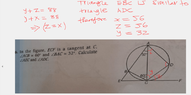
...Just thinking is it possible to determine all the angles in the given diagram? my thinking is as shown on the diagram below;

My reasoning being ##∠EBC## is similar to ##∠ADC## they have a common angle i.e ##92^0##.

##∠CAD=DCF=BEC=56^0##

##∠ACD=88^0 - ∠DCF=32^0##
 

Attachments

  • math diagram.png
    math diagram.png
    40.2 KB · Views: 176
chwala said:
@sammy but we know that ##∠ECA=∠ADC## using the alternate segment theorem. Angle ##BCE=32^0.## I do not need ##∠ACF## to determine this.
Apologies !

I overlooked your reasoning establishing that ##∠ABC=∠ACF## .
 
  • Like
Likes chwala
chwala said:
...Just thinking is it possible to determine all the angles in the given diagram? my thinking is as shown on the diagram below;

My reasoning being ##∠EBC## is similar to ##∠ADC## they have a common angle i.e ##92^0##.

##∠CAD=DCF=BEC=56^0##

##∠ACD=88^0 - ∠DCF=32^0##

math-diagram-png.png
Yes, ##∠CAD=∠DCF## .

But no, you can not determine ##∠ACD## , ##∠CAD## , nor ##∠DCF## .
 

Similar threads

  • · Replies 40 ·
2
Replies
40
Views
5K
  • · Replies 29 ·
Replies
29
Views
7K
  • · Replies 21 ·
Replies
21
Views
4K
Replies
5
Views
3K
  • · Replies 1 ·
Replies
1
Views
3K
