Calculate Capacitance with Dielectrics

Click For Summary
The discussion focuses on calculating the capacitance of a parallel-plate capacitor with a dielectric slab inserted between its plates. The slab's position does not affect the overall capacitance, which can be modeled as a series of three capacitors, each with different dielectric constants. The potential difference remains consistent regardless of the slab's placement, as the charge on the capacitor stays the same while the electric field changes within the dielectric. The explanation includes the concept of using metal foils as new plates to simplify the analysis. Ultimately, the capacitance remains constant irrespective of the slab's location within the capacitor.
screen1998
Messages
3
Reaction score
0
Hi, I need help with this.
A non-conducting slab of thickness t, area A and dielectric constant κe is inserted into the space between the plates of a parallel-plate capacitor with spacing d, charge Q and area A, as shown in Figure 7.7.5(a). The slab is not necessarily halfway between the capacitor plates. What is the capacitance of the system?
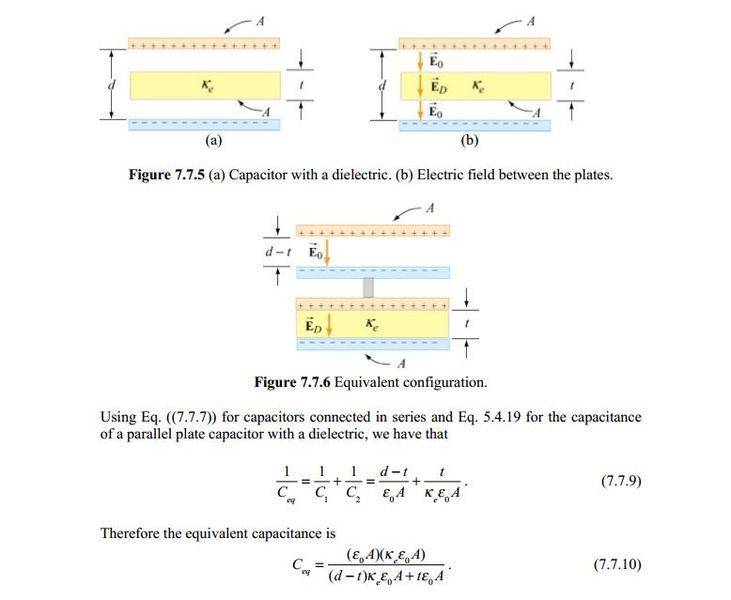
attachment.php?attachmentid=58329&d=1367243066.jpg

What I don't understand here is the transform from Figurre 7.7.5 to Figure 7.7.6.
How we know that Figure 7.7.6 is the equivalent configuration of Figure 7.7.5?
And why the two dielectrics don't create electric plates because they have different dielectric constants? I know dielectric polarisation but in this case there are two dielectrics with different dielectric constants, therefore I wonder if these electric dipoles will cancel out in the region between two plates of the capacitor.
 

Attachments

  • Capacitor.JPG
    Capacitor.JPG
    31.2 KB · Views: 2,950
Last edited:
Physics news on Phys.org
Any help?:smile:
 
Put the slab anywhere - the resultant capacitor is series resultant of three capacitors. Does the result depend to where the slab was placed ?

ehild
 
ehild said:
Put the slab anywhere - the resultant capacitor is series resultant of three capacitors. Does the result depend to where the slab was placed ?

ehild
Hi ehild,
Could you explain why there are two capacitors in series? What are the sencond plate of these capacitors?
 
The potential is the same along a plane parallel with the capacitor plates. You can substitute an equipotential surface by a thin metal foil- nothing changes.
Putting a dielectric slab of thickness t inside the capacitor at distance d1 from the top plate, and imagining thin metal foils on the top and base faces of the dielectric slab,it is equivalent with three capacitors in series: all with area A, thickness and relative dielectric constant d1,1 ; t, ε, (d-d1-t), 1. The metal foils serve as new plates, see figure. Write up the resultant: you will see that d1 cancels. The resultant capacitance is the same for all d1, it can be even zero, which corresponds to the situation that the dielectric slab touches one plate.

A more basic approach is through the definition of capacitance: It is charge over voltage. Inserting the dielectric slab does not change the charge on the capacitor, but changes the electric field inside the dielectric slab. If it was E without the dielectrics, inside the dielectrics it will be E/εr. You get the potential difference between the plates by integrating the electric field along the gap between the plates: it is Ed1+t E/εr+E(d-t-d1)=E(d-t)+tE/εr. The voltage does not depend on the position of the slab, so you can shift it to one plate and then you get two capacitors in series.

ehild
 

Attachments

  • dielslab.JPG
    dielslab.JPG
    5.9 KB · Views: 791
The book claims the answer is that all the magnitudes are the same because "the gravitational force on the penguin is the same". I'm having trouble understanding this. I thought the buoyant force was equal to the weight of the fluid displaced. Weight depends on mass which depends on density. Therefore, due to the differing densities the buoyant force will be different in each case? Is this incorrect?

Similar threads

  • · Replies 6 ·
Replies
6
Views
2K
Replies
4
Views
2K
  • · Replies 4 ·
Replies
4
Views
2K
Replies
5
Views
619
Replies
3
Views
2K
Replies
6
Views
3K
Replies
10
Views
4K
  • · Replies 20 ·
Replies
20
Views
4K
  • · Replies 8 ·
Replies
8
Views
2K
  • · Replies 17 ·
Replies
17
Views
3K