Calculate largest, smallest, average, standard deviation and sum without arrays

  • Thread starter blu3jam
  • Start date
  • Tags Tags
    deviation
4 replies · 6K views · last reply
blu3jam
Messages
7
Reaction score
0
Write a program to find and display the Largest, Smallest, Average, standard deviation and the Sum of all numbers entered from the keyboard.The data entry should end with a Sentinel Value. After finishing ask if the user wants to continue entering new set of numbers or not.
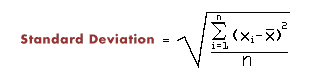
Formula for standard deviation: the square root of the sum over i from 1 to n of (xi minus x-bar) squared, divided by n.
, where X indicates average
My question is can we write this program without using arrays ? Does anybody have a suggestion ?
 
Last edited:
Not really. It will make your life easier to use arrays. It will help if there is a known number of samples, perhaps you can ask the user before you create the array and then once you know the value, create it with that many locations.

Also, it's A TON easier to go through hundreds or even thousands of x values with an array (using either a for or while loop). Imagine wanting to store 4,000 x values. That means you need 4,000 manually defined variables. Manually, as in you type x_1, x_2, x_3, ..., x_3999, x_4000.

Use an array. Use loops. This will make your life easier.
 
no way you should be doing any statistical programming without using arrays/lists/something like that.
 
I figured it out now ,instead of saving inputs separately by using arrays, I can convert deviation formula another form

Derivation of the sum of squared deviations from the mean: sum over i from 1 to N of (x_i - x̄)² equals the sum of x_i² minus N times x̄², written across four aligned lines of equations.

Formula for standard deviation: sigma equals the square root of one over N times the quantity, sum from i=1 to N of x_i squared, minus N times x-bar squared.


Now , it's easy to calculate. Thanks
 
Easy to calculate, but potentially inaccurate. Computers don't have infinite precision. What you did works mathematically but loses accuracy when performed using numbers as typically represented on computers (e.g., doubles or floats in the C language).