Calculate Natural frequency of a vibrator

Click For Summary
SUMMARY

The discussion focuses on calculating the natural frequency of an industrial vibrator using Hooke's law. The calculated natural frequency is approximately 27.3 Hz, derived from an effective spring constant of 360 N/mm and a mass of 12 kg. The participants clarify the conversion of spring constants from kg/mm to N/mm and discuss the implications of mass placement and spring configurations. The analysis emphasizes the importance of accurate calculations to prevent structural damage during the vibrator's operation.

PREREQUISITES
  • Understanding of Hooke's law and its application in mechanical systems
  • Knowledge of natural frequency calculations in mechanical engineering
  • Familiarity with spring constants and their unit conversions
  • Basic principles of dynamics and mass-spring systems
NEXT STEPS
  • Research the derivation of natural frequency formulas for multi-mass systems
  • Learn about the effects of mass distribution on vibrational characteristics
  • Explore advanced spring system configurations and their impact on frequency calculations
  • Study the implications of eccentric masses in mechanical systems
USEFUL FOR

Mechanical engineers, vibration analysts, and anyone involved in the design and analysis of industrial vibrators and similar mechanical systems.

Pivskid
Messages
8
Reaction score
0
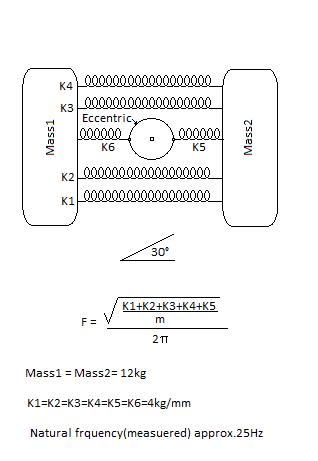
I have a construction of a vibrator (industrial use).
I should be able to calculate the natural frequency, by means of Hooke's law.
Since I have a physical device I already have a "real world" measurement of the Natural frequency.
The problem is: How to calculate it?
I have tried to do some equivalent work, and a calculation that is far of the measured value.
You could say "why calculate when you have the measured value".
The vibrator at hand now, is only a model.
I need to be able to calculate the NF fairly accurate, in order not to demolise the building where the real one is installed :o)
ke96xh.png

Observe that the 2 mass'es are placed in an angle of 30° from horizontal.
That is..mass2 is higher than mass1.
All springs are equal, eventhough the drawing might insinuate otherwise.
 
Last edited:
Physics news on Phys.org
What does the central object do?
Are the masses free to move in 2 (or even 3) dimensions? This would make an analytic approach tricky.

A naive ansatz:
Assume that 4kg/mm really means 40N/mm (kg/m is not a meaningful unit for springs).
Replace the 6 springs by an effective spring of (4+1/2)*40N/mm = 180N/mm. Use symmetry to reduce the problem to 1 mass with an effectice spring of D=360N/mm, attached to a fixed end. This gives ##f=\frac{1}{2\pi} \sqrt{\frac{D}{m}} = 27.6 Hz##.
Working with g=9.81m/s^2 instead of g=10m/s^2 reduced D by 2% and f by 1%, so the result would be ~27.3Hz. Both values are quite close to the measured frequency.
 
The central object, I assume you mean the eccentric, it drives the vibrator.
It is a motor with an eccentric attaached to the shaft.
The 2 masses are moving in one direction (the 30° from horizontal).
I understand how you get the 4kg/mm to 40N/mm, since it is essentially the same.
But then I'm lost.
You replace the 6 springs into 4+½, where does the ½ come from ?
Then you reduces the 2 masses to 1 by symmetry.. how? (mass1+mass2 ?)
And you end up with an equivalent spring twice as high 360N/mm ?
 
4 springs are connecting both masses, they can be added. The two middle springs can be replaced with an effective spring of 20N/mm. If you use 20N of force, you compress both springs by 1/2 mm and therefore the total length reduces by 1mm.

In the same way, a 180N/mm-spring can be replaced by a 360N/mm-spring if I just look at the compression on one side. This is the other direction.
 
ohh you see spring K5 and K6 as being in series.
Well there might be a catch to that, since the eccentric is by the propelling motor is attached to the frame.
I still do not get what you did to the mass m in the equation (=240N ?)

I cannot get your formula to result in 27,6Hz :o(
 
ohh you see spring K5 and K6 as being in series.
Well there might be a catch to that, since the eccentric is by the propelling motor is attached to the frame.
That is no problem, you can consider just one side all the time if that is easier to visualize. There, one spring does not matter at all.

mfb said:
##f=\frac{1}{2\pi} \sqrt{\frac{D}{m}} = 27.6 Hz##
D=360N/mm, m=12kg.
Did you consider the mm <-> m conversion?
 
Yes, I let the 360N/mm -> 360kN/m
I now understand you set the mass to 12kg not 120N, in the equation, as I expected.
Ít surprises me a little. Why in kg and not N ?
 

Similar threads

  • · Replies 2 ·
Replies
2
Views
4K
Replies
1
Views
2K
Replies
6
Views
3K
  • · Replies 3 ·
Replies
3
Views
3K
  • · Replies 2 ·
Replies
2
Views
8K
  • · Replies 1 ·
Replies
1
Views
4K
  • · Replies 5 ·
Replies
5
Views
3K
  • · Replies 8 ·
Replies
8
Views
3K
  • · Replies 12 ·
Replies
12
Views
4K
  • · Replies 1 ·
Replies
1
Views
13K