Calculate Speed of Rock after Falling 5 Seconds in Vacuum

  • Context: High School 
  • Thread starter Thread starter Tregg Smith
  • Start date Start date
  • Tags Tags
    Acceleration Rock
Click For Summary
SUMMARY

The speed of a rock falling in a vacuum after 5 seconds is calculated using the formula v = at, where 'a' is the acceleration due to gravity (9.8 m/s²). This results in a final speed of 49 m/s, equivalent to approximately 110 MPH. For inclined planes, the force required to lift a weight on a 45-degree angle is determined using the formula F = M*g*sin(A), where M is the mass, g is gravitational acceleration, and A is the angle. For a 100 kg mass at 45 degrees, the effective weight is approximately 70 kg.

PREREQUISITES
  • Understanding of basic physics concepts such as gravity and acceleration.
  • Familiarity with trigonometric functions, specifically sine.
  • Knowledge of the formula for force on an inclined plane.
  • Basic mathematical skills for calculations involving units of measurement.
NEXT STEPS
  • Study the principles of gravitational acceleration and its effects on falling objects.
  • Learn about trigonometric functions and their applications in physics.
  • Research the dynamics of inclined planes and the forces involved.
  • Explore real-world applications of these physics concepts in engineering and sports science.
USEFUL FOR

Students of physics, engineers, fitness trainers, and anyone interested in understanding the mechanics of motion and forces in both theoretical and practical contexts.

Tregg Smith
Messages
43
Reaction score
0
I used to know this stuff. How fast will a rock be going after falling 5 seconds in a vacuum?
I'd also like to know the formula in simple terms.

At the gym on the hip sled we call it- you lay back and push up with feet and legs. The rack supporting the weights is at 45 degrees. If you have 500# on it how much force is required to move it? I'd also like the formula for this as well as the answer. I think it's a simple 50% or 250# because it's at 45 degrees but not sure. I just don't like these kids bragging to an old guy that they are pushing 500#!

hip sled here:
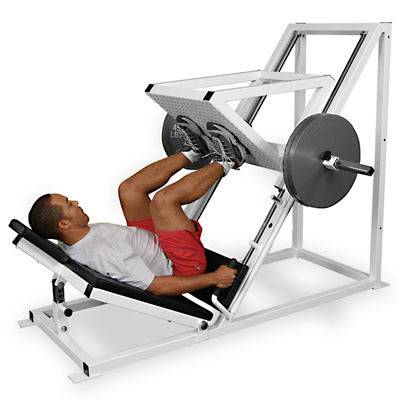
AC038202l.jpg


Thank you! Tregg
 
Physics news on Phys.org
if its 45 degrees. what is sin(45)? its more than 50%. Anyways, the answer is Fgsin(45).
 
If the mass of the "weight" is M, gravitational acceleration is g, and the angle between the inclined plane and the ground is A, then the force necessary to lift the weight is

F = M*g*sin(A)

This corresponds to lifting a mass M' = F/g = M*sin(A)

Example:
M=100kg, g=10m/s^2, A=45 degrees gives M' = 100*sin(45) kg

Now, sin(45) = sqrt(2)/2, which is approx 0.7, so M' = 70 kg in this case.

If the angle A was 30 degrees, it would be half, since sin(30) = 1/2.

Torquil
 
As for your question on the falling rock, I'm going to assume you mean on the surface of Earth, where gravity accelerates the rock at 9.8 m/s^2

thus for 5 seconds we have:

v = at = (9.8 \frac{m}{s^2}) (5 s) = 49 \frac{m}{s} = 110 MPH
 

Similar threads

  • · Replies 3 ·
Replies
3
Views
2K
  • · Replies 2 ·
Replies
2
Views
15K
Replies
5
Views
8K
  • · Replies 1 ·
Replies
1
Views
6K
  • · Replies 11 ·
Replies
11
Views
3K
  • · Replies 1 ·
Replies
1
Views
4K
  • · Replies 1 ·
Replies
1
Views
4K