SUMMARY
This discussion focuses on creating a program to calculate statistical metrics such as the largest, smallest, average, standard deviation, and sum of numbers entered via keyboard input, concluding with a sentinel value. The consensus is that using arrays simplifies the process significantly, especially when handling large datasets, as it avoids the cumbersome task of defining numerous individual variables. While alternative methods exist, they may lead to inaccuracies due to the limitations of floating-point precision in programming languages like C.
PREREQUISITES
- Understanding of basic programming concepts
- Familiarity with statistical calculations, including standard deviation
- Knowledge of loops in programming (for and while loops)
- Experience with data types in C, specifically doubles and floats
NEXT STEPS
- Learn how to implement arrays in C for statistical calculations
- Research the implications of floating-point precision in programming
- Explore alternative data structures for handling dynamic input sizes
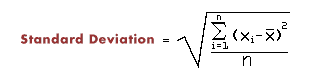
- Study the mathematical derivation of the standard deviation formula
USEFUL FOR
Programmers, data analysts, and students learning statistical programming who need to efficiently handle and analyze numerical input without excessive manual variable management.