Calculate Static Equilibrium: SOH/CAH/TOA?

Click For Summary
SUMMARY

Calculating static equilibrium requires understanding the relationship between angles and their respective components. When using the SOH-CAH-TOA mnemonic, the sine function is applied to the component opposite the angle, while the cosine function is used for the adjacent component. This relationship is contingent upon whether the angle is measured from the x-axis or y-axis. If the angle is relative to the y-axis, the sine function applies to the x-component, necessitating careful attention to the reference axis when resolving forces.

PREREQUISITES
  • Understanding of trigonometric functions: sine, cosine, tangent
  • Familiarity with static equilibrium concepts in physics
  • Ability to resolve vectors into components
  • Knowledge of angle measurement relative to axes
NEXT STEPS
  • Study vector resolution techniques in physics
  • Explore advanced applications of SOH-CAH-TOA in static equilibrium problems
  • Learn about the implications of angles not aligned with standard axes
  • Practice problems involving static equilibrium with varying angle references
USEFUL FOR

Students in physics, engineering professionals, and anyone studying mechanics who needs to master the calculation of static equilibrium and vector components.
Mason98
Messages
27
Reaction score
1
Homework Statement
Sin for Y axis and Cos for X axis?
Relevant Equations
Sin = opp/hyp Cos = Adj / hyp
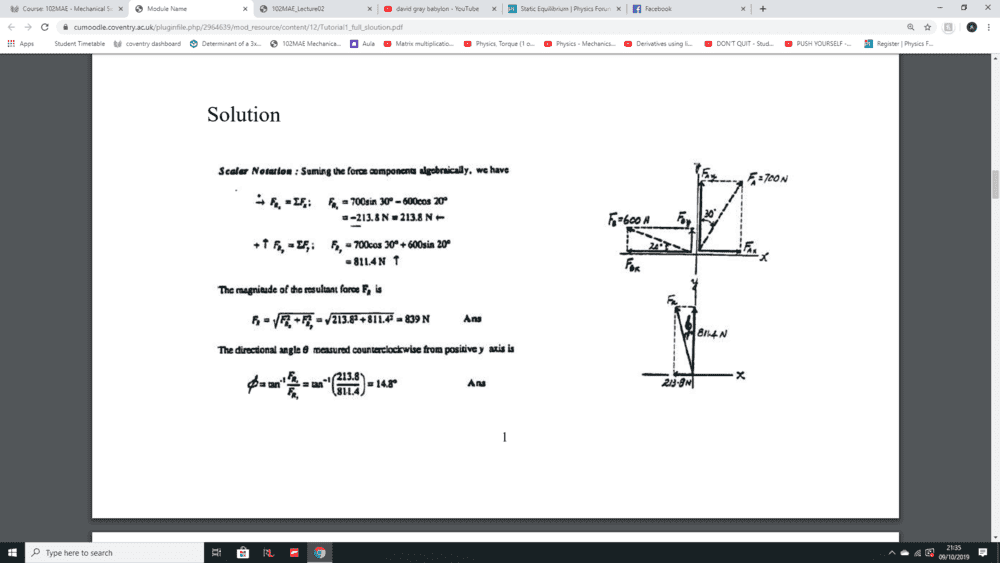
When calculating static equilibrium, i know that you have to split for example, F1 into F1x and F1y. when using soh/cah/toa is it always SIN for the Y axis and always Cos for the X axis? I've been following this method and getting it wrong some times it's really stressing me out, Thanks for any help in advance.
1570653357500.png
 
Last edited:
Physics news on Phys.org
Mason98 said:
when using soh/cah/toa is it always SIN for the Y axis and always Cos for the X axis?
No. It all depends on what angle you are using. If the angle is with respect to the x-axis, then fine: The x-component would use cosine, etc. But if the given angle is with respect to the y-axis, things are reversed.

Remember that sinθ = cos (90° - θ).
 
  • Like
Likes   Reactions: Mason98
so that is how in the picture Fax is sin because the angle given is in respect to the y-axis which would mean to use sin?
 
Mason98 said:
so that is how in the picture Fax is sin because the angle given is in respect to the y-axis which would mean to use sin?
Exactly!
 
  • Like
Likes   Reactions: Mason98
Doc Al said:
Exactly!
Thank you very much! I appreciate your help :)
 
But if you adopt this as a new rule-of-thumb, you'll still be in a pickle when the problem gives you an angle which is relative to neither the x nor y axis.
 

Similar threads

  • · Replies 31 ·
2
Replies
31
Views
4K
  • · Replies 1 ·
Replies
1
Views
2K
  • · Replies 3 ·
Replies
3
Views
2K
  • · Replies 1 ·
Replies
1
Views
2K
Replies
5
Views
1K
Replies
1
Views
6K
  • · Replies 3 ·
Replies
3
Views
2K
  • · Replies 6 ·
Replies
6
Views
2K
Replies
1
Views
1K
Replies
2
Views
3K