Calculate the correlation coefficient in the given problem

Click For Summary
SUMMARY

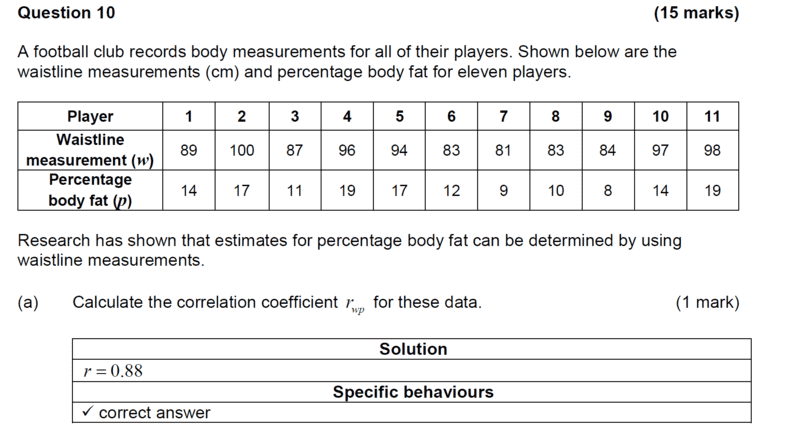
The forum discussion centers on calculating the correlation coefficient and the least-squares regression equation for waistline measurements (X) and percentage body fat (Y) using the given data. The correlation coefficient is calculated as 0.88, indicating a strong positive relationship. The least-squares regression equation derived is y = 0.5x + 31.4. The discussion also addresses the appropriateness of switching X and Y, concluding that while correlation is symmetric, the context of dependent and independent variables must be considered.

PREREQUISITES
  • Understanding of correlation coefficients and their significance
  • Familiarity with least-squares regression analysis
  • Basic knowledge of statistical notation and formulas
  • Ability to perform calculations involving sums and averages
NEXT STEPS
  • Learn about the implications of correlation coefficients in statistical analysis
  • Study the derivation and application of least-squares regression equations
  • Explore the differences between dependent and independent variables in regression analysis
  • Investigate rounding rules in statistical calculations and their impact on results
USEFUL FOR

Statisticians, data analysts, and students studying statistics who are interested in understanding correlation and regression analysis in practical applications.

chwala
Gold Member
Messages
2,828
Reaction score
420
Homework Statement
see attached
Relevant Equations
stats
Unless there is another alternative method, i would appreciate...ms did not indicate working...thought i should share my working though...
1680380454844.png


Let Waistline= ##X## and Percentage body fat =##Y## and we know that ##n=11##

##\sum X=992, \sum XY=13,772## and ## \sum Y=150##

Then it follows that,

Correlation coefficient

= ##\dfrac{(11×13,772)-992×150}{\sqrt {(11×89,950)-992^2)(11×2,202)-150^2)}}=\dfrac{151,492-148,800}{3045.4379}=\dfrac{2,692}{3045.4379}=0.8839=0.88## (to two decimal places).

switching ##x## and ##y## would that be appropriate? considered wrong with correct working? ...just asking. By letting ##X## be the Percentage body fat, that is...

...next i would want to determine the equation of least-squares...

Cheers!
 
Last edited:
Physics news on Phys.org
chwala said:
switching x and y would that be appropriate? considered wrong with correct working?
I don't believe that switching x and y would be appropriate.

"Estimates for percentage of body fat can be determined by ... waistline measurements."

This statement implies that the independent variable X is the set of waistline measurements, and the dependent variable Y is the set of percentages of body fat.
 
  • Like
Likes   Reactions: chwala
yap...i can from my calculations that the equation of least squares would be given by;

##y=β_1x+β_0##

where,

##β_1=\dfrac{13,772-\frac{992×150}{11}}{89,950-\frac{992×992}{11}}=\dfrac{244.73}{489.64}=0.4998=0.5## to one decimal place.

##β_0=13.636-(0.4998×90.18)=13.636-45.07=31.43##

thus,##y=0.4998x+31.43=0.5x+31.4##

I noted that if we input,

##0.5## instead of ##0.4998## in the equation, ##β_0=13.636-(0.5×90.18)=13.636-45.09=31.454##
which rounds to ##-31.5##(to one decimal place) which is not as is indicated on ms below. At what point does one round off? or rather what ##β_1## value should one use?

Mark scheme solution

1680385631930.png
cheers!
 
Last edited:
chwala said:
yap...i can from my calculations that the equation of least squares would be given by;
##y=β_1x+β_0##
where,
##β_1=\dfrac{13,772-\frac{992×150}{11}}{89,950-\frac{992×992}{11}}=\dfrac{244.73}{489.64}=0.4998=0.5## to one decimal place.
##β_0=13.636-(0.4998×90.18)=13.636-45.07=31.43##
Sign error above. That last number should be -31.43.
chwala said:
thus,
##y=0.4998x+31.43=0.5x+31.4##

I noted that if we input,
##0.5## instead of ##0.4998## in the equation, ##β_0=13.636-(0.5×90.18)=13.636-45.09=31.454##
which rounds to ##-31.5##(to one decimal place) which is not as is indicated on ms below. At what point does one round off? or rather what ##β_1## value should one use?
There are different rules about rounding when the digit following the digit to round is 5. One rule says that if the digit to be rounded, round towards an even digit in the digit in front of that one. So, using this rule, -31.45 would round to -31.4 while -31.35 would round to -31.4.
 
  • Informative
Likes   Reactions: chwala
Yes, correlation is,symmetric; Corr(X,Y)=Corr( Y,X).
But , regarding the line of best fit Y^=m^x ×b^
you can't just solve for X to get the best fit between Y and X. For one, if Y depends on X, it doesn't follow that X depends on Y; consider for one Y= height, X = age.
 
  • Like
Likes   Reactions: chwala
WWGD said:
Yes, correlation is,symmetric; Corr(X,Y)=Corr( Y,X).
But , regarding the line of best fit Y^=m^x ×b^
you can't just solve for X to get the best fit between Y and X. For one, if Y depends on X, it doesn't follow that X depends on Y; consider for one Y= height, X = age.
Meaning that we can indeed switch ##x## and ##y## in determining the correlation coefficient. I will check on this ... cheers @WWGD
 
I believe correlation is the inner-product in a space of Random Variables. Will double check on that.
 
  • Like
Likes   Reactions: chwala
Mark44 said:
I don't believe that switching x and y would be appropriate.

"Estimates for percentage of body fat can be determined by ... waistline measurements."

This statement implies that the independent variable X is the set of waistline measurements, and the dependent variable Y is the set of percentages of body fat.
Your statement seems to be correct.
 

Similar threads

  • · Replies 1 ·
Replies
1
Views
1K
  • · Replies 1 ·
Replies
1
Views
2K
  • · Replies 3 ·
Replies
3
Views
2K
Replies
1
Views
2K
Replies
15
Views
3K
  • · Replies 7 ·
Replies
7
Views
3K
Replies
3
Views
4K
  • · Replies 4 ·
Replies
4
Views
2K
  • · Replies 3 ·
Replies
3
Views
4K
  • · Replies 13 ·
Replies
13
Views
10K