Calculating the Limit of (1 + 2^x)^(2^(-x))

  • Thread starter Thread starter LCSphysicist
  • Start date Start date
  • Tags Tags
    Limit
Click For Summary
The limit of (1 + 2^x)^(2^(-x)) as x approaches infinity is discussed, concluding that it approaches one. The confusion arises from equating this limit with Euler's number, leading to a misunderstanding about the behavior of the variable a when it is unbounded. A key point is that if a approaches infinity, the limit does not align with the definition of Euler's number. The discussion emphasizes the necessity for the terms within the parentheses to tend toward one rather than infinity for the limit to hold true. Clarification on these points resolves the initial misconceptions about the limit's behavior.
LCSphysicist
Messages
644
Reaction score
162
Homework Statement
.
Relevant Equations
(1 + a^x)^(a^(-x))
(1 + a^x)^(a^(-x))
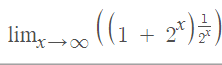
Let's assume a, say, two.

the limit of it, with x tending to infinity,
1589004694518.png
is one, but i was thinking...
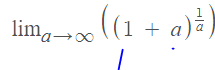
Calling 2^x by a, we have that when x tend to infinity, so do a, So:
1589004584056.png
that is euler number no? Contradictory... where am i wrong?
 

Attachments

  • 1589004449884.png
    1589004449884.png
    1.1 KB · Views: 220
Physics news on Phys.org
LCSphysicist said:
one

That's what I got. The way I usually deal with limits of this form is to express it as a function of the exponential function and the natural logarithm, then use l'Hopital's rule on the power.
 
Eclair_de_XII said:
That's what I got. The way I usually deal with limits of this form is to express it as a function of the exponential function and the natural logarithm, then use l'Hopital's rule on the power.
Yes but, what is wrong in the second case?
 
I think that the problem is that ##a## is not bounded, and it would not be the same as the limit for Euler's number if you tried to put it that way. For example, if you let ##a=\frac{1}{n^2}##, then as ##a\rightarrow \infty##, ##n^2\rightarrow 0^+##. Then your second limit becomes:

##\lim_{a \rightarrow \infty}(1+a)^{\frac{1}{a}}=\lim_{n^2\rightarrow 0}(1+\frac{1}{n^2})^{n^2}\neq e##

Maybe if you switched around the negative signs in the equation in the Relevant Equations part of your post, it would be some function of Euler's number.
 
  • Like
Likes LCSphysicist
Euler's number is ##\lim (1+\frac{1}{n})^n ## as ##n\to \infty## or equivalently ##\lim (1+n)^{\frac{1}{n}}## as ##n\to 0##.

BUT you have ##\lim (1+n)^{\frac{1}{n}}## as ##n\to \infty##
 
  • Like
  • Informative
Likes SammyS, FactChecker and LCSphysicist
Delta2 said:
Euler's number is ##\lim (1+\frac{1}{n})^n ## as ##n\to \infty## or equivalently ##\lim (1+n)^{\frac{1}{n}}## as ##n\to 0##.

BUT you have ##\lim (1+n)^{\frac{1}{n}}## as ##n\to \infty##
Oh so i was wrong to think that the third therm was too equivalent.
I really messed me up, the terms between the parentheses need to tend to one, not to infinity... thank you both guys
 
  • Like
Likes Delta2

Similar threads

  • · Replies 25 ·
Replies
25
Views
1K
  • · Replies 12 ·
Replies
12
Views
2K
Replies
8
Views
4K
  • · Replies 17 ·
Replies
17
Views
1K
Replies
8
Views
2K
  • · Replies 14 ·
Replies
14
Views
4K
Replies
6
Views
3K
  • · Replies 12 ·
Replies
12
Views
3K
  • · Replies 9 ·
Replies
9
Views
2K
  • · Replies 11 ·
Replies
11
Views
3K