Calculate the position for a linear acutator

  • Context: Automotive 
  • Thread starter Thread starter Apple&Orange
  • Start date Start date
  • Tags Tags
    Linear Position
Click For Summary
SUMMARY

The discussion centers on calculating the optimal position for linear actuators in a hinge system designed for a hard lid on a pickup truck, specifically using 600N, 900N, or 1200N actuators to lift a total weight of 95kg. Participants emphasize the importance of calculating shear force and bending moment to determine the best actuator placement, ideally closer to the hinge for practical reasons such as reduced stroke length and wire length. However, this practical placement may lead to increased effort due to opposing rotation if the center of mass (COM) is not properly considered. The consensus is that the actuator should be positioned to minimize opposing forces while ensuring ease of use.

PREREQUISITES
  • Understanding of linear actuator specifications and force ratings
  • Basic principles of shear force and bending moment calculations
  • Knowledge of center of mass (COM) concepts in mechanical design
  • Familiarity with hinge systems and their mechanical advantages
NEXT STEPS
  • Research linear actuator force calculations and selection criteria
  • Study shear force and bending moment diagrams in mechanical engineering
  • Explore center of mass calculations for various shapes and systems
  • Investigate practical design considerations for hinge systems in automotive applications
USEFUL FOR

Mechanical engineers, automotive designers, and anyone involved in the design and implementation of actuator systems for lifting mechanisms.

Apple&Orange
Messages
28
Reaction score
2
Hi everyone!

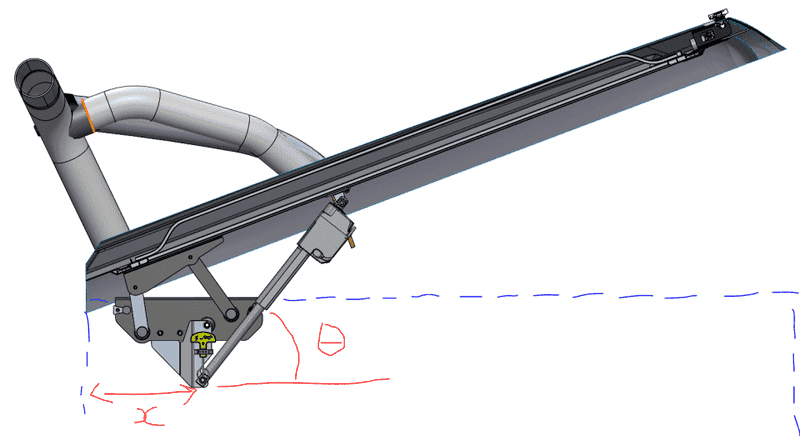
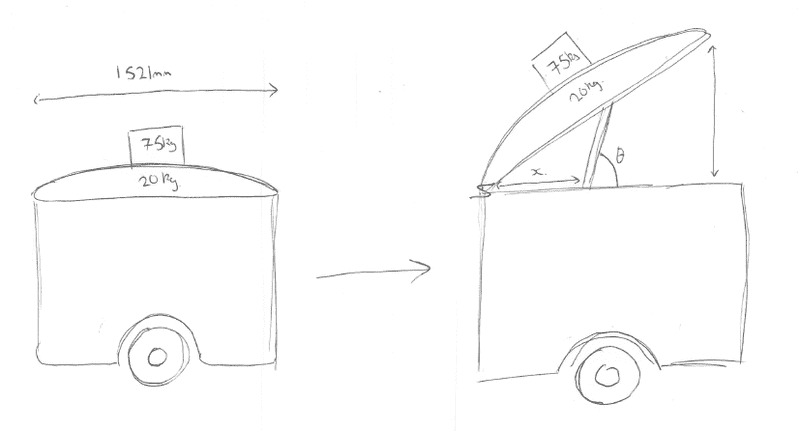
So I'm working on project where I have to design a hinge system for a hard lid that is fitted onto the back of a pickup truck.
In this system, I will be using 2x linear actuator(s) that will need to lift a total weight of roughly 95kg.
At the moment, I've got a selection of 600N, 900N, and 1200N single actuators to choose from.
upload_2017-3-7_8-32-34.png


upload_2017-3-7_8-34-6.png


In the past, I would figure the ideal position for the actuator via experimentation. However, I would like to tackle this problem through a more calculative approach. Having said this though...it has been a while since I've done any form of engineering calculation, and would greatly appreciate it if someone could point me in the right direction.

From memory though, it seems like I would need to calculate the shear force and bending moment?

Cheers
 
Engineering news on Phys.org
Just imagine that you were in the box and wanted to raise the lid . Where would be best place to push and at what angle would you push ?
 
Thanks Nidum

Would the best place to push the lid be at the very end of the lid?
As for the angle, would the ideal place be perpendicular to the surface of the lid?
 
  • Like
Likes   Reactions: Nidum
In a practical design you will probably have to come a good way back towards the hinge when actually locating the actuator but keeping the line of action of the actuator as near as possible perpendicular to lid surface is definitely a good idea .
 
  • Like
Likes   Reactions: Apple&Orange
Hey Nidum
Thanks for the feedback. Just so I am on the right track...

From a practical point of view, it would be best to have the actuator closer to the hinge the as shown below?

upload_2017-3-15_9-21-16.png


I am guessing this is more practical for the following reasons:
  • Less intrusive for people to load things at the back.
  • Less stroke length required for the actuator.
  • Less wire length required to connect the actuator to the car battery.
However, with the ideal position...

upload_2017-3-15_9-28-47.png


A lower force rating actuator can be used, but it turn, it has the opposite effects as having the actuator in the 'practical location'.

Would this be correct?

Additionally, I did a bit of revision regarding the physics behind this, and it seems like it has something to do with the Centre of Mass.
When the COM of the lid is the left hand side of the actuator (i.e. the ideal location), there is no opposing rotation when the person and/or the actuator attempts to lift the lid.
However, when the COM is on the right hand side of the actuator, (i.e. the practical location), there is opposing rotation, which will require more effort to lift the lid.

Is that a correct assumption to make?
 

Similar threads

Replies
6
Views
1K
  • · Replies 20 ·
Replies
20
Views
3K
  • · Replies 22 ·
Replies
22
Views
3K
  • · Replies 9 ·
Replies
9
Views
5K
  • · Replies 5 ·
Replies
5
Views
6K
  • · Replies 5 ·
Replies
5
Views
11K
  • · Replies 16 ·
Replies
16
Views
2K
  • · Replies 3 ·
Replies
3
Views
4K
  • · Replies 1 ·
Replies
1
Views
5K
  • · Replies 9 ·
Replies
9
Views
10K