Calculate the sides of a triangle knowing its area, perimeter and angle A.

Click For Summary
SUMMARY

This discussion focuses on calculating the sides of a triangle given its area, perimeter, and angle A. The specific values provided are an area of 30 m², a perimeter of 30 m, and an angle A of 30º. The calculations involve using the law of cosines and geometric principles to derive the side lengths, resulting in two possible solutions for side c: approximately 8.75 and 13.71. The online tool TrianCal is recommended for visualizing the triangle based on these parameters.

PREREQUISITES
  • Understanding of triangle properties and the law of cosines
  • Familiarity with geometric constructions and triangle similarity
  • Basic knowledge of numerical methods for solving equations
  • Experience with online triangle calculators like TrianCal
NEXT STEPS
  • Learn how to apply the law of cosines in triangle calculations
  • Explore geometric constructions for triangles given specific parameters
  • Study numerical methods for solving polynomial equations
  • Investigate advanced triangle properties and their applications in geometry
USEFUL FOR

Mathematicians, geometry enthusiasts, students studying trigonometry, and anyone involved in solving triangle-related problems.

loquetedigo
Messages
12
Reaction score
0
Calculate the sides of a triangle knowing its area, perimeter and angle A.

Area = 30 m2
Perimeter = 30m
Angle A = 30º

NOTE = You can use the online triangle calculator TrianCal to see and draw the results.
NOTE = Do not use the values ??of responses.

A) 6.09, 9.36 and 14.55
B) 7.40, 8.63 and 13.97
C) 7.54, 8.75 and 13.71
D) Imposible
 
Mathematics news on Phys.org
Hello and welcome to MHB, loquetedigo! :)

We ask that our users show their progress (work thus far or thoughts on how to begin) when posting questions. This way our helpers can see where you are stuck or may be going astray and will be able to post the best help possible without potentially making a suggestion which you have already tried, which would waste your time and that of the helper.

Can you post what you have done so far (in all of the questions you posted)?
 
You have posted 3 problems of the same type; namely give 3 elements of a triangle, construct the triangle. Here's a link that shows geometric constructions for many of the possibilities of the 3 elements -- The many ways to construct a triangle and additional triangle facts

The program that you referenced seems to be a very nice program to solve the problem for "a few" of the many possibilities for the 3 elements. I'm going to try and contact the author to see if he might give some indication as to how the program is written.

I think the best solution is geometric in nature. For example, (one of your posts), given $h_a,\,h_b,\,h_c$, it is clear that $h_aa=h_bb=h_cc=2S$ and so the sought triangle $T$ is similar to the triangle $T_1$ with sides $1/h_a,\,1/h_b,\,1/h_c$. The latter is easy to construct and then a similarity transformation produces T. Easily, the area $S$ of $T$ satisfies $$S={1\over 4S_1}$$

For the problem at hand you're given $S$, $p$ and $A$. So in standard notation, let $x=c$. Since $S=1/2bc\sin(A)$, in terms of $x$, $b=2S/(x\sin(A)$. By the law of cosines you can get a in terms of x. So
$$x+2S/(x\sin(A)+\sqrt{x^2+4S^2/(x^2\sin^2(A))-4S/\sin(A)\cos(A)}-p=0$$

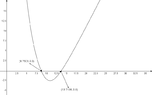
So now "all you have to do" is substitute for the given values and solve for x. You could try and simplify the equation, but you'll probably be forced to solve numerically anyway. So I just solved the above with the given values and obtained 2 solutions for $x=c$, namely $x=8.7503$ and $x=13.7138$. Then from here, $a$ and $b$ are easily obtained. Here's the graph of the function above:

View attachment 5079

The graph indicates exactly 2 solutions, and I'm pretty confident in this case that there are exactly 2 such triangles. However, this graphical method in general seems to be a little suspect. Again, the best solution is a geometric solution. For your problem about two heights and the perimeter, I could not find a geometric solution. However, a graphical solution similar to the above is fairly easy. and I leave it to you.
 

Attachments

  • johng007.png
    johng007.png
    5.6 KB · Views: 143
Last edited by a moderator:
many thanks!
 
Let the side opposite $A$ be $a$, the side opposite $B$ be $b$ and the side opposite $C$ be $c$ with $c=\overline{AB}$. As angle $A$ is $30^\circ$, the altitude from $C$ to $c$ is $\dfrac{b}{2}$ so, using the value of $30$ for the area, $\dfrac{bc}{4}=30\implies b=\dfrac{120}{c}$. From the law of cosines we have $a=\sqrt{b^2+c^2-\sqrt3bc}$. Substituting all of this into the formula for perimeter we have

$\sqrt{\left(\dfrac{120}{c}\right)^2+c^2-120\sqrt3}+\dfrac{120}{c}+c=30$.

Rearranging, squaring and simplifying gives

$c^2-(19+2\sqrt3)c+120=0\implies c=\dfrac{19+2\sqrt3\pm\sqrt{76\sqrt3-107}}{2}$.
 
The altitude from $C$ to $c$ is not $\dfrac{b}{2}$ for all triangles.
 
But there exists an altitude $\dfrac s2$ for some side $s$.
 
The altitude from $C$ to $c$ is not $\dfrac{b}{2}$
 

Similar threads

Replies
1
Views
2K
  • · Replies 2 ·
Replies
2
Views
3K
Replies
2
Views
1K
  • · Replies 2 ·
Replies
2
Views
1K
Replies
2
Views
2K
Replies
1
Views
2K
Replies
1
Views
2K
  • · Replies 3 ·
Replies
3
Views
2K
  • · Replies 6 ·
Replies
6
Views
4K
  • · Replies 9 ·
Replies
9
Views
4K