MHB Calculate the volume of the set M

  • Thread starter Thread starter mathmari
  • Start date Start date
  • Tags Tags
    Set Volume
Click For Summary
The set M is defined by the inequality \(x^2 + y^2 - z^2 \leq 1\) with constraints \(0 \leq z \leq 3\). The discussion involves calculating the volume of M using cylindrical coordinates, where the boundaries are established as \(0 \leq r \leq \sqrt{1 + z^2}\), \(0 \leq z \leq 3\), and \(0 \leq \theta \leq 2\pi\). The volume element in cylindrical coordinates is \(r \, d\theta \, dr \, dz\), and the integral setup is confirmed as \(\int_0^3 \int_0^{\sqrt{1+z^2}} \int_0^{2\pi} r \, d\theta \, dr \, dz\). There are also discussions about using software like Geogebra for visualizing the set, with notes on how to input the equations correctly.
mathmari
Gold Member
MHB
Messages
4,984
Reaction score
7
Hey! :giggle:

We have the set $M=\{(x,y,z)\in \mathbb{R}^3 : x^2+y^2-z^2\leq 1, \ 0 \leq z\leq 3\}$. Draw $M$ and calculate the volume of $M$. I have done the following :

\begin{equation*}\int_M\, dV=\int\int\int\, dx\, dy\, dy\end{equation*} Which are the boundaries of the integrals? Do we have to use spherical coordinates?

Or do we set $x=r\cos\theta$ and $y=r\sin\theta$ and $z$ remains $z$ with $0\leq z\leq 3$ ?
We have that $x^2+y^2-z^2\leq \Rightarrow r^2-z^2\leq 1 \Rightarrow r^2\leq 1+z^2 \Rightarrow -\sqrt{1+z^2}\leq r\leq \sqrt{1+z^2}$ and since $r$ is the radius and so it must be positive we get $0 \leq r\leq \sqrt{1+z^2}$, right? But what about $\theta$ ?

Or is there an other way to calculate that?

:unsure:
 
Physics news on Phys.org
Hey mathmari!

It's called cilindrical coordinates.
$\theta$ goes all the way around and is between 0 and $2\pi$. 🤔
 
Klaas van Aarsen said:
It's called cilindrical coordinates.
$\theta$ goes all the way around and is between 0 and $2\pi$. 🤔

So the boundaries are $0 \leq r\leq \sqrt{1+z^2}$, $0\leq z\leq 3$ and $0\leq \theta\leq 2\pi$, right?

So do we have so far the following?
\begin{align*}\int_M\, dV=\int_0^3\int_0^{\sqrt{1+z^2}}\int_0^{2\pi}\, d\theta \, dr\, dz=\int_0^3\int_0^{\sqrt{1+z^2}}\left [\theta\right ]_0^{2\pi} \, dr\, dz=\int_0^3\int_0^{\sqrt{1+z^2}}2\pi \, dr\, dz=\int_0^32\pi \left [r\right ]_0^{\sqrt{1+z^2}}\, dz=\int_0^32\pi\sqrt{1+z^2} \, dz\end{align*}

:unsure:

How do we know that $\theta$ goes all the way around? Is it because we don't have any restriction? :unsure:
 
Last edited by a moderator:
mathmari said:
So the boundaries are $0 \leq r\leq \sqrt{1+z^2}$, $0\leq z\leq 3$ and $0\leq \theta\leq 2\pi$, right?

So do we have so far the following?
It should be
\begin{align*}\int_M\, dV=\int_0^3\int_0^{\sqrt{1+z^2}}\int_0^{2\pi}\, r\, d\theta \, dr\, dz\end{align*}
An infinitesimal volume element in cylindrical coordinates is $r\, d\theta \, dr\, dz$.
Or put otherwise, the absolute value of the Jacobian determinant is $r$. 🧐

mathmari said:
How do we know that $\theta$ goes all the way around? Is it because we don't have any restriction?
Indeed.
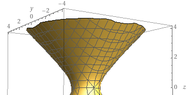
We should be able to see it in a drawing. 🤔
 
Klaas van Aarsen said:
We should be able to see it in a drawing. 🤔

With which programm can I draw that? :unsure:

I tried with Geogebra, but it doesn't work, maybe I write the input in a wrong way.

1630741334781.png


:unsure:
 
Last edited by a moderator:
mathmari said:
With which programm can I draw that? :unsure:

I tried with Geogebra, but it doesn't work, maybe I write the input in a wrong way.

Wolfram gives me:
1630758717250.png
In Geogebra 3D, I could make:

1630758517380.png


I used Tools / Intersect to intersect the hyperboloid and the planes.
 

Attachments

  • 1630758108155.png
    1630758108155.png
    5.7 KB · Views: 176
Klaas van Aarsen said:
Wolfram gives me:
View attachment 11317In Geogebra 3D, I could make:

View attachment 11318

I used Tools / Intersect to intersect the hyperboloid and the planes.

Ah to plot that do we use $x^2+y^2-z^2=1$ instead of $x^2+y^2-z^2\leq 1$ ? :unsure:
 
mathmari said:
Ah to plot that do we use $x^2+y^2-z^2=1$ instead of $x^2+y^2-z^2\leq 1$ ?
I guess so. Geogebra doesn't seem to like the $\le$. :unsure:
 

Similar threads

  • · Replies 18 ·
Replies
18
Views
3K
  • · Replies 4 ·
Replies
4
Views
3K
  • · Replies 16 ·
Replies
16
Views
2K
  • · Replies 2 ·
Replies
2
Views
2K
  • · Replies 0 ·
Replies
0
Views
2K
  • · Replies 4 ·
Replies
4
Views
1K
  • · Replies 2 ·
Replies
2
Views
2K
  • · Replies 2 ·
Replies
2
Views
2K
Replies
4
Views
2K
  • · Replies 3 ·
Replies
3
Views
2K