Calculating an n X n determinant

Join the discussion
Ask a follow-up here, or get your own question answered by working scientists, mathematicians and engineers — people, not an autocomplete.
Real named experts · corrections over time · the nuance an AI answer skips
5 replies · 1K views
TGV320
Messages
40
Reaction score
27
Homework Statement
Help in order to solve a determinant
Relevant Equations
Determinants
Hello,

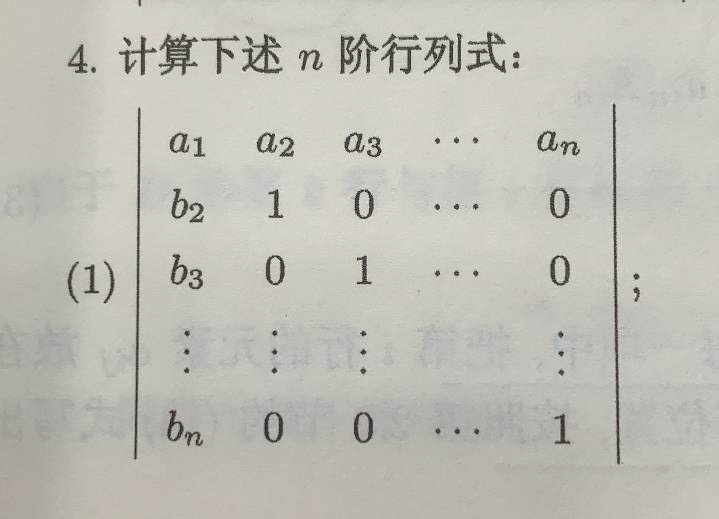
I need some advice because I just can't figure out how to solve the problem. I could try to make the determinant triangular by adding all the b together, but that doen't seem a good way of solving the problem. Is there any direction I should be thinking of?
1699948294438.jpg
Thanks
 
Physics news on Phys.org
TGV320 said:
Homework Statement: Help in order to solve a determinant
Relevant Equations: Determinants

Hello,

I need some advice because I just can't figure out how to solve the problem. I could try to make the determinant triangular by adding all the b together, but that doen't seem a good way of solving the problem. Is there any direction I should be thinking of?

View attachment 335323Thanks
Hint: Follow PeroK's advice and find the determinant by expanding along the bottom row.

-Dan
 
Reply
  • Like
Likes   Reactions: TGV320, e_jane and PeroK
By considering the Leibniz formula, one can figure out that only some terms survive, where the permutations do not contain zeroes.
 
Reply
  • Like
Likes   Reactions: TGV320 and topsquark
Multiply the ##i^{th}## row by ##-a_i## and add it to the first. You just need to see what the top left element will be.
 
Reply
  • Like
Likes   Reactions: TGV320 and topsquark
Hi,
Thanks for the advice.
I have figured it out,though I never thought about getting the answer by experimenting on it, always thought it to n. That way of doing it with n=2 then 3 is quite illuminating.

1700045361111.jpg