Utilizing Cayley-Hamilton's Theorem to Solve N x N Determinant Problem

  • Thread starter Thread starter kockabogyo
  • Start date Start date
  • Tags Tags
    Determinant
Click For Summary

Homework Help Overview

The discussion revolves around proving inequalities involving determinants of matrix expressions, specifically using Cayley-Hamilton's theorem. The matrices A and B are elements of the space of n x n real matrices.

Discussion Character

  • Exploratory, Assumption checking, Mathematical reasoning

Approaches and Questions Raised

  • Participants explore the expression A^2 + A + E and its determinant, suggesting different approaches to manipulate the terms. There is a focus on separating cases based on the determinant of A being zero or non-zero. Some participants express uncertainty about the linear term in their manipulations.

Discussion Status

Participants are actively discussing various approaches to the problem, with some offering alternative terms to square in their attempts. There is a recognition of the need to clarify assumptions and explore different cases, but no consensus has been reached on a specific method or solution.

Contextual Notes

Participants are considering the implications of the determinant being zero or non-zero, which may affect their strategies for proving the inequalities. There is also a reference to the Cayley-Hamilton theorem as a potential tool in their reasoning.

kockabogyo
Messages
3
Reaction score
1
1. Given [itex]A,B\in Mat _n(\mathbb{R})[/itex]

2. Show that:
a) [itex]\det (A^2 + A + E)\geq 0[/itex]
b) [itex]\det (E+A+B+A^2+B^2)\geq 0[/itex] ,
where [itex]E[/itex] is the unit matrix.
3. My attempt at a solution
[itex]A^2 + A + E[/itex]=[itex](A + E)^2 -2A[/itex]


https://drive.google.com/file/d/0B8zKPTh1siSsOHNWQnBfaXR3QXM/view?usp=sharing
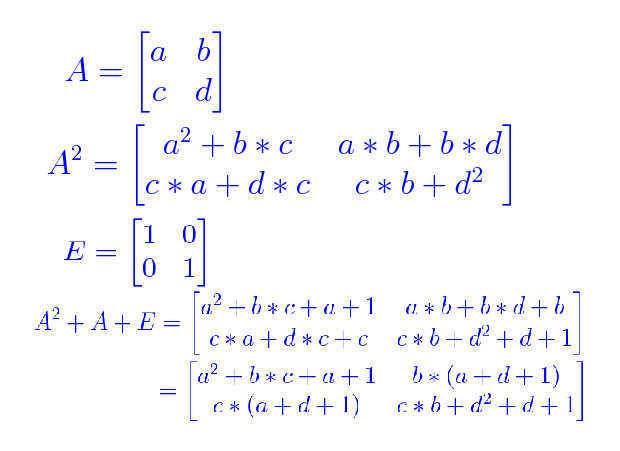
Snapshot.jpg

pleas give me tips to solve
 
Last edited by a moderator:
  • Like
Likes   Reactions: nuuskur
Physics news on Phys.org
kockabogyo said:
[itex]A^2 + A + E[/itex]=[itex](A + E)^2 -2A[/itex]
Something went wrong with the linear term, and I would choose a different term to square.

You can consider the cases ##det(A)=0## and ##det(A) \neq 0## separately, that gives more freedom to manipulate A in one case.
 
mfb said:
Something went wrong with the linear term, and I would choose a different term to square.

You can consider the cases ##det(A)=0## and ##det(A) \neq 0## separately, that gives more freedom to manipulate A in one case.

Thanks, yes, sorry not - 2A only -A , but than?
 
I would choose a different term to square. A term that doesn't leave an A outside.
 
  • Like
Likes   Reactions: kockabogyo
mfb said:
I would choose a different term to square. A term that doesn't leave an A outside.

O Yeah!.. I think I found it.. Cayley Hamilton's context A2 - Tr(A)*A+det(A)*E = O
 

Similar threads

  • · Replies 1 ·
Replies
1
Views
2K
  • · Replies 2 ·
Replies
2
Views
2K
  • · Replies 10 ·
Replies
10
Views
3K
  • · Replies 6 ·
Replies
6
Views
3K
  • · Replies 6 ·
Replies
6
Views
3K
  • · Replies 3 ·
Replies
3
Views
1K
  • · Replies 5 ·
Replies
5
Views
7K
  • · Replies 1 ·
Replies
1
Views
7K
  • · Replies 1 ·
Replies
1
Views
4K
  • · Replies 67 ·
3
Replies
67
Views
12K