Calculating Apparent Semimajor Axis: A Unit Conversion Challenge

  • Thread starter Thread starter arcTomato
  • Start date Start date
  • Tags Tags
    Astrophisics Axis
Click For Summary
The discussion centers on the challenges of converting units related to the parallax method for determining distances in astronomy, specifically regarding arcseconds and parsecs. Participants clarify that an arcsecond is one sixtieth of one sixtieth of a degree and discuss the calculation process for deriving distances, particularly in astronomical units (AU). A user initially struggles with their calculations but eventually realizes their mistake in unit conversion after receiving guidance. The conversation emphasizes the importance of showing detailed calculation attempts for effective assistance. Ultimately, the user successfully arrives at the correct answer by converting units appropriately.
arcTomato
Messages
104
Reaction score
27
Homework Statement
Lead linear size of the semi-major axis by using precision parallax
Relevant Equations
precision parallax
Hello

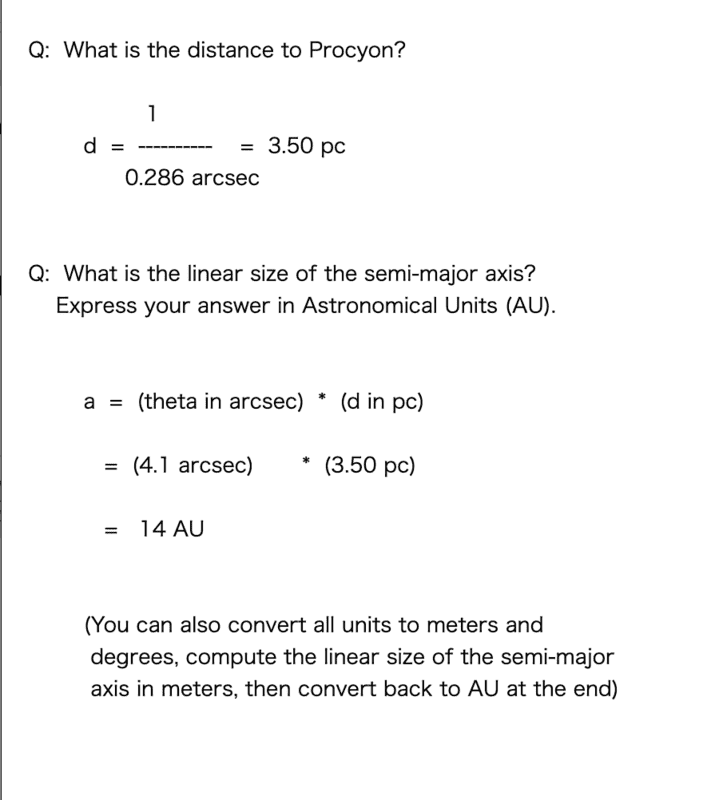
I think this image's calculation is wrong.
I cannot convert units(What is arcsec??How convert to pc??)

How do you think ??I would like to see your calculation process.

I'm so grad if you show.
243799
 
Physics news on Phys.org
What do you know about the parallax method of distance determination?

An arcsec (arcsecond) is one sixtieth of one sixtieth of one degree. That is:
$$arcsec = \frac{1°}{60 \times 60} = \frac{1°}{3600}$$
 
  • Like
Likes arcTomato
gneill said:
What do you know about the parallax method of distance determination?

An arcsec (arcsecond) is one sixtieth of one sixtieth of one degree. That is:
$$arcsec = \frac{1°}{60 \times 60} = \frac{1°}{3600}$$

Thank you !
I think I know,But I cannot lead 14AU again.( I lead 10455AU😭)
Could you show me a process?
 
arcTomato said:
Thank you !
I think I know,But I cannot lead 14AU again.( I lead 10455AU😭)
Could you show me a process?
Helpers can only give hints and suggestions, we cannot do the work for you. If you show your calculation attempts in detail then we can point out where you might have gone wrong.

I suspect that there was more to the question that you haven't shown, since there's no apparent place that the 4.1 arcsec in question B came from. I imagine that the original problem statement gave the parallax reading for Procyon and the apparent angular measure of some body orbiting it.

The calculation shown in your image looks simple enough: ##4.1 \times 3.50 = 14.3 \text{(in AU)}##
 
  • Like
Likes arcTomato
arcTomato said:
I think this image's calculation is wrong.
To me, both calculations in the picture looks correct. Although, there is no complete explanation provided, where the parallax in the second questions comes from, it apparently points to the fact that Procyon is binary star system and it refers to the semi-major axis of this binary (Although wiki mentions value ##4.3''## instead, but this is not important - use the value you are given).

If you are not sure why the sheer multiplication of the values in ##arcsec## and ##pc## works, you can convert the values to ##rad## and ##AU## respectively, before the multiplication.
 
  • Like
Likes arcTomato
gneill said:
Helpers can only give hints and suggestions, we cannot do the work for you. If you show your calculation attempts in detail then we can point out where you might have gone wrong.

I suspect that there was more to the question that you haven't shown, since there's no apparent place that the 4.1 arcsec in question B came from. I imagine that the original problem statement gave the parallax reading for Procyon and the apparent angular measure of some body orbiting it.

The calculation shown in your image looks simple enough: ##4.1 \times 3.50 = 14.3 \text{(in AU)}##

Wow,this is so simple!
Finally I lead 14AU.
I realize my mistake about convertion.

I'm sorry for my bad English, and I appreciate for your help!
 
Whan I convert all units to ##rad## and ##AU##, I can lead right answer! thank you!

But,,,,
lomidrevo said:
If you are not sure why the sheer multiplication of the values in ##arcsec## and ##pc## works,

Yes, exactly!
My pic shows that we should use ##degree## and ##maters##?? It also works??
 
  • Like
Likes lomidrevo
arcTomato said:
Yes, exactly!
My pic shows that we should use degreedegreedegree and matersmatersmaters?? It also works??
Yes, because of the way that parsecs are defined in terms of radius of the Earth's orbit (1 AU by definition : look up the definition).
 
gneill said:
Yes, because of the way that parsecs are defined in terms of radius of the Earth's orbit (1 AU by definition : look up the definition).
I got it.
I have lead right answer again (in degrees) !
Thanks for your kindness!
 
  • Like
Likes lomidrevo
  • #10
Happy to help!
 
  • Like
Likes arcTomato

Similar threads

  • · Replies 3 ·
Replies
3
Views
979
Replies
15
Views
7K
  • · Replies 5 ·
Replies
5
Views
3K
Replies
4
Views
2K
  • · Replies 2 ·
Replies
2
Views
2K
  • · Replies 5 ·
Replies
5
Views
2K
Replies
1
Views
1K
Replies
2
Views
2K
Replies
1
Views
3K
  • · Replies 9 ·
Replies
9
Views
2K