Calculating Deceleration Using Calculus

3 replies · 3K views · last reply
shableep
Messages
2
Reaction score
0
A friend of mine lead me to this math example when I asked him what math would be involved in finding the deceleration necessary to stop an already accelerated object over a certain distance. For example, a car going 50mph that must stop in 40ft.

This was the example...
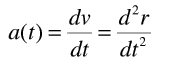
Equation a(t) = dv/dt = d²r/dt², acceleration defined as the first derivative of velocity and the second derivative of position with respect to time.


...and I have no idea where to start. Could anyone help me interpret this? And... sorry about bugging you guys with my general lack of physics understanding.
 
Do you know calculus? If you want to stop with a constant deceleration a start with

[itex]x''(t) = -a[/itex] and integrate twice to get position as a function of a and t. Set the initial velocity to 50mph (in feet per second2), initial position x = 0 and require the velocity is 0 when x = 40. Solve for a.
 
Thanks, LCKurtz. And no, I don't know calculus =( And while I'm sure this is probably infinitely useful, I unfortunately don't know what it is to integrate twice. It's looking like I might be in over my head and I should look into some good calculus books.

Thanks again for the help.
 
Well, yes you will need calculus to solve that kind of problem, although some non-calculus physics books may give you the formulas without deriving them. You can do constant velocity problems with algebra using d = rt, but variable speed requires calculus. Early editions of calculus books are available cheap. You don't need the latest ones.