Calculating Forces in a Leg: Gait Analysis and Joint Reaction Force

  • Thread starter Thread starter By55
  • Start date Start date
Click For Summary
SUMMARY

This discussion focuses on calculating forces in the context of gait analysis, specifically the Achilles tendon force and joint reaction force based on given ground reaction force (GRF) components. The vertical GRF is 67 N, and the horizontal GRF is 15 N, with additional parameters including distances and angles related to the ankle joint and tibia. The calculated values for the Achilles tendon force (Ft) are approximately 776 N, while the joint reaction forces in the x and z directions (Rx and Rz) are approximately 67 N and 1.4 kN, respectively. The discussion emphasizes the importance of using correct equations and methods for solving balance equations in biomechanics.

PREREQUISITES
  • Understanding of biomechanics principles, particularly joint reaction forces
  • Familiarity with ground reaction force (GRF) components
  • Knowledge of trigonometric functions for force resolution
  • Ability to formulate and solve equilibrium equations
NEXT STEPS
  • Study the application of Newton's laws in biomechanics
  • Learn how to derive and solve equilibrium equations in 2D systems
  • Explore the use of LaTeX for formatting equations in academic discussions
  • Investigate advanced gait analysis techniques and tools
USEFUL FOR

This discussion is beneficial for biomechanics students, physical therapists, and researchers involved in gait analysis and joint force calculations, as well as anyone interested in the mechanical aspects of human movement.

By55
Messages
4
Reaction score
3
Homework Statement
Already posted
Relevant Equations
Basic eq that states that for a stationary object the sum of forces is 0 and for a statinary object also the sum of moments is 0.
TL;DR Summary: I had this question in my voluntary homework, but I cant seem to get it done the right way. I have tried to make the balance equations for the x and z axis as well as one for the moment.

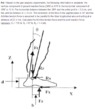
Full question here, also as a PNG below
Based on the gait analysis experiments, the following information is available: the vertical component of ground reaction force (GRF) is 67 N, the horizontal component of GRF is 15 N. The horizontal distance between the GRF and the ankle joint b = 3.2 cm, and the vertical distance d = 2.6 cm. The inclination of the tibia in the sagittal plane is 10° and the Achilles tendon force is assumed to be parallel to the tibial longitudinal axis and acting at a distance of 25.4 mm. Calculate the Achilles tendon force and the joint reaction force. (answers: Ft ≈ 776 N, Rx ≈ 67 N, Rz ≈ 1.4 kN).

Typo in the picture, vertical GRF is 67N)
My answer so far in the pdf, ask if (when) there is something you cant understand
 

Attachments
  • Problem4.1.PNG
    Problem4.1.PNG
    41 KB · Views: 150
  • Problem4.pdf
    Problem4.pdf
    152 KB · Views: 128
Last edited:
Physics news on Phys.org
Welcome to PF. Can you please attach the problem and diagram instead of linking off-site? That would help a lot. Thanks.
 
berkeman said:
Welcome to PF. Can you please attach the problem and diagram instead of linking off-site? That would help a lot. Thanks.
Oh, yes of course. My bad for missing the button to add attachments
 
  • Like
Likes   Reactions: berkeman
By55 said:
I have tried to make the balance equations for the x and z axis as well as one for the moment.
Please also post your attempt, per forum rules.
 
  • Like
Likes   Reactions: By55
Sorry for al this hassle. Posting this here since it doesn't let me edit the OG post anymore. But here is my train of thought so far:

Firstly lets define the point of GRF as B and the joint as A. Now ##B_z = 76N,~B_x = 15N##. Also we can get the x and z components from the Achilles tendon force ##F_t##.
$$F_x = sin(10)*F_t, ~F_z = cos(10)*F_t$$.
Now the x-axis balance is ##-B_x-R_x+sin(10)*F_t=0##
And for z-axis ##B_z-R_z+cos(10)*F_t=0##
And the moment balance $$0.032m*B_z-0.026*B_x-0.025m*F_x+0.0044m*F_z=0$$, where the lengts of B_z and B_x are from the assignment and for F_x and F_z they are calculated usind sin- and cos-functions. When solving these three equations, I get these answers that aren't even close to the correct ones.
Also I tried to calculate the F_t from the moment equation, since it is the only variable there, but get something like ##2.18N*10^5##
 
Last edited:
By55 said:
Sorry, it's there now
PDF is not a great choice. On my iPad I would have to download it.
Forum rules say you should type in your work, preferably using LaTeX.
Upload images for diagrams, of course, but images for equations are a pain, even if legible, because those responding cannot copy/paste. If you must upload images of your working, ensure they are clearly legible and number the equations.
 
  • Like
Likes   Reactions: berkeman
@By55 -- There is a "LaTeX Guide" link below the Edit window. I will send you some additional LaTeX tips now via Private Message (PM).
 
Really appreciate your patience, I have a ton going at the moment and now realise that this was maybe not the best time to ask help for this problem, but here we are. Thank you for the PM!
 
  • Like
Likes   Reactions: berkeman

Similar threads

  • · Replies 3 ·
Replies
3
Views
3K
  • · Replies 7 ·
Replies
7
Views
9K
Replies
3
Views
2K
Replies
1
Views
6K
  • · Replies 17 ·
Replies
17
Views
2K
  • · Replies 4 ·
Replies
4
Views
5K
  • · Replies 1 ·
Replies
1
Views
2K
  • · Replies 1 ·
Replies
1
Views
6K
  • · Replies 8 ·
Replies
8
Views
3K
Replies
10
Views
9K