Calculating how many revolutions it takes to reach the final speed

Click For Summary
SUMMARY

The discussion focuses on calculating the number of revolutions a merry-go-round makes to reach a final angular speed of 11 rpm, given specific parameters including a constant force of 98 N applied at a 15° angle, a mass of 850 kg, and a radius of 2.6 m. Participants emphasize the need to apply Newton's Laws and the equations for constant angular acceleration, analogous to linear acceleration. The key steps outlined include calculating the total moment of inertia, applied torque, angular acceleration, and the angular distance covered before converting this to revolutions.

PREREQUISITES
  • Understanding of Newton's Laws of Motion
  • Familiarity with angular kinematics and dynamics
  • Knowledge of moment of inertia calculations
  • Ability to convert between angular velocity units (rpm to rad/sec)
NEXT STEPS
  • Calculate the total moment of inertia for the system
  • Determine the applied torque from the given force and angle
  • Compute the angular acceleration using the torque and moment of inertia
  • Use angular kinematic equations to find the angular distance and convert it to revolutions
USEFUL FOR

Students studying physics, particularly those focusing on rotational dynamics, as well as educators looking for practical examples of applying Newton's Laws and angular motion concepts.

haven
Messages
7
Reaction score
0
Homework Statement
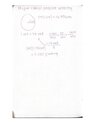
I don't understand what I am doing wrong when solving this problem. The radius of the circle is 2.6 meters which means the circumference is 2pi*2.6. If the final angular velocity is 11 rpm how do I find how many revolutions it took?
Relevant Equations
1 rev = 2pi
11 rpm equals 1.15 rad/ sec not sure how this helps contribute to the question but I solved for it just in case
 
Physics news on Phys.org
What's the question ?
 
  • Like
Likes   Reactions: berkeman
Dylan exerts a constant force of 98 N on a merry-go-round 15° from the tangential direction and is able to accelerate the ride and his friends from rest to a final angular speed of 11 rpm. The merry-go-round has a mass of 850 kg, a radius of 2.6 m, and a radius of gyration about the center of 1.9 m. Corbin (67 kg) and Andrew (63 kg) sit opposite each other on the edge of the ride.

How many revolutions did it take the merry-go-round to get to its final speed?
 
haven said:
Homework Statement:: I don't understand what I am doing wrong when solving this problem. The radius of the circle is 2.6 meters which means the circumference is 2pi*2.6. If the final angular velocity is 11 rpm how do I find how many revolutions it took?
Relevant Equations:: 1 rev = 2pi

11 rpm equals 1.15 rad/ sec not sure how this helps contribute to the question but I solved for it just in case
Welcome to PF. :smile:

As already mentioned, you did not post the full text of the problem statement. We need that in order to help you. We also need to see all of your calculations on the problem, in order to check those and provide hints for fixes/improvements.
 
haven said:
Dylan exerts a constant force of 98 N on a merry-go-round 15° from the tangential direction and is able to accelerate the ride and his friends from rest to a final angular speed of 11 rpm. The merry-go-round has a mass of 850 kg, a radius of 2.6 m, and a radius of gyration about the center of 1.9 m. Corbin (67 kg) and Andrew (63 kg) sit opposite each other on the edge of the ride.

How many revolutions did it take the merry-go-round to get to its final speed?
And your work on the solution?
 
berkeman said:
And your work on the solution?
 

Attachments

  • Scanned Documents 6.jpg
    Scanned Documents 6.jpg
    16.7 KB · Views: 134
attachments
Unreadable. Please type your work into the forum. You can also see the "LaTeX Guide" link below the Edit window.
 
There are forces, torques, moment of inertia in this problem. The angular velocity of the Merry-go-round is not constant. You must apply Newton’s Laws.
 
Okay, nice work on the dimensional analysis - that may come in handy - but, I don't think the rest of it is necessary to solve the problem (I could be wrong : I haven't done it, myself). Can you see your way from where you're at, to the solution ?

If you don't mind me paraphrasing, you've been given :

- a disk, of
- a certain radius, mass, and​
- (unloaded) gyradius, with​
- a couple extra masses at the edge of the disk ;​
and
- a force,
- applied angled tangentially,​
- until it reaches a final angular velocity.​

You're asked to find how many revolutions it takes to reach that final angular velocity.
 
  • #10
The equations for constant angular acceleration are analogous to those for constant linear acceleration ("SUVAT").
You have an initial (angular) velocity, a final (angular) velocity, and a constant (angular) acceleration, and you want to find the (angular) distance. What SUVAT equation does that suggest?
Can you compute that acceleration?
 
  • #11
@haven, you will need to go through various steps to answer this question. Suggestion:

1. Find the total moment of inertia.
2. Find the applied torque.
3. Using the above answers, find the angular acceleration.
4. Using the angular acceleration, find the angle (in radians) covered to reach the find speed.
5. Convert this angle to rotations.

Post your attempt for each step - one step at a time if unsure, or several steps at a time if confident.
 
  • Like
Likes   Reactions: PeroK

Similar threads

  • · Replies 1 ·
Replies
1
Views
4K
  • · Replies 3 ·
Replies
3
Views
2K
  • · Replies 5 ·
Replies
5
Views
2K
  • · Replies 4 ·
Replies
4
Views
2K
  • · Replies 2 ·
Replies
2
Views
3K
  • · Replies 21 ·
Replies
21
Views
2K
  • · Replies 7 ·
Replies
7
Views
3K
  • · Replies 2 ·
Replies
2
Views
836
Replies
9
Views
3K
  • · Replies 2 ·
Replies
2
Views
2K