Calculating load/force for an adjustable climbing wall

  • Context: Misc. 
  • Thread starter Thread starter athlon2k2
  • Start date Start date
  • Tags Tags
    Wall
Click For Summary

Discussion Overview

The discussion revolves around the calculations and considerations involved in constructing an adjustable climbing wall, focusing on the load and force calculations related to the wall's structure and the pulley system intended for use. Participants explore the physics of load distribution, safety concerns, and the implications of using various pulley systems.

Discussion Character

  • Exploratory
  • Technical explanation
  • Debate/contested

Main Points Raised

  • One participant estimates the total weight of the climbing wall and climber to be 600 lbs, suggesting that the maximum load on each pulley could be 150 lbs, but acknowledges that pulleys may exert double the load, leading to a potential force of 300 lbs on each pulley.
  • Another participant introduces the concept of snatch blocks, noting that while they reduce the force needed to lift the wall, they increase the force exerted on the pulleys, raising concerns about safety.
  • A suggestion is made to add more pulleys to distribute the load across the wall, although space limitations are acknowledged.
  • Concerns are raised about liability and safety, questioning whether the builder has considered insurance implications and adherence to safety codes.
  • The builder responds that they are aware of the risks and are taking precautions, including consulting a structural engineer and using well-rated materials.

Areas of Agreement / Disagreement

Participants express differing views on safety and liability concerns, with some emphasizing the need for adherence to safety codes and insurance considerations, while others focus on the physics of the construction and load calculations. The discussion remains unresolved regarding the best approach to ensure safety while achieving the intended functionality of the climbing wall.

Contextual Notes

Participants mention various assumptions regarding weight distribution, safety measures, and the physics of pulley systems. There are unresolved questions about the adequacy of the calculations and the implications of using different pulley configurations.

athlon2k2
Messages
5
Reaction score
2
TL;DR
I'm building an adjustable climbing wall based on a pulley system but need to figure out the forces involved to adequately reinforce the supports.
The construction of this climbing wall is all done with 2x6 boards and 3/4" plywood. With some base calculation I estimate the wall to weigh roughly 400 lbs. Assuming the max weight of a climber is 200lbs. That would put me at 600lbs. Since this wall is on a hinge the maximum weight at the top when the climbing wall is perpendicular to the floor would be half the weight (300lbs). I intend to use a pulley system with a pulley on each upper corner of the wall. So dividing the load by 2, I estimate each corner to weigh 150lbs.

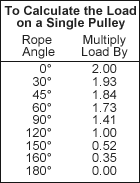
Here is where it gets little tricky. When I look up some specs on pulleys they state that the force can be up to double the load. This means each pulley could have up to 300 lbs of force. If assuming that being perpendicular to the ground is worst case, then the angle of force on the pulley would be down and out at a 45 degree angle.

In the end this means each pulley would need to support 150lbs of downward force and 150lbs of outward force (away from the wall).

Can someone please valid this is the way to calculate this? Here are some pictures of the project and supporting data.

I have 152 linear feet of 2x6 studs and 3 sheets (4'x8') of 3/4" plywood


https://www.engineersedge.com/commercial_lumber_sizes.htm

http://theplywood.com/weight
1590711888277.png
 
Physics news on Phys.org
Here’s a cool video on snatch blocks which are a form of pulleys.


it might get you thinking about your setup.
 
Hey jedishrfu,

Thanks for the video. I love watching Destin's videos. I have been looking into this when I saw that most bike hoists uses a snatch block style system. The great thing is you can set it up so you can use a lot less force to move something. The unfortunate thing is it adds more force to the pulley and this is my issue. I'm cutting the force it takes to lift the wall in half but I'm doubling the force exerted on the pulley. My biggest fear is one of the pulleys being ripped out of the wall while I'm 10 feet in the air and landing on my back.
 
  • Like
Likes   Reactions: jedishrfu
I guess one thing to think about is that I could add more pulleys and therefore spread the load across the wall instead of just one point. I have 24" between the 2x6s so that doesn't give me much room but I'll look into that option. Thanks again.
 
  • Like
Likes   Reactions: jedishrfu
Aren't you likely to get sued if someone gets injured on your wall?

Shouldn't you be looking for mandated construction and safeguard details from applicable safety codes rather than on the Internet?

Are you insured? What does your insurance company require?

If someone does get hurt and your defense is, "Well, some guys on the Internet (don't know their names) said it was OK," then your chance of winning is nil.
 
Hey anorlunda,

I appreciate the concern. I am building this wall for myself. That said, I'm sure other people close to me will use it. This is not something I would let children use and all adults would be warned that I built it (maybe a sign "cliimb at your own risk" would be useful). Just like having a pool or stairs I run the risk of someone getting injured at my house. Thankfully I rarely have people over and I do have very good insurance.

In regards to safety codes, I am being very careful to only purchase items that have been rated well past the weight I intend to have and are ASME certified. I also have been consulting with a structural engineer (loosely) as well as looking at the UBC and other sources.

My main goal here was to look at the physics involved and to make sure I was using the right formulas and math to get load on the pulleys. I'm not holding anyone liable (because I can't and wouldn't). This is a physics forum and thought this would be the right place to bounce my theory off of or get more insight. I only took physics in college so I'm pretty rusty, but this has been fun and challenging.
 
athlon2k2 said:
Thankfully I rarely have people over and I do have very good insurance.
Have you talked to your insurance company about this climbing wall that you are adding to your home? Probably it is similar to adding a pool to your home -- it can change the premiums that you pay for some insurance coverages.
 
I have not, but I will talk to my agent.
 
athlon2k2 said:
I appreciate the concern. I am building this wall for myself. That said, I'm sure other people close to me will use it.
It is not just your safety in question. This is not a private conversation. Anybody, including children, can find it via search. We have no way to judge how they might apply or misapply advice here.

Our guidelines say "no dangerous topics." Thread closed.
 

Similar threads

  • · Replies 2 ·
Replies
2
Views
3K
  • · Replies 3 ·
Replies
3
Views
2K
  • · Replies 5 ·
Replies
5
Views
3K
  • · Replies 4 ·
Replies
4
Views
2K
  • · Replies 1 ·
Replies
1
Views
2K
  • · Replies 2 ·
Replies
2
Views
6K
  • · Replies 8 ·
Replies
8
Views
3K
  • · Replies 5 ·
Replies
5
Views
8K
  • · Replies 17 ·
Replies
17
Views
63K
Replies
13
Views
4K