Calculating Norm of Prime Ideal p = (3, 1 - √-5)

  • Thread starter Thread starter Firepanda
  • Start date Start date
  • Tags Tags
    Norm
Click For Summary
SUMMARY

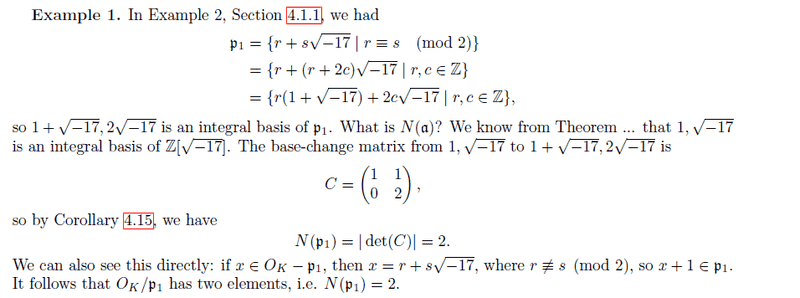
The discussion focuses on calculating the norm of the prime ideal p = (3, 1 - √-5). The user successfully calculated the norm of a similar ideal q = (3, 1 + √-5) using the determinant of a base change matrix and integral bases. The conversation highlights two methods for norm calculation: computing a determinant and using residue rings. The residue ring approach is illustrated through the example of the ideal p1 = (2, 1 + √-17), demonstrating the equivalence of polynomial rings and quotient structures.

PREREQUISITES
  • Understanding of prime ideals in algebraic number theory
  • Familiarity with integral bases and their determinants
  • Knowledge of residue rings and polynomial ring quotients
  • Experience with algebraic structures involving square roots of negative integers
NEXT STEPS
  • Study the calculation of norms for various prime ideals in algebraic number fields
  • Learn about the determinant method for finding integral bases in number theory
  • Explore residue rings and their applications in ideal theory
  • Investigate the properties of polynomial rings and their quotients in algebra
USEFUL FOR

Mathematicians, algebraic number theorists, and students studying ideal theory and algebraic structures will benefit from this discussion.

Firepanda
Messages
425
Reaction score
0
I need to calculate the norm of the ideal

p = (3, 1 - √-5)

All the information I have is that it's a prime ideal.

I managed to calculate the normal of the ideal q = (3, 1 + √-5) (which was 3) by finding a the determinant of a base change matrix by considering an integral basis

Here I'm not sure how to do that (in the other example I managed to show an equivelence relation so that I could find an integral bases)

Here is a similar example with the ideal p1 = (2, 1 + √-17)
34sflaf.png


Any help appreciated, thanks.
 
Physics news on Phys.org
Well, you seem to have been shown two methods: compute a determinant, and compute a residue ring. What difficulty have you had trying to use either method?P.S. when computing the residue ring, I often find it easier to think of your ring as being the quotient of a polynomial ring:

\begin{align}<br /> \mathbb{Z}[\sqrt{-17}] / (2, 1 + \sqrt{-17}) &amp;\cong<br /> \left( \mathbb{Z}[x] / (x^2 + 17) \right) / (2, 1 + x)<br /> \\ &amp;\cong \mathbb{Z}[x] / (2, 1+x, x^2 + 17)<br /> \\ &amp;\cong \left(\mathbb{Z}[x] / (2)\right) / (1+x, x^2 + 17)<br /> \\ &amp;\cong \cdots\end{align}
 

Similar threads

Replies
30
Views
3K
  • · Replies 15 ·
Replies
15
Views
4K
Replies
15
Views
4K
  • · Replies 1 ·
Replies
1
Views
2K
  • · Replies 16 ·
Replies
16
Views
3K
  • · Replies 16 ·
Replies
16
Views
3K
  • · Replies 6 ·
Replies
6
Views
1K
  • · Replies 11 ·
Replies
11
Views
2K
  • · Replies 21 ·
Replies
21
Views
1K
  • · Replies 31 ·
2
Replies
31
Views
2K