Calculating phasors from sensor readings

  • Thread starter Thread starter TerGrim
  • Start date Start date
  • Tags Tags
    Phasors Sensor
Click For Summary

Discussion Overview

The discussion revolves around calculating voltage and current phasors from sensor readings in an unbalanced 3-phase, 3-wire electrical system. Participants explore methods for creating a polar plot of these phasors based on instantaneous voltage and current measurements, while addressing the challenges posed by their limited electrical engineering background.

Discussion Character

  • Exploratory
  • Technical explanation
  • Debate/contested
  • Mathematical reasoning

Main Points Raised

  • One participant seeks guidance on calculating voltage and current phasors from phase-to-phase and phase-to-ground voltage readings, as well as line currents, noting the need to adjust for a wye configuration.
  • Another participant questions the meaning of "instantaneous values" and whether they refer to RMS values or specific points on the sine wave.
  • There is a discussion about the definition of "instantaneous RMS" and how it can be calculated based on sampling intervals.
  • A participant suggests using trigonometric relationships to derive phasors, emphasizing the importance of rigorous naming conventions for phasors and their geometric representation.
  • Concerns are raised about the implications of an unbalanced system on the symmetry of the phasor triangle, with a suggestion to use basic geometry to construct the phasor diagram.
  • Another participant proposes that the length of the current phasor is proportional to the instantaneous current reading and discusses how to determine the angle using the voltage phasor and power factor.
  • There is mention of the need for specific measuring instruments to accurately determine phase angles and power factors, with a suggestion to create a phasor diagram based on these measurements.

Areas of Agreement / Disagreement

Participants express varying levels of understanding and clarity regarding the definitions and calculations involved in phasor analysis. There is no consensus on the interpretation of "instantaneous values," and multiple approaches to calculating phasors are discussed without resolution.

Contextual Notes

Participants highlight limitations in their understanding of electrical engineering concepts, particularly regarding the definitions of instantaneous and RMS values, which may affect their calculations. The discussion also reflects the complexity of working with unbalanced systems and the need for precise measurements and conventions.

Who May Find This Useful

This discussion may be useful for hobbyists and students interested in electrical engineering, particularly those working with 3-phase systems and phasor analysis.

TerGrim
Messages
2
Reaction score
0
Hi!

I am working on a project (hobby basis) and with limited EE background.
I wish to make a polar plot, showing the current and voltage phasors for each phase (unbalanced 3-phase, 3 wire system (IT system), se picture below.).

I have obtained the following readings (instantaneous values):
  • Phase to phase voltages (U12, U23, U31)
  • phase to ground voltages (U1, U2, U3)
  • currents (i1, i2, i3) I believe these are measured as line currents, so have to divide by sqrt(3) to get the phase currents as my setup is connected in wye config (not grounded).
  • power factor for each phase, so I can calculate the phase difference between the voltage and current phasor.
Based on this readings, how should I go if I want to calculate the voltage and current phasors for each phase, is it possible with this readings?

For the voltage phasors, I could use the following cosine, since I have the phase-to-phase, and phase to ground voltage readings.

triangle.PNG


For the currents, since I read the instantaneous currents, is the length of my current phasor equal to this value? And to get the angle, I would use the angle of voltage phasor, and then shift it again using the angle calculated from the power factor?

Am I on the right track?
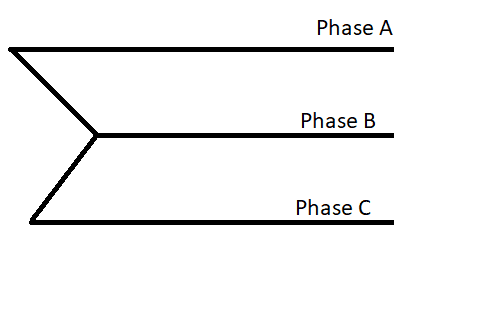
setup.png
Sorry if my post is messy, give me feedback if anything has to change.

Best regards from Germany :)
 

Attachments

  • setup.png
    setup.png
    1.6 KB · Views: 480
  • triangle.PNG
    triangle.PNG
    3.4 KB · Views: 546
Engineering news on Phys.org
see if this link is any help

https://www.electronics-tutorials.ws/accircuits/phasors.htmli'm confused by this conflict, though

upload_2019-2-6_5-29-0.png


and what do you mean by "instantaneous values" ?
 

Attachments

  • upload_2019-2-6_5-29-0.png
    upload_2019-2-6_5-29-0.png
    17.2 KB · Views: 426
Thanks, I will have a look at the link once I get home.

I should have written phase to neutral point, I think(?). I am testing this on a setup that is earthed like an IT system, i.e. the neutral point is not connected to earth. Sorry for not beeing clear, lack of EE/math knowledge is holding me down, but I thought this was a good way to get some more knowledge :)
jim hardy said:
see if this link is any help
and what do you mean by "instantaneous values" ?
Thanks, my manual (in german) says "instant value", but I need to find out if this is the "instant" rms value or any value on the sine wave.

I believe its RMS, but then again, I find it abit weird when they say "instant value" if its rms, because to calculate rms you need more than one reading?
 
TerGrim said:
Thanks, my manual (in german) says "instant value", but I need to find out if this is the "instant" rms value or any value on the sine wave.

Digital: RMS generally means a calculation based on an entire cycle. However at each sampling interval, you could calculate a rolling RMS for the preceding cycle. 100 samples per second, 100 RMS calculations per second. That can be what they mean by instantaneous RMS.

Analog: AC analog meters inherently measure RMS.
 
I think instantaneous current it is i(t)=√2*Irms*cos(ω*t+φ). For any t we'll get another i. [Imax=√2*Irms]. The phasor will be Irms[cos(φ)±jsin(φ)]Usually we take one of the voltage as φ=0 then we can consider φ from here.
We can read the instantaneous current on a recorder tape [or oscilloscope] since the values are changing fast at the industrial frequency[50-60 hz] using an d.c.meter. An a.c. avometer usually will give you a r.m.s. value only as anorlunda already said.
 
TerGrim said:
I wish to make a polar plot, showing the current and voltage phasors for each phase

Did you take a look at that tutorial?

TerGrim said:
  • Phase to phase voltages (U12, U23, U31)
  • phase to ground voltages (U1, U2, U3)

That's a good start.

It's important to be rigorous in your naming and your drafting.

Draw a triangle with sides of length U12, U23, and U31.

Next find where is the Neutral, which i hope is what you called "Ground".
Do that with a compass by drawing lines of length U1 U2 and U3 from the respective vertices to wherever they intersect.
You should get something resembling this

upload_2019-2-7_12-23-58.png


Now add your arrowheads .
This is where rigor pays off , and that's the secret to success in learning to work with three phase.

Decide which end of each phasor you want to call FROM and which end to call TO,
and always write their names that way.
I use the convention subscript them From-To
For example,
if you decide to call the end with an arrowhead TO and the other end FROM
( we call them Head and Tail as with arrows)
then we should make the sketch look like this
(well, leave your arrowheads black)
and my convention would be 'write their names UFrom-To'

upload_2019-2-7_12-42-0.png


I could equally well have named those interior phasors UN1 UN2 and UN3 and put their arrowheads out at the vertices ,
and probably would have but i wanted you to see the mechanics of construction
and i wound up with too many overlapping arrowheads out there at the vertices - it was ugly

Here's the beauty of three phase - it's all 30 and 60 and 90 and 120 degree angles, so the geometry works out quite convenient.
Observe in a balanced system that
Angle between any two phase to phase voltages is 60 degrees
Angle between any two phase to neutral voltages is 120 degrees
Angle between any phase-to-phase and any phase-to-neutral voltage ie either 30 or 90 degrees.
So the only cosines you have to remember are 0.5 and ½√3 .

Now it's time for you to practice picking any phasor and writing its name.
Form the habit now of being rigorous in naming and drawing.

Now here's a pill to swallow
Every textbook author is free to define his naming and arrowhead convention
and here on PF you will see posts from disparate textbooks
so establish early what is the convention in use for a conversation.
I cannot overstress the importance of that point

Now
you have to imagine that triangle rotating at frequency of the system you're studying.
US power is of course 60hz
yours is probably 50 hz
in airplanes you'll find 400 hz
in car alternators it's in proportion to (engine speed X pulley ratio X number of poles) so quite variable.
By agreement(!) among power engineering folks we almost universally draw our phasor diagram rotating CCW
so the phase sequence of that sketch we made would be 123 because that's the order in which the vertices would go by an observer standing near the triangle.
On engineering drawings there's usually a little arrow showing the direction of rotation just as a reminder..
upload_2019-2-7_13-8-17.png


That's enough to absorb in one sitting, i think.
 

Attachments

  • upload_2019-2-7_12-23-58.png
    upload_2019-2-7_12-23-58.png
    1.2 KB · Views: 368
  • upload_2019-2-7_12-42-0.png
    upload_2019-2-7_12-42-0.png
    1.6 KB · Views: 382
  • upload_2019-2-7_13-8-17.png
    upload_2019-2-7_13-8-17.png
    2.1 KB · Views: 376
Last edited:
If your system is unbalanced your triangle won't be so symmetric as the example above
But knowing all those voltages you can construct it using just high school geometry..

Keep us posted ?

old jim
 
TerGrim said:
  • currents (i1, i2, i3) I believe these are measured as line currents, so have to divide by sqrt(3) to get the phase currents as my setup is connected in wye config (not grounded).
  • power factor for each phase, so I can calculate the phase difference between the voltage and current phasor.

it's not clear where you took those measurements.

can you draw a sketch (maybe in Paint?) and upload it ?

TerGrim said:
For the currents, since I read the instantaneous currents, is the length of my current phasor equal to this value?
Proportional to it. Pick a scale factor cm per amp that fits your page...

TerGrim said:
And to get the angle, I would use the angle of voltage phasor, and then shift it again using the angle calculated from the power factor?
You could try that.
Is your load connected phase to phase or phase to neutral ?
 
What do we need it is a a.c. voltmeter, an ampermeter and a single phase wattmeter.
Let's say we take voltage U1o and I1o and the power P1o=U1o*I1o*cos(φ1o) so we have φ1o. If I want to measure φ12 between U1 and U2 I need a known R inserted between U2 terminals and so we have a current in phase with U2 so the wattmeter will show cos(φ12). A phasor diagram as Jim indicates it could be done now.
 

Similar threads

Replies
35
Views
6K
  • · Replies 77 ·
3
Replies
77
Views
9K
  • · Replies 4 ·
Replies
4
Views
4K
  • · Replies 5 ·
Replies
5
Views
3K
  • · Replies 3 ·
Replies
3
Views
2K
  • · Replies 6 ·
Replies
6
Views
4K
  • · Replies 17 ·
Replies
17
Views
4K
  • · Replies 8 ·
Replies
8
Views
2K
  • · Replies 5 ·
Replies
5
Views
3K
  • · Replies 26 ·
Replies
26
Views
4K