Calculating Routes on a Grid: Using Combinations and Pascal's Triangle

Click For Summary

Homework Help Overview

The problem involves calculating the number of routes on a rectangular grid from point A to point B, specifically using combinations and considering routes that pass through a specific intersection, C. The subject area includes combinatorial mathematics and grid pathfinding.

Discussion Character

  • Exploratory, Assumption checking

Approaches and Questions Raised

  • The original poster attempts to calculate the number of routes using combinations, specifically referencing P(66,6)/6!. They express confusion regarding the distance calculation and the resulting answer. Another participant questions the calculation of the total number of blocks, suggesting a maximum distance of 17 blocks instead of 66.

Discussion Status

The discussion is ongoing, with participants exploring the initial calculations and questioning assumptions about the distance. One participant acknowledges the misunderstanding and indicates they have clarity moving forward.

Contextual Notes

There appears to be a misunderstanding regarding the distance between points A and B, which is critical for the calculations. The original poster's reference to 66 blocks is challenged, suggesting a need for clarification on the grid layout.

SeththeBaller
Messages
13
Reaction score
0
1. The streets of a city are laid out in a rectangular gird, as shown below
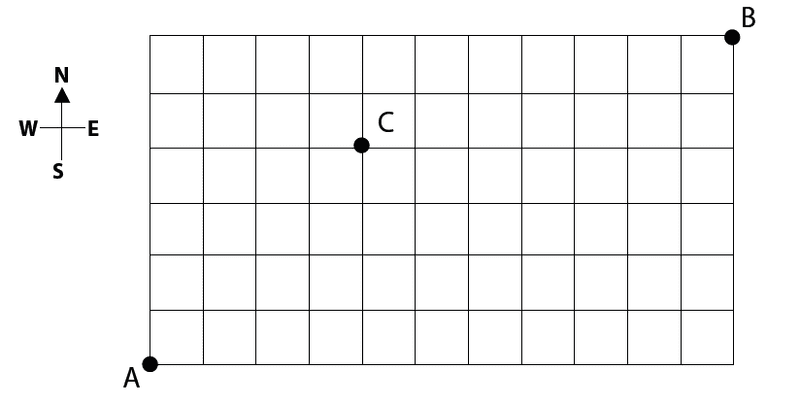
pbmlY.png


a) Use combinations to find the number of routes through the grid that lead from point A to point B by only traveling north or east. Show your calculations

b) How many of these routes pass through intersections C


2. Alright, so I've solved similar questions before. I get to P(66,6)/6! only to get some absurd answer. I understand that from point A to point B there is a distance of 66 blocks-11 east, 6 north. Somehow I believe that the exponential answer that comes from this is not what my professor expects.

I was wondering if I could have help with this please and thank you :D
 
Last edited:
Physics news on Phys.org
How did you get 66 blocks? No matter how you travel, the most you could possibly get is 17 (11 east + 6 north). Multiplying gives you the area, not the distance.
 
Whoops, lmao, sorry long day, that makes so much sense, I know what to do from here lol
 
Np, I know the feeling, gl :P
 

Similar threads

  • · Replies 5 ·
Replies
5
Views
3K
  • · Replies 11 ·
Replies
11
Views
2K
  • · Replies 3 ·
Replies
3
Views
4K
  • · Replies 2 ·
Replies
2
Views
4K
  • · Replies 2 ·
Replies
2
Views
5K
  • · Replies 7 ·
Replies
7
Views
3K
  • · Replies 4 ·
Replies
4
Views
8K
Replies
5
Views
7K
Replies
2
Views
3K
Replies
3
Views
2K