greg_rack
Gold Member
- 361
- 79
- Homework Statement
- Show that the horizontal distance of the shear center(SC) from the web is given by: ##\xi_s=-d\frac{(d/h)^2sin\alpha cos\alpha}{1+6(d/h)+2(d/h)^3sin^2\alpha}##(picture of cross section(cs) below)
- Relevant Equations
- General shear flow equation: ##q_s=-\frac{V_yI_{yy}-V_xI_{xy}}{I_{xx}I_{yy}-I_{xy}^2}\int_{0}^{s}tyds-\frac{V_xI_{xx}-V_yI_{xy}}{I_{xx}I_{yy}-I{xy}^2}\int_{0}^{s}txds+q_{s,0} \ \ \ \ \ \ \ \ ## (1.1)
Here is the diagram of the cs:
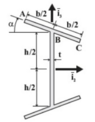
As a premise I must say that this topic(shear center and shear flow distributions) is still very hectic in my mind; I aim to clarify it a bit by asking you guys this :)
So, in order to identify the SC location, I must compute at what distance a point shear force must act so that it produces the same torque as the shear flow distribution; I'll pick this point to be the center of the web and call it H.
Let's thus assume the vertical shear force will act a distance ##\xi_s## to the left of H. I can therefore write:
$$V_y\xi_s=\sum{M_{qs}}$$
where ##\sum{M_{qs}}## is indeed the sum of all the contributions of the shear flow(sf) distributions to the internal torque about point H.
And now the fun begins... say I start by trying to determine the sf distribution in segment AB and segment CB defining a distance variable ##s_1## for the former, ##s_2## for the latter both going from the free edge "inwards".
Applying eqn (1.1) to flanges CB and AB yields(leaving 'y' indicated, as it's where the difference between the two lies):
$$q_{s}=-\frac{V_y}{I_{xx}}\int_{0}^{s_i}tyds$$
Working this out leaving 's' indicated, dividing by t and integrating both from 0 to b/2 should yield the total stress acting on the two flanges from which we can compute the force ultimately contributing to the integral torque, needed to solve for ##\xi_s##.
But now all the questions arise:
Thank you in advance,
Greg
As a premise I must say that this topic(shear center and shear flow distributions) is still very hectic in my mind; I aim to clarify it a bit by asking you guys this :)
So, in order to identify the SC location, I must compute at what distance a point shear force must act so that it produces the same torque as the shear flow distribution; I'll pick this point to be the center of the web and call it H.
Let's thus assume the vertical shear force will act a distance ##\xi_s## to the left of H. I can therefore write:
$$V_y\xi_s=\sum{M_{qs}}$$
where ##\sum{M_{qs}}## is indeed the sum of all the contributions of the shear flow(sf) distributions to the internal torque about point H.
And now the fun begins... say I start by trying to determine the sf distribution in segment AB and segment CB defining a distance variable ##s_1## for the former, ##s_2## for the latter both going from the free edge "inwards".
Applying eqn (1.1) to flanges CB and AB yields(leaving 'y' indicated, as it's where the difference between the two lies):
$$q_{s}=-\frac{V_y}{I_{xx}}\int_{0}^{s_i}tyds$$
Working this out leaving 's' indicated, dividing by t and integrating both from 0 to b/2 should yield the total stress acting on the two flanges from which we can compute the force ultimately contributing to the integral torque, needed to solve for ##\xi_s##.
But now all the questions arise:
- in order to succesfully apply eqn(1.1), should I know the direction of the shear flows beforehand? Otherwise, I wouldn't know how to manage the +/- signs; this really trips me off. For a vertical ##V_y## I would say the shear flow grows from 0 to a value both from C to be and from A to B, as for the "normal I beam" counterpart... but I am not sure; this is mere intuition. So is this equation limited for application to cases in which the sketch of the final distribution is already known?
- an year ago I attended a course on mechanics on material, in which the "shear formula" ##\tau=\frac{VQ}{It}## was derived and though a bit mysterious, was easy to use... but long story short a take away was that I couldn't fully rely on the equation: the distribution has to be more or less predicted, to check the numbers. Now, as (1.1) is the general case and the shear formula an approximation for a simple case, do the same "practical rules" apply when it comes to performing calculations on thin-walled sections?
Thank you in advance,
Greg