Calculating Support Reaction Force for an Impulse-Driven Bumper Project

Click For Summary

Discussion Overview

The discussion revolves around calculating the support reaction force in a bumper project involving a pendulum and a block. Participants explore the dynamics of the system, including the impact forces and the role of support reactions during the collision. The scope includes theoretical considerations and mathematical modeling related to impulse and force calculations.

Discussion Character

  • Exploratory
  • Technical explanation
  • Debate/contested

Main Points Raised

  • One participant questions how to calculate the support reaction force without knowing the impact time, suggesting the relationship F * t = m * V.
  • Another participant seeks clarification on the nature of the collision, asking whether the pendulum drops onto the block or if the block slides into the pendulum.
  • A participant confirms that the pendulum drops and hits the block, emphasizing the need to determine if any force is transferred to the support.
  • One participant asserts that there is likely an impulse on the pendulum from the block, which may affect the support, but questions whether the support is loose or fixed.
  • Another participant suggests that if the rod's moment of inertia is neglected, the force on the support might also be negligible.

Areas of Agreement / Disagreement

Participants express differing views on whether a force is transferred to the support and the significance of the rod's moment of inertia. No consensus is reached regarding the calculation of the support reaction force.

Contextual Notes

Participants mention the need for impact time and the implications of neglecting certain factors, such as the rod's moment of inertia, but do not resolve these aspects.

yilbaris
Messages
6
Reaction score
0
Hi, i have a question..

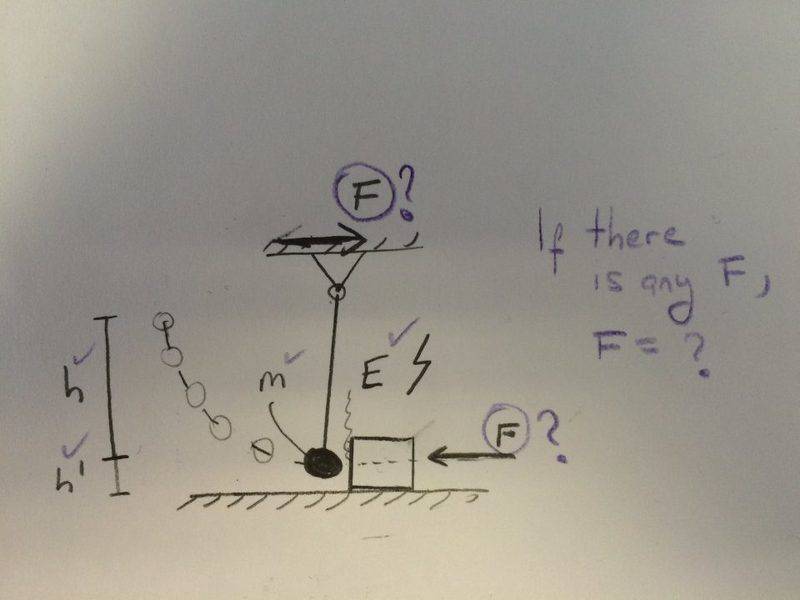
I need to make a "bumper project" as shown in figure.
I have all the geometric information about system and also know weight and energy which is transferred.
I need to calculate the support reaction but i can not convert the energy to the force without "impact time". (F * t = m * V )

Also, i m not sure is there any reaction force on the supports because it s a pin connection.
Is it possible to calculate F?
IMG_4018.JPG
 
Engineering news on Phys.org
So is the pendulum dropping down and hitting the block or is the block sliding into the pendulum? Before the collision, the pendulum has a well defined angular velocity. I believe you would be able to set up a differential equation using friction and gravity (on the pendulum) and appropriate initial conditions. Would you mind clarifying what you're looking for?
 
Thank you BiGyElLoWhat.

Pendulum is dropping down and hitting the block and yes, angular velocity is known (calculated).

Actually, the main question is that "is there any force transferred to support?" If yes, second step, which is the hardest part, is to calculate amount of force.
 
I think the short answer would be yes.

There is an impulse on the pendulum by the block, and in turn the rod by the pendulum, and as they contact, the ball 'tries' to act as a pivot point about which the rod will rotate. Is the support loose or fixed?

Another thing to consider: If you're neglecting the rod's moment of inertia, (and thus it's kinetic energy), you could probably neglect the force on the support as well, as I would think it should be negligible in comparison. Some one may want to correct me on this fact, though.
 
Thank you for answers..
 

Similar threads

Replies
3
Views
2K
Replies
13
Views
4K
  • · Replies 4 ·
Replies
4
Views
2K
  • · Replies 14 ·
Replies
14
Views
2K
  • · Replies 9 ·
Replies
9
Views
2K
  • · Replies 8 ·
Replies
8
Views
2K
  • · Replies 5 ·
Replies
5
Views
3K
  • · Replies 3 ·
Replies
3
Views
2K
  • · Replies 5 ·
Replies
5
Views
3K
  • · Replies 2 ·
Replies
2
Views
6K