Calculating suspension requirements for a cart?

  • Thread starter Thread starter beany_bot
  • Start date Start date
  • Tags Tags
    Cart Suspension
Click For Summary
SUMMARY

This discussion focuses on calculating suspension requirements for a cart designed for comfort, specifically for transporting a child. The recommended approach involves using an air suspension system, which can be achieved by incorporating inflatable rubber inner tubes between the axle and the cart. For optimal comfort, the suspension should achieve a natural frequency of 1 Hz to 1.5 Hz, necessitating springs that allow for a static deflection of 4 to 10 inches under the cart's weight. A practical example provided indicates that a cart weighing 200 lb requires a 20 lb/in effective coil rate for each wheel to achieve the desired deflection and frequency.

PREREQUISITES
  • Understanding of basic physics principles related to suspension systems
  • Knowledge of spring rates and deflection calculations
  • Familiarity with air suspension systems and their components
  • Experience with cart design and load distribution
NEXT STEPS
  • Research "spring rate calculations for suspension systems"
  • Explore "designing air suspension systems for lightweight vehicles"
  • Investigate "calculating natural frequency in suspension design"
  • Learn about "load distribution techniques for cart stability"
USEFUL FOR

Individuals involved in DIY cart construction, engineers focused on suspension design, and parents seeking safe and comfortable transport solutions for children.

beany_bot
Messages
10
Reaction score
0
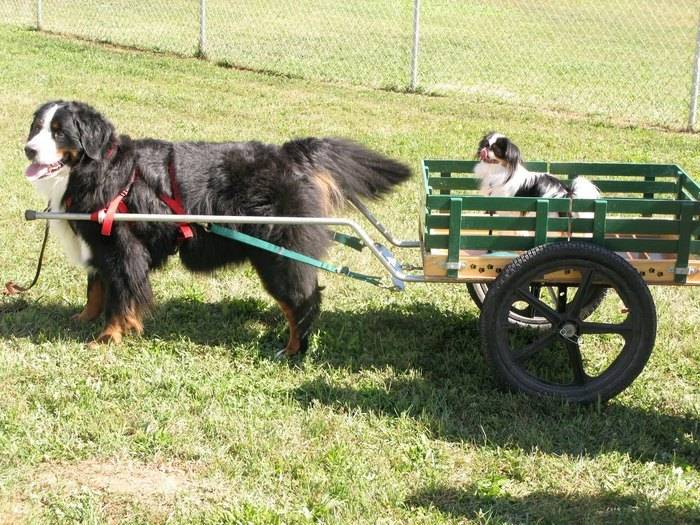
Hi, I am building a cart for my dog to pull around. I am going to put my child in it once they are about 1.
Something like this.
Picture+054.jpg


The paths we plan to go on though are not very smooth so I want to fit some suspension to the cart to make a smoother journey.
Now the weight of the cart will be relatively little so I can't use trailer or automotive suspension, so I am wondering how do I calculate what suspension is required? I've google but not found a simple "input weight and find what suspension required" type formula. I want it for "comfort". This isn't a race cart and won't be cornering fast.

I'm sure I could make some sort of leaf spring / silvercross pram type suspension. but no idea to what forces it should be set to? twice the weight of the cart? 3x? 4x? not a clue.
 
Last edited:
Engineering news on Phys.org
I'm not sure how you'd calculate that but I'd use a stiff axle like the one pictured and mount the wagon at 4 points, build the wagon to loosely bolt to the axle with a vertical slotted tracks at these 4 points (so the wagon body can travel up and down) build a flat box structure under the wagon (on the axle)... then just insert an inflatable rubber car or truck inner tube between the axle and the wagon, figure out a way to secure the tube so that it doesn't come out, then inflate it to the desired springiness. Then you have an adjustable air ride system.
 
The above "air suspension" is a good suggestion. I owned an early model Morgan sports cars that had an essentially rigid suspension and the seat cushions had an air "bladder" made up of a coiled bicycle type tube; and this system worked pretty well. Actually, placing a cushion inside the wagon is still the best way to reduce hard and painful pressure points on the seating area.
 
The suspension requirement for comfort is a natural frequency in the range of 60 to 90 cycles per minute (CPM), or about 1 Hz to 1.5 Hz. To get this, you will need springs that will cause the cart to sink between 4 and 10 inches under the cart's weight.

There is more information here.

There is a calculator here. For example, if you have a cart that weights 200 lb (loaded) and a 2-wheel and axle assembly of 20 lb that would mean 100 lb corner weight and 10 lb unsprung weight (for each wheel). You will find that you need a 20 lb/in effective coil rate to obtain a 4.5" [ = (100-10)/20 ] static deflection (or a 1.48 Hz wheel frequency). If you have a 1:1 motion ratio (like with a solid axle), this will mean a 20 lb/in spring for each wheel. Anyway, you can play around with your numbers.

If the static deflection is too much for your liking, you can add preload to the spring, i.e. having the spring compressed while the wheel is off the ground. The more it is compressed, the less it will initially deflect under the cart's weight. But the frequency will remain the same and the ride comfort criteria will still be respected.
 

Similar threads

  • · Replies 1 ·
Replies
1
Views
3K
  • · Replies 3 ·
Replies
3
Views
2K
  • · Replies 3 ·
Replies
3
Views
2K
  • · Replies 4 ·
Replies
4
Views
2K
Replies
13
Views
3K
  • · Replies 7 ·
Replies
7
Views
9K
  • · Replies 12 ·
Replies
12
Views
8K
Replies
6
Views
2K
  • · Replies 9 ·
Replies
9
Views
8K
  • · Replies 15 ·
Replies
15
Views
4K