Calculating Symmetry Factors for Graphs: Reasoning Behind Findings

  • Context: Graduate 
  • Thread starter Thread starter kau
  • Start date Start date
  • Tags Tags
    Symmetry
Click For Summary

Discussion Overview

The discussion revolves around calculating symmetry factors for specific Feynman diagrams within the context of $$\phi^3$$ theory. Participants explore the reasoning behind their findings and the discrepancies in their calculations, focusing on the two-vertex and zero-vertex diagrams.

Discussion Character

  • Technical explanation
  • Debate/contested

Main Points Raised

  • One participant calculates a symmetry factor of 2 for a two-vertex diagram and 1 for a zero-vertex diagram, suggesting that the expected values should be 4 and 2, respectively.
  • The same participant details their reasoning involving combinations of sources and fields, leading to a calculation of 6*3*2 divided by 2*(3!*3!), resulting in a symmetry factor of 2, which they believe is incorrect.
  • Another participant provides a logical explanation regarding the normalization of terms in Feynman diagrams, stating that permutations of propagators, vertices, and externals can lead to overcounting, necessitating division by a symmetry factor.
  • This second participant argues that the symmetry factor for the first diagram is 4, explaining that it arises from the ability to exchange sources and derivatives, as well as identical figures due to the exchange of legs of the propagator.

Areas of Agreement / Disagreement

Participants express differing views on the correct symmetry factors for the diagrams, with one participant asserting a factor of 2 for the two-vertex case and another proposing a factor of 4. The discussion remains unresolved regarding the correct calculations and interpretations.

Contextual Notes

There are unresolved assumptions regarding the normalization of terms and the specific definitions of symmetry factors in the context of the diagrams discussed. The calculations depend heavily on the interpretation of permutations and exchanges within the diagrams.

kau
Messages
53
Reaction score
0
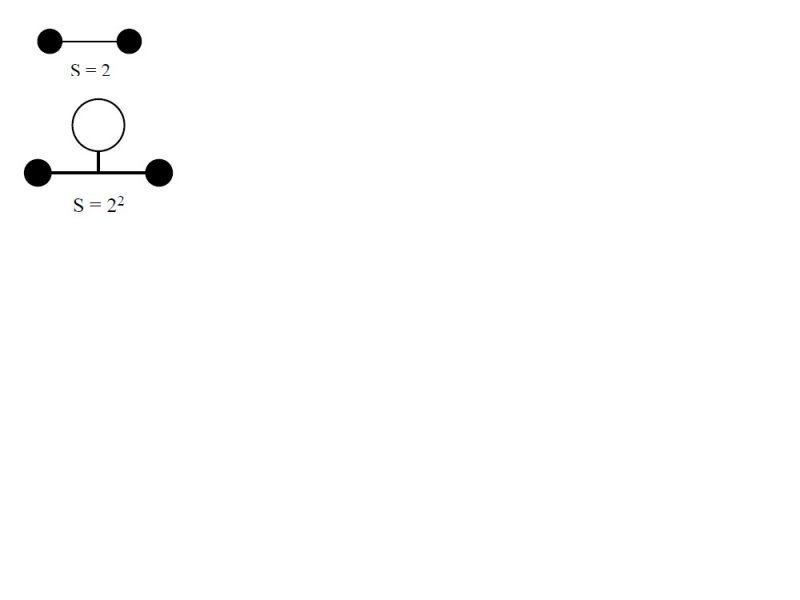
consider the following two graphs. I want to calculate the symmetry factors for them . I am using field contraction method for that. but I am getting 2 for the 2 vertex diagram and 1 for the zero vertex diagram where it should be 4 and two respectively. Can anyone do it for me. I am writing briefly the reason behind my findings. i am considering $$\phi^3$$ theory. So for vertex zero case i don't have any factors left. In case of two vertex case. say I am denoting two vertices as v and w and the sources as x and y. ok. now x can be combined with 6 possible ways and therefore y can be combined with 2 possible ways. now if i call that one v. then i am left with one field in v and 3 in w. they can combine 3 ways. so i got 6*3*2. now i have to divide it by 2*(3!*3!). and this would give me 1/2. so the symmetry factor is two. but that is a wrong answer. so where did i missed the point.??
upload.jpg
 
Physics news on Phys.org
Thanks for the post! Sorry you aren't generating responses at the moment. Do you have any further information, come to any new conclusions or is it possible to reword the post?
 
Greg Bernhardt said:
Thanks for the post! Sorry you aren't generating responses at the moment. Do you have any further information, come to any new conclusions or is it possible to reword the post?
 
i have found some logical explanation behind these things. actually what happen in case of drawing a feynman diagram is that if every term is properly normalized then all the factors get canceled appropriately. in that case we consider that permutations of propagators,vertices,externals lead to different diagram. but it turns out that some of these permutations are same. so we have over counted them,therefore we ave to divide the amplitude(we get following feynman rules) by that factor. like in the first diagram we can exchange the two sources and it is same as reversing the propagator,but we have considered both. so s=2. and in the second case you can exchange the derivatives at the vertex (connected to sources) and that is same as exchangin the propagators along with sources. so this gives 2. another two comes due to the identical figures due to exchange of two legs of the curved propagator. this gives another two. so we have total 4 as a symmetry factor.
 

Similar threads

  • · Replies 4 ·
Replies
4
Views
3K
  • · Replies 4 ·
Replies
4
Views
2K
  • · Replies 2 ·
Replies
2
Views
11K
  • · Replies 8 ·
Replies
8
Views
4K
  • · Replies 1 ·
Replies
1
Views
2K
  • · Replies 5 ·
Replies
5
Views
4K
  • · Replies 4 ·
Replies
4
Views
3K
  • · Replies 1 ·
Replies
1
Views
2K
  • · Replies 1 ·
Replies
1
Views
4K
  • · Replies 9 ·
Replies
9
Views
4K