Tymofei
- 8
- 2
- Homework Statement
- Dynamics
- Relevant Equations
- General moment eq
Summary:: Just a simple 3d rigid dynamics question which I am trying to solve by placing coordinat system differently from original solution.Everything looks ok but results are different.
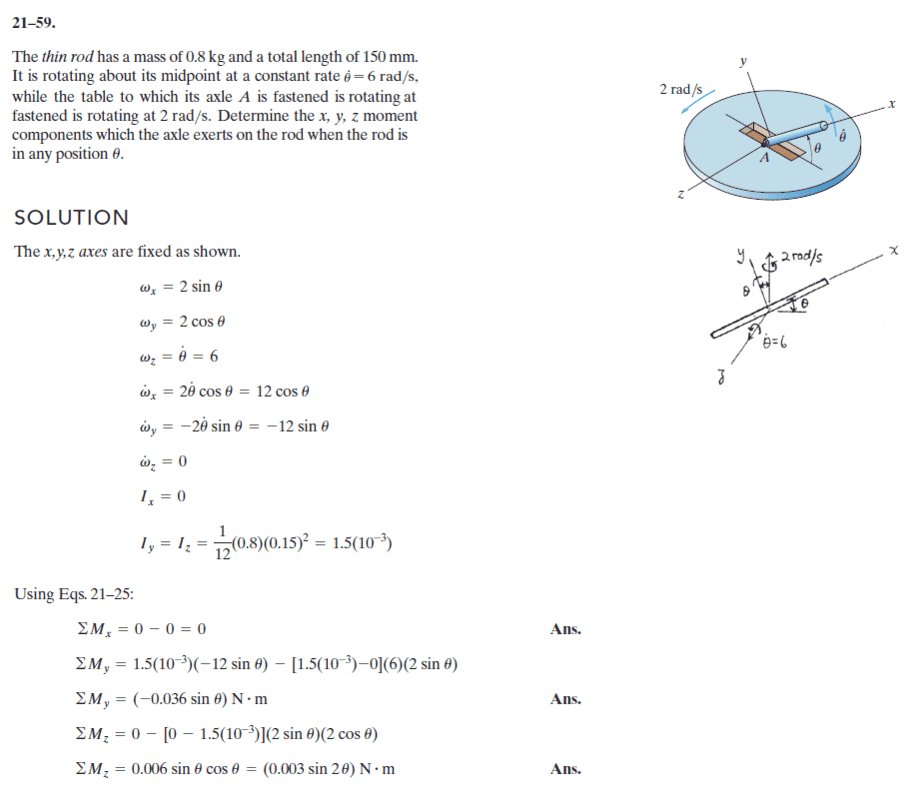
Mod note: Post moved from technical section.
Thats my question.As you see coordinate system was located at center of mass.I just shifted it to point A and recalculated values.
Everything was same except Inertia about z and y-axis which was multiplied by 4.But at the same time moment effect coming from gravitational force was included to calculations so i thought they will cancel each other.But results was different than was mentioned on the original solution.
I know it looks nonsense trying to figure it when i already have solution but I am kind of obsessed .
By the way my values were:
My values for coordinate system placed at point 'A':
w_z = 6 rad/s
w_x = 2sin(theta) rad/s
w_y = 2cos(theta) rad/s
w_x/dt = 12cos(theta) rad/s^2
w_y/dt = -12sin(theta) rad/s^2
I_z = I_y = 6*10^-3 , I_x = I_xy = I_xz = I_yz = 0
Sum M_x = 0 = M_A_x
Sum M_y = 6*10^-3 * -12sin(theta)* -6*10^-3 * 12sin(theta) = -144* sin(theta)*10^-3 = M_A_y
Sum M_z = 6 * 10^-3 * 2 sin(2theta) = M_A_z - 0.8*9.81*0.075*sin(theta) ==> M_A_z = 6 * 10^-3 * 2 sin(2theta) + 0.8*9.81*0.075*sin(theta)
Mod note: Post moved from technical section.
Thats my question.As you see coordinate system was located at center of mass.I just shifted it to point A and recalculated values.
Everything was same except Inertia about z and y-axis which was multiplied by 4.But at the same time moment effect coming from gravitational force was included to calculations so i thought they will cancel each other.But results was different than was mentioned on the original solution.
I know it looks nonsense trying to figure it when i already have solution but I am kind of obsessed .
By the way my values were:
My values for coordinate system placed at point 'A':
w_z = 6 rad/s
w_x = 2sin(theta) rad/s
w_y = 2cos(theta) rad/s
w_x/dt = 12cos(theta) rad/s^2
w_y/dt = -12sin(theta) rad/s^2
I_z = I_y = 6*10^-3 , I_x = I_xy = I_xz = I_yz = 0
Sum M_x = 0 = M_A_x
Sum M_y = 6*10^-3 * -12sin(theta)* -6*10^-3 * 12sin(theta) = -144* sin(theta)*10^-3 = M_A_y
Sum M_z = 6 * 10^-3 * 2 sin(2theta) = M_A_z - 0.8*9.81*0.075*sin(theta) ==> M_A_z = 6 * 10^-3 * 2 sin(2theta) + 0.8*9.81*0.075*sin(theta)
Last edited by a moderator: