Calculating the normal force due to moment load on a thrust bearing

Click For Summary
SUMMARY

This discussion focuses on calculating the normal force acting on individual pads of a thrust bearing under axial and moment loads. The design features two rings and sliding pads made of low-friction plastic, with the moment load affecting the distribution of force on the pads. The axial load must be sufficient to maintain bearing stability, while the moment load introduces additional forces that vary across the pads. Participants emphasize the importance of detailing load vectors and ensuring proper alignment of the bearing components.

PREREQUISITES
  • Understanding of thrust bearing mechanics
  • Knowledge of axial and moment load calculations
  • Familiarity with low-friction materials in engineering
  • Ability to interpret engineering drawings and load vectors
NEXT STEPS
  • Research formulas for calculating normal force in thrust bearings
  • Explore methods for analyzing load distribution in bearing pads
  • Learn about the effects of moment loads on bearing performance
  • Investigate design techniques for ensuring alignment in thrust bearings
USEFUL FOR

Mechanical engineers, bearing designers, and anyone involved in the design and analysis of thrust bearings under varying load conditions.

vatuhiva
Messages
3
Reaction score
0
TL;DR
Calculating the normal force in the bearing pads of a thrust-bearing due to axial and moment loads.
Hello all!

I have a mathematical question for you. I'm trying to design a thrust bearing that can withstand axial and moment loads. I've added a picture of a similar design. The design consists of two rings (grey) and sliding pads (blue) fixed on the bottom ring. The top ring slides over the blue pads. The blue pads are made of an plastic with a low coefficient of friction. I would like to calculate the required force needed for the bearing to turn. therefore I need to know the force acting on the individual pads. I would also like to check whether the pressure on the individual pads will be acceptable.

The axial load will need to be large enough to keep the bearing in place. But once that is the case the moment load will put an extra force on the pads on the right side of the bearing and relieve the pads on the left. I trying to find any formula's that could help me solve this issue but sofar I haven't been able to find suitable information regarding this issue.

I hope there are people out there that can help me a bit further! I there are any question I will be happy to answer those!
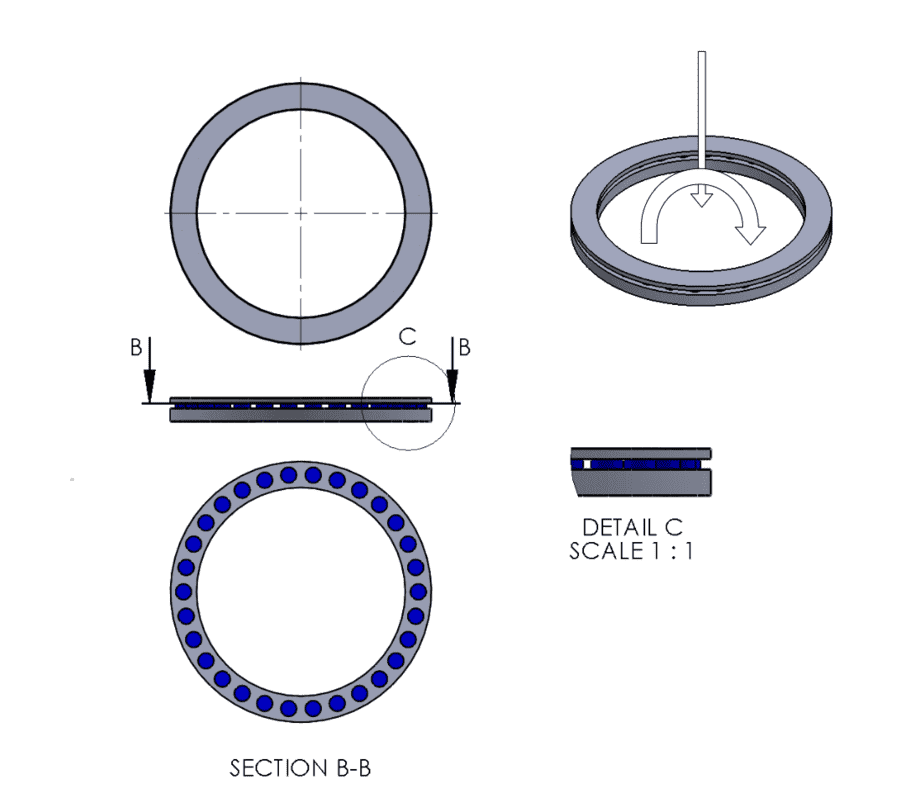
Knipsel.PNG
 
Engineering news on Phys.org
vatuhiva said:
Summary: Calculating the normal force in the bearing pads of a thrust-bearing due to axial and moment loads.

the moment load will put an extra force on the pads on the right side of the bearing and relieve the pads on the left
Silly question , but why is there a moment? Is the shaft not constrained along its axis.
 
256bits said:
Silly question , but why is there a moment? Is the shaft not constrained along its axis.
not a silly question, the shaft is not constrained along its axis. Also, the shaft is extremely short, the length of the shaft is the same as the diameter of the bearing
 
If the shaft is not restrained radially, will there be a problem of keeping the two rings in alignment with each other?
Also, can you show us a detail drawing of the most heavily loaded segment (plastic pad on the right) with load vectors as you see them on this one pad.
 
AZFIREBALL said:
If the shaft is not restrained radially, will there be a problem of keeping the two rings in alignment with each other?
Also, can you show us a detail drawing of the most heavily loaded segment (plastic pad on the right) with load vectors as you see them on this one pad.
Hi Azfireball,

this is a simplified version of the final design, in the final design the rings will be radially constrained, but it will be done in such a way to have no effect on the loads previously presented.

below I edited the drawing to have a crosssection of the heaviest loaded pad. The forces will be perpendicular to the pad. Does this answer you questions?
1572962376016.png
 
Is the bottom plate stationary (Fixed in position?)
Are the rub segments fixed to the lower plate?
Are the aspect dimensions (height to width) of the rub segment accurately depicted in the new rub segment detail drawing?
 

Similar threads

  • · Replies 9 ·
Replies
9
Views
1K
  • · Replies 2 ·
Replies
2
Views
1K
  • · Replies 6 ·
Replies
6
Views
3K
  • · Replies 4 ·
Replies
4
Views
3K
  • · Replies 3 ·
Replies
3
Views
3K
  • · Replies 15 ·
Replies
15
Views
3K
Replies
5
Views
37K
  • · Replies 5 ·
Replies
5
Views
8K
  • · Replies 16 ·
Replies
16
Views
2K
  • · Replies 4 ·
Replies
4
Views
2K