Calculating Thevenin Equivalent Voltage for a Complex Network

Join the discussion
Registration is free. Ask a follow-up in this thread, or start your own.
5 replies · 3K views
magnifik
Messages
350
Reaction score
0
I need help finding the thevenin equivalent voltage for the following network:
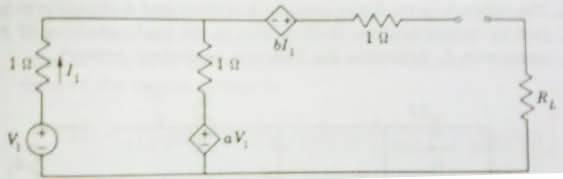
2lxyyh5.jpg


i did source transformations so that i could analyze it using the node voltage method.

72c84j.png

my equations are:
I1 = v1
(a) vx + vx - vT = v1 + av1 - bv1
2vx - vT = v1 + av1 - bv1
(b) vT - vx + vT = bv1
2vT - vx = bv1

when i simplify (by substituting vx), i get
vT = v1/3(a + b + 1)

however, the answer should be
vT = v1/2(a + b + 1 - ab)

help please! thanks.
 
Last edited:
Physics news on Phys.org
magnifik said:
I need help finding the thevenin equivalent voltage for the following network:
2lxyyh5.jpg


i did source transformations so that i could analyze it using the node voltage method.
72c84j.png

my equations are:
I1 = v1
(a) vx + vx - vT = v1 + av1 - bv1
2vx - vT = v1 + av1 - bv1
(b) vT - vx + vT = bv1
2vT - vx = bv1

when i simplify (by substituting vx), i get
vT = v1/3(a + b + 1)

however, the answer should be
vT = v1/2(a + b + 1 - ab)

help please! thanks.

I think I've spotted a problem with how you've redrawn your circuit.

I think it be should more like this,

attachment.php?attachmentid=35760&stc=1&d=1306029035.png


EDIT: There's really no reason to apply source transformations to the circuit at all, the original circuit can be solve by writing two KVL equations.

[tex]\text{Equation 1:}[/tex]

[tex]Voc = I_{1} + aV_{1} + bI_{1}[/tex]

[tex]\text{Equation 2:}[/tex]

[tex]-V_{1} + 2I_{1} + aV_{1} = 0[/tex]

[tex]\text{Equation 2} \Rightarrow \text{Equation 1}[/tex]

This gives the expected result.

The Latex doesn't seem to be working, but hopefully you can follow through my work.
 

Attachments

  • 72c84j.png
    72c84j.png
    1.5 KB · Views: 488
Last edited:
thank you for your help!
 
can you explain for first KVL equation? I'm not sure where the I1 comes from
 
magnifik said:
can you explain for first KVL equation? I'm not sure where the I1 comes from

Here we are writing a KVL in the righthand loop.

Notice that the loop is open thus there is no current flowing in this loop except for the current in the vertical, leftmost branch.

This current is clearly I1 by writing a KCL at the top node.

Clear?
 
jegues said:
Here we are writing a KVL in the righthand loop.

Notice that the loop is open thus there is no current flowing in this loop except for the current in the vertical, leftmost branch.

This current is clearly I1 by writing a KCL at the top node.

Clear?

yup. thanks.